

Key takeaways
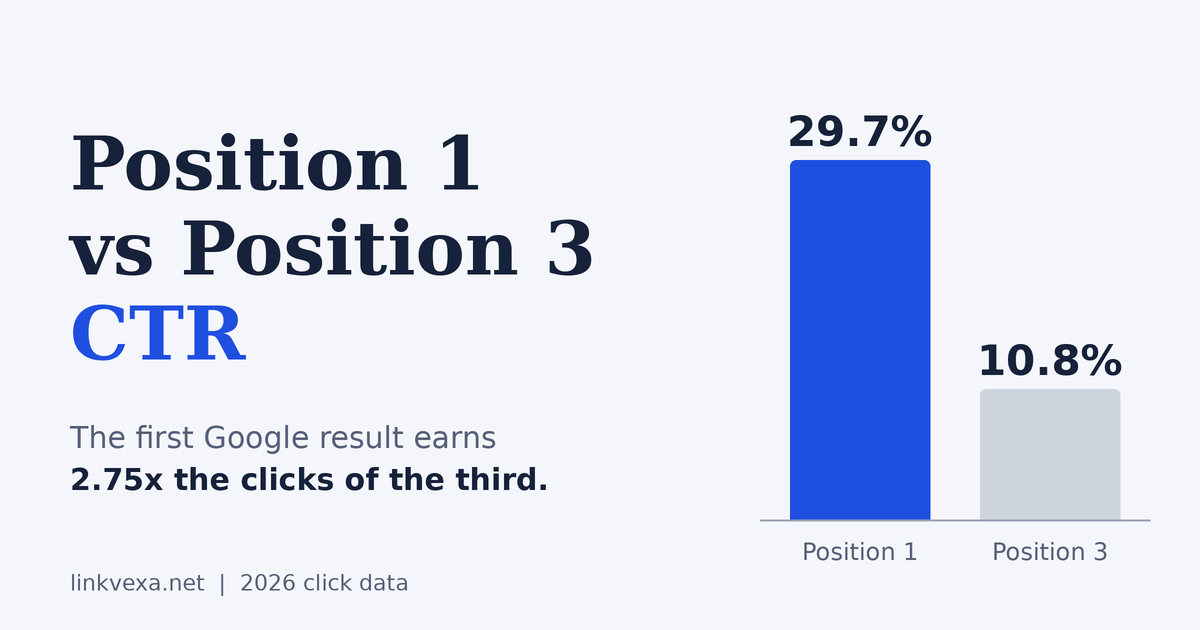
In our position 1 vs position 3 CTR analysis, the top organic result on Google earned 2.75 times as many clicks as the third result.
- Position #1 averaged a 29.7% click-through rate (CTR). Position #3 averaged 10.8%.
- That gap equals 175% more traffic for the first result.
- On a keyword with 100,000 monthly searches, Position #1 delivers about 18,900 more visits per month than Position #3.
- With a 2% conversion rate and a $100 average order, that difference is worth $37,800 in monthly revenue (an illustrative example, not a measured result).
- The advantage of ranking first ranged from 143% in e-commerce to 192% in finance.
Introduction
Ranking on the first page of Google is no longer enough: a single position can change how much traffic a page receives.
The gap between Position #1 and Position #3 looks small on a results page, but it is large in clicks. It is also harder to close than it used to be. More sites compete for the same keywords, and AI-generated answers and other search features now take up space above the organic listings.
This position 1 vs position 3 CTR study measures how much more traffic Position #1 earns than Position #3 across 13 industries and four keyword intents in 2026. It also estimates what that difference can mean for revenue and outlines how to move a page up.
About this analysis
The position 1 vs position 3 CTR analysis covers 20,000 keywords on 135 websites, tracked from January to May 2026.
| Measure | Value |
|---|---|
| Websites analyzed | 135 |
| Keywords tracked | 20,000 |
| Monthly search impressions | 58 million |
| Industries covered | 13 |
| Countries | United States, United Kingdom, Canada, Australia |
| Study period | January to May 2026 |
The 13 industries are technology, healthcare, finance, SaaS, marketing, e-commerce, education, travel, real estate, legal, insurance, business and news.
How the data was collected
- Keyword selection. We selected 20,000 keywords that ranked between Positions #1 and #3.
- Traffic measurement. Click and impression data came from Google Search Console, analytics platforms and SEO monitoring tools.
- Position comparison. We compared CTR and clicks for Positions #1, #2 and #3.
- Intent grouping. Keywords were grouped as informational, commercial, transactional or navigational.
- Data cleaning. We removed extreme outliers and seasonal spikes so that short-term swings did not distort the averages.
Limitations
Because every keyword already ranked in the top three, the results describe the gap among top results only. They do not show how CTR falls further down the page. The sample covers 135 sites, and click rates vary by query type, search features and device, so individual keywords will differ from these averages.
Position 1 vs position 3 CTR: the click-through data
In the position 1 vs position 3 CTR comparison, Position #1 averaged 29.7% against 10.8%, or 2.75 times as many clicks.
| Position | Average CTR | Clicks per 100,000 monthly searches | Clicks vs. Position #3 |
|---|---|---|---|
| #1 | 29.7% | 29,700 | 2.75x |
| #2 | 16.4% | 16,400 | 1.52x |
| #3 | 10.8% | 10,800 | 1.00x |
The first result earns 175% more clicks than the third and 81% more than the second. Moving up one place from #3 to #2 adds about 52% more traffic. The jump from #2 to #1 is larger still.
What the gap is worth in revenue
Under the assumptions below, the position 1 vs position 3 CTR gap is worth $37,800 in revenue per month.
This is an illustrative calculation for one keyword with 100,000 monthly searches, a 2% conversion rate and a $100 average order value. Your own conversion rate and order value will change the result. To improve the rate itself, see our guide to conversion rate optimization.
| Position | Monthly visitors | Conversions | Monthly revenue |
|---|---|---|---|
| #1 | 29,700 | 594 | $59,400 |
| #3 | 10,800 | 216 | $21,600 |
| Difference | 18,900 | 378 | $37,800 |
Differences by industry
Finance gains most from ranking first (+192%), e-commerce least (+143%)
Traffic at Position #1 compared with Position #3, by industry. Position #3 traffic is set to 100.
- Position #3 traffic (100)
- Extra traffic at Position #1
- All-industry average (+175%)
Finance, healthcare, SaaS and technology sit above the 175% all-industry average. Marketing, travel and e-commerce sit below it. Results for the other six industries are not reported here.
What makes the first position so valuable
Four factors tend to widen the position 1 vs position 3 CTR gap.
- Search intent. When people want a quick answer, as with informational queries, they often click the first result that looks credible and stop there.
- Brand recognition. Well-known brands often earn a CTR above the benchmark for their position, because searchers trust a name they already know.
- Mobile screens. Fewer results fit above the fold on a phone, so the top listing takes a larger share of attention.
- AI-generated answers. When AI Overviews in Google Search or a similar feature sit above the organic results, every listing is pushed down the page. A page ranking third may then appear well below the first screen.
These are patterns to test against your own Search Console data rather than fixed rules. Sorting your keywords by search intent and device will show which of them apply to your site.
How to move from Position #3 to Position #1
To close the position 1 vs position 3 CTR gap, aim for the top spot on your most valuable keywords, not just a place on page one. Five areas do most of the work. For a wider view, see our guide to Google ranking factors in 2026.
- Make the listing worth clicking. Rewrite title tags and meta descriptions so they match what the searcher wants. A higher CTR can support stronger performance over time.
- Build topical authority. A cluster of connected, in-depth pages on one subject usually outperforms a single isolated article.
- Earn quality backlinks. Links from respected, relevant sites remain one of the clearest signals of authority. Stick to white hat link building methods that earn links rather than buy them.
- Improve the page experience. Fast loading, clear navigation and genuinely helpful content keep visitors on the page and support rankings. A practical website speed optimization guide covers the main fixes.
- Target featured snippets. Answer the question directly and concisely near the top of the page to win more visibility and clicks.
Action plan
Start with the keywords you already rank for, because they are the cheapest to improve.
Now
- List the keywords where you rank #2 or #3.
- Review the pages ranking above you and note what they do better.
- Rewrite weak title tags and meta descriptions.
- Update outdated content.
- Add internal links to these pages from related articles.
Next 1-3 months
- Earn backlinks from relevant, trusted sites.
- Cover the topic more completely with supporting pages.
- Improve page speed and mobile experience.
- Add concise answers that can win featured snippets.
Long term
- Publish original research that others want to cite.
- Strengthen brand recognition.
- Build full topic clusters around your core subjects.
- Review ranking opportunities every month.
- Keep most of your SEO effort on keywords already in the top three.
Frequently asked questions
Is the position 1 vs position 3 CTR gap really that large?
Yes. In this analysis, Position #1 received 175% more traffic than Position #3, which is 2.75 times as many clicks.
What CTR does Position #1 receive?
Position #1 averaged a 29.7% click-through rate, compared with 16.4% for Position #2 and 10.8% for Position #3.
Does the industry change the gap?
Yes. The advantage of ranking first was largest in finance (192%), healthcare (188%) and SaaS (181%), and smallest in e-commerce (143%).
Is moving from #3 to #1 worth the effort?
Often, yes. The extra traffic can bring more leads and sales, which can justify a serious investment in the pages that matter most.
What helps a page move up?
Better content, stronger trust signals, quality backlinks and a smoother user experience. No single change works on its own.
Conclusion
The position 1 vs position 3 CTR gap is large: in this analysis the first result earned 2.75 times as many clicks.
For competitive keywords, that gap can mean thousands of extra visits and a meaningful amount of monthly revenue. As AI-generated answers and other features take more room on the results page, the top organic positions matter even more.
The practical lesson is to focus on the keywords where you already rank in the top three, and to work on winning and holding the first position there.
About the author
Daniel is the founder of LinkVexa and researches search marketing. The work focuses on how search engines surface content and on turning that data into practical advice for website owners, bloggers and marketers.
LinkVexa publishes search studies, marketing guides and strategies that help site owners earn organic traffic and keep up with changes in the industry. [LinkVexa]