

Ask ten SEOs about Google ranking factors 2026 and you’ll get eleven answers. Some swear by backlinks. Others say content is everything. A few insist that speed is the secret, while the loudest voices online claim SEO is dead because of AI. Frustrating, right?
So instead of guessing, I went through the most credible research published this year on SEO ranking factors. The main source is the Google Ranking Factors Expert Survey 2026, released in September. I paired it with a large ranking study and fresh data on how AI Overviews are changing clicks and search engine rankings. Where the evidence is solid, I’ll say so. Where it’s just opinion, I’ll say that too, because the difference matters more than most articles admit.
Where the Google Ranking Factors 2026 Data Comes From
| Source | Type | Scale |
|---|---|---|
| Zyppy Google Ranking Factors Expert Survey 2026 | Expert opinion survey | 131 SEO professionals, 103 signals, 13,665 data points |
| Backlinko and Ahrefs ranking study | Correlation study | 11.8 million Google results |
| Ahrefs AI Overviews study (April 2025) | Click-impact analysis | 300,000 keywords |
| Randomized field experiment (July 2026) | Causal experiment | Outbound organic clicks |
| Seer Interactive measurement | Click-through analysis | 42 organizations |
A Quick Word on Reading SEO Studies
Not all research is equal, and this is where many bloggers slip up.
A survey tells you what experienced people believe. That’s useful, but belief isn’t proof. A correlation study shows that two things tend to appear together, like high rankings and lots of backlinks, without telling you which one caused the other. And a controlled experiment, the gold standard, changes one thing and measures the result. Those are rare in SEO.
Keep that ladder in mind. When I say “experts rated this highly,” that’s a survey. When I say “pages with this ranked better,” that’s correlation. I’ll try never to blur the two.
The Top 10 Google Ranking Factors in 2026, According to 131 SEOs
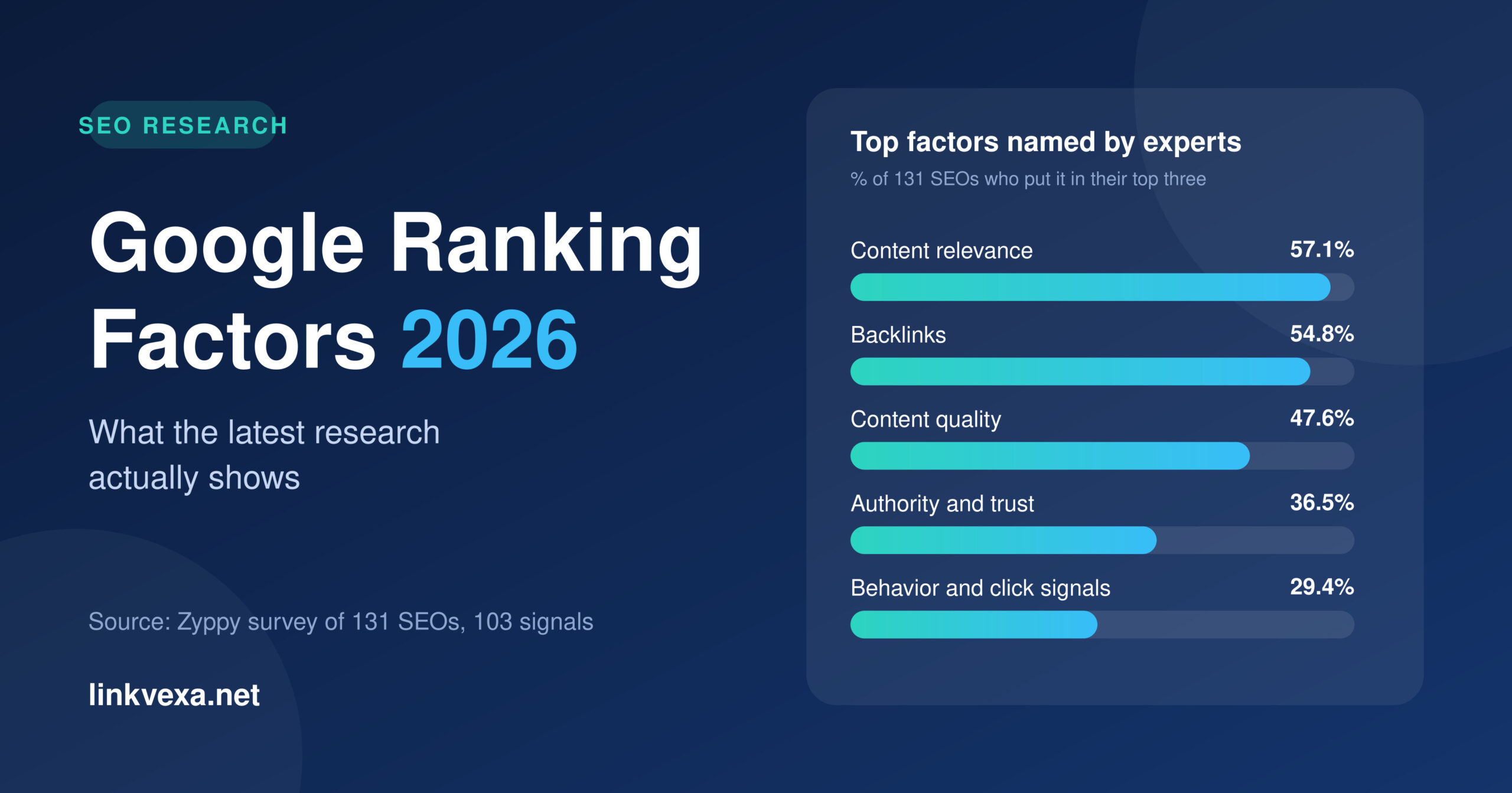
In the Zyppy survey, every expert picked the three factors they considered most important. The number below shows how many of them put each factor in their top three.
| Rank | Factor | Named in top three by |
|---|---|---|
| 1 | Content relevance | 57.1% |
| 2 | Backlinks | 54.8% |
| 3 | Content quality | 47.6% |
| 4 | Authority and trust | 36.5% |
| 5 | Behavior and click signals | 29.4% |
| 6 | Brand signals | 27.0% |
| 7 | User satisfaction (task completion) | 19.8% |
| 8 | Technical SEO health | 17.5% |
| 9 | Topical authority | 14.3% |
| 10 | Internal links | 11.1% |
Notice how the list is dominated by relevance, links and quality, while technical SEO sits down at eighth place. That doesn’t make technical work unimportant, as you’ll see below, but it does show where experts think the biggest gains come from.
Google Ranking Factors 2026: The Six Key Findings
Here is what the research says about each major Google ranking signal, starting with the one experts rated highest.
1. Search Intent Is the Real Starting Line
Here’s the single most useful finding. On the survey’s separate scoring scale, search intent match was the highest-rated signal out of 103. Not backlinks. Not speed. Intent.
What does that mean in practice? It means Google wants to know whether your page does what the searcher came to do. If someone types “best budget laptop” and lands on a history of laptops, it doesn’t matter how clean your code is. They’ll hit the back button, and returning to the results page scored negatively in the survey’s user-signal group.
The panel also pointed to something called information gain. When ten articles say the same thing, the one that adds a fresh example, a real number or a different angle wins the tiebreak. That’s exactly why copy-and-reword content struggles now. If you want to sharpen this skill, start with how to write content that matches search intent.
Try This Today
Type your target keyword into Google and open the top five results. Note what format they share, whether step-by-step guides, lists, comparisons or product pages. If all five are guides and yours is an opinion essay, you’ve found an intent mismatch. Reshape the page to match the format searchers clearly expect, then add your own angle on top.
2. Backlinks Haven’t Gone Anywhere
Every year someone declares backlinks dead. Every year the data disagrees. In 2026, experts ranked them second overall, and links from trusted, topically relevant sites were among the highest-rated Google ranking signals in the entire survey. Spam links, on the other hand, were rated among the worst.
One idea came up again and again: links that send real visitors beat links nobody clicks. Experts stressed that links from real audiences count for more than links nobody clicks, and that fits the direction of the larger studies.
| Measurement (Backlinko and Ahrefs, 11.8M results) | Result |
|---|---|
| Backlinks: position #1 vs positions #2 to 10 | #1 had about 3.8 times more |
| Number of referring domains | Correlated with first-page rankings |
| Total backlinks | Correlated with first-page rankings |
| Page-level link authority (URL Rating) | Weak correlation |
Remember the ladder, though. This is correlation. Top pages may collect links because they’re already visible. Still, when surveys and large datasets point the same way, it’s smart to listen.
There’s useful news for anyone tempted by shortcuts, too: Google’s John Mueller confirmed in January 2026 that comment spam links don’t affect rankings. So spammy comment links are not worth your time or money. If you’d rather build links the safe way, here’s a guide on link building strategies that avoid spammy tactics.
One expert added a useful warning: exact-match anchor text works only up to a point. What matters is how much of your total anchor profile it makes up, so keep it varied and natural.
3. Quality Is the New Filter
Content quality took third place, and the experts were clear about what counts: original research and first-party data topped the list. That’s no accident. AI has made average content almost free to produce, so average content has lost its value.
Respondents didn’t condemn AI itself. Their objection was to publishing at scale with nothing added. One panelist even described good results from AI-assisted pages that went through heavy human editing. The pattern is easy to see: the tool doesn’t matter much, the added value does.
So ask yourself a blunt question before hitting publish. Does this page tell readers something they can’t get from the top five results already? If not, it’s filler, no matter who wrote it.
4. Brand, Trust and User Behavior Matter More Than We Admit
Authority and trust took fourth place in the survey, which lines up with what Google’s quality guidelines call E-E-A-T: experience, expertise, authoritativeness and trust. The practical side is simple. Name your authors, show who runs the site and back up claims with credible sources.
Brand signals landed sixth, and within that group, online reputation and branded search volume scored highest. Think about it: nobody searches for a name they’ve never heard of. When people look you up directly, it’s a strong hint that you’re a real, trusted entity.
User behavior also climbed in this edition. Task completion and satisfaction scored best, while people bouncing back to the search results after visiting a page scored negatively. The survey authors link this to evidence that surfaced in Google’s antitrust trial and the 2024 documentation leak. The takeaway is refreshingly practical: build pages that finish the job, so nobody needs to go back and try another result.
5. Technical SEO Keeps You in the Game, It Doesn’t Win It
Most experts called technical SEO table stakes. Broken technical health can sink you, but perfect technical health won’t rescue weak content. One contributor shared a case where canonical tags pointed to unrelated pages. After fixing it, impressions and clicks jumped noticeably. That’s the kind of problem worth finding.
Speed and Core Web Vitals, though, split the room. Some called them wildly overrated, while others said speed truly matters for big e-commerce stores. The older Backlinko and Ahrefs study found no correlation between loading speed and rankings. Mobile usability was the user-experience factor experts valued most. The takeaway for anyone chasing the Google algorithm: don’t treat any single score as a magic switch.
My read: fix what’s genuinely broken, then stop obsessing over a perfect score. If you run WordPress, this walkthrough on improving Core Web Vitals on a WordPress site covers the fixes that are actually worth your time.
A Practical First Check
Open Google Search Console and go to the Page indexing report. Look at the reasons your pages are not indexed. Messages about duplicate pages, canonical problems or accidental noindex tags are usually the easiest to fix and the most costly to ignore. Correct them, request indexing for your most important pages, and check the report again after a few weeks to confirm the numbers are moving in the right direction.
6. Internal Links: The Lever You Fully Control
Topical authority and internal links finished ninth and tenth in the vote count, which sounds unimpressive. But read the written comments and the tone changes. One expert argued that a good internal link can be worth as much as a very good backlink. Another called internal linking the one ranking lever a site controls completely.
For smaller sites, that’s gold. You can’t force anyone to link to you, but you can decide exactly how your own pages connect. A solid structure shows Google which pages matter and which topics you cover in depth. Two guides to start with: building a strong internal linking structure for SEO and building topical authority on a small website.
A Simple Exercise
Pick your most important page, then search your own site with Google’s site operator, for example site:yourdomain.com your keyword. Every related post that appears is a chance to add a contextual link to that page. Use descriptive anchor text that tells readers what they’ll find, rather than vague phrases like “click here.”
The AI Overviews Problem
Ranking well is only half the story now, because AI Overviews change what a ranking is worth.
| Study | What it found |
|---|---|
| Ahrefs (300,000 keywords, April 2025) | The top organic result lost 34.5% of clicks when an AI Overview appeared |
| Randomized field experiment (July 2026) | AI Overviews cut outbound organic clicks by 39.8% and raised zero-click searches by 34.5% |
| Seer Interactive (42 organizations) | Click-through rate on AI Overview queries fell 61% between June 2024 and September 2025 |
Those numbers explain why many publishers feel pressure on their organic traffic even when rankings hold steady. There is a silver lining, though. The signals the survey highlighted, such as trusted links, recognizable brands and genuinely helpful pages, are the ones that make a site worth citing and worth clicking. If this is a concern for you, read how to optimize content for Google AI Overviews.
Mistakes That Quietly Hurt Rankings
Plenty of sites lose ground not from lack of effort but from effort in the wrong place. These come up constantly:
- Polishing technical scores while the page answers the wrong question.
- Buying bulk links instead of earning a few strong ones.
- Publishing unedited AI drafts at scale.
- Writing three articles for the same keyword, so they compete with each other.
- Treating the meta description as a ranking tool. It isn’t one. Write it to earn clicks.
- Ignoring brand, then wondering why nobody searches for the site by name.
Applying These Ranking Factors to Your Kind of Website
The research is the same, but your priorities shift depending on what you run.
Blogs and Content Sites
Lead with intent and original angles. Build tight topic clusters and link them well before spending on outreach.
Business and Service Sites
Show real people and real credentials. Reviews, clear company details and trusted mentions help customers decide who to believe.
Online Stores
Technical hygiene matters more at scale, since one bad template or canonical tag can affect thousands of pages. Mobile experience and speed deserve real attention here.
Finance and Health Sites
Trust comes first. Name your authors, cite credible sources and update information regularly, because readers are making serious decisions.
A Quick Checklist Before You Publish Any Page
Run through these questions once. They take five minutes and catch most of the problems described above.
- Can I state in one sentence what the reader will be able to do after reading this page?
- Does the page add at least one thing the top results don’t, such as a real example, a number or personal experience?
- Is there a named author with a short bio?
- Does the page link to two or three genuinely related pages on my site, using descriptive anchor text?
- Do other pages on my site link back to it?
- Is it free of broken canonicals, accidental noindex tags and mobile layout problems?
- Is the meta description written to earn a click rather than to stuff a keyword?
What This Research Can’t Tell You
I’d be doing you a disservice if I skipped the limits:
- The survey reflects expert belief, not Google’s confirmed algorithm.
- Correlation doesn’t prove cause, especially with backlinks.
- The 11.8 million result study is older than the 2026 survey, and Google updates keep shifting things.
- Every niche behaves differently, and sensitive topics face stricter trust expectations.
A Practical Priority List
| Priority | Action | Why it matters |
|---|---|---|
| 1 | Match each page to one clear search intent | Rated the strongest signal of 103 |
| 2 | Add original data, examples or firsthand experience | Quality is the filter against cheap content |
| 3 | Earn links from trusted, relevant sites | Backlinks ranked second |
| 4 | Grow branded searches and mentions | Brand signals are rising |
| 5 | Strengthen internal links and topic clusters | The one lever you control fully |
| 6 | Fix real technical errors, then move on | Technical health is a floor |
| 7 | Give readers fewer reasons to bounce back to Google | Task completion matters |
Frequently Asked Questions
What is the most important Google ranking factor in 2026?
In the Zyppy survey, search intent match scored highest, and content relevance was the factor named most often in experts’ top three.
Do backlinks still matter?
Yes. Experts placed them second, and large datasets show top results tend to have more referring domains. Quality and relevance count for more than raw numbers.
Is the meta description a ranking factor?
No. Experts rated it as having no meaningful ranking effect, though it can change how many people click.
Are Core Web Vitals a ranking factor?
It’s debated. Treat them as a user-experience baseline rather than a main driver.
Does AI-written content hurt rankings?
Low-value AI content published at scale is viewed negatively. AI-assisted content with strong human editing and real added value is a different story.
How long until changes show results?
Research doesn’t give a fixed timeline. Technical fixes can show effects fast, while authority, brand and links usually take months.
Should small websites worry about AI Overviews?
Be aware, not alarmed. Clicks are shrinking on many queries, so aim to be cited, build a recognizable brand and offer value a short summary can’t replace.
The Bottom Line on Google Ranking Factors 2026
Strip away the noise and the research says something simple. Give people exactly what they came for, add something others haven’t, earn trust from real sources and make your brand worth searching for. Technical work keeps you eligible, and internal links help you use the authority you already have.
Don’t try to do everything at once. Pick one page this week, check its intent, add one original element, connect it to related posts and watch what happens to your organic traffic over the next few months. That small loop, repeated, beats any “secret” ranking trick.