


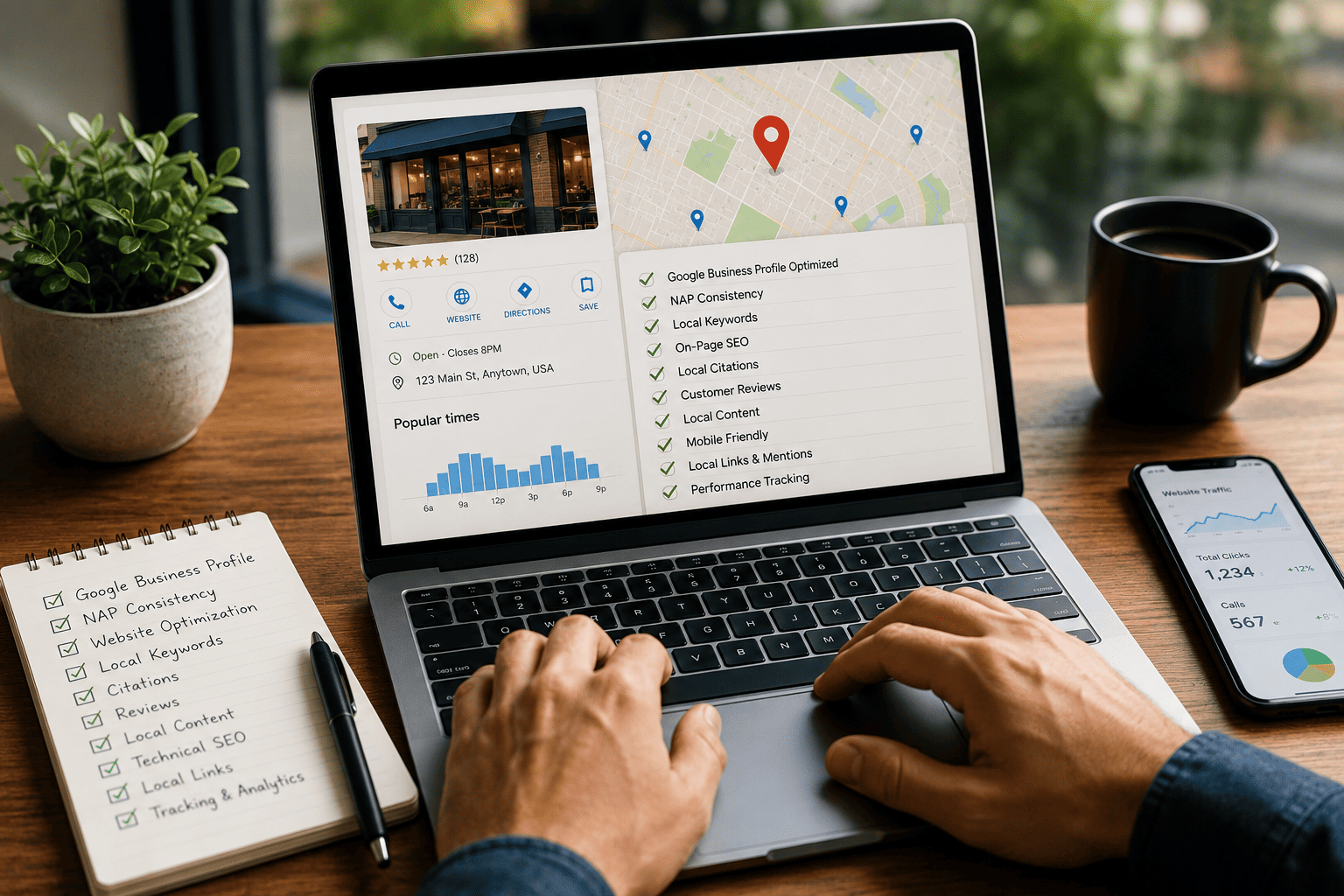
Introduction
For local businesses, appearing in front of nearby customers at the right moment can make a significant difference in calls, website visits, store visits, and sales. But simply having a website is not enough. Businesses need accurate information, a well-optimized online presence, strong local relevance, and a consistent strategy across search platforms.
A Local SEO Checklist provides a practical framework for making sure the essential elements of local search optimization are covered. From optimizing your Google Business Profile and website to managing citations, reviews, local content, and technical SEO, each element contributes to a stronger local presence.
The goal of this guide is not to encourage businesses to chase hundreds of directory listings or manipulate search results. Instead, it focuses on accurate information, relevance, user experience, trust, and sustainable local SEO practices. Consistent business information across relevant platforms is also an important part of local visibility.
Local SEO Checklist at a Glance
| Local SEO Element | What to Check | Why It Matters |
| Google Business Profile | Name, category, hours, services, photos | Helps customers discover your business |
| NAP Information | Name, address, phone | Maintains consistency |
| Website | Location and service information | Supports local relevance |
| Local Keywords | City, neighborhood, and service terms | Targets local search intent |
| Reviews | Genuine reviews and responses | Builds trust |
| Citations | Relevant directories and platforms | Improves business discovery |
| Local Content | Useful location-focused content | Demonstrates local relevance |
| Technical SEO | Speed, mobile usability, indexing | Improves website experience |
| Links & Mentions | Relevant local and industry websites | Builds authority |
| Tracking | Rankings, traffic, calls, leads | Measures performance |
Quick Answer: What Is a Local SEO Checklist?
A Local SEO Checklist is a structured list of actions used to improve a business’s visibility in location-based searches.
A strong checklist should cover:
- Google Business Profile optimization
- Accurate NAP information
- Website and on-page optimization
- Local keyword research
- Local landing pages
- Business citations
- Review management
- Local content
- Mobile and technical SEO
- Local links and mentions
- Performance monitoring
The most important principle is quality over quantity. Creating hundreds of irrelevant listings is not a substitute for maintaining accurate, trustworthy, and relevant business information. The source material similarly emphasizes that citation quality, accuracy, relevance, consistency, and ongoing management are more important than simply increasing the number of listings.
Complete Local SEO Checklist
1. Optimize Your Google Business Profile
Your Google Business Profile Optimization should be one of the first items you review.
Make sure your profile contains:
- Correct business name
- Accurate address or eligible service-area information
- Current phone number
- Correct primary category
- Relevant secondary categories
- Website URL
- Business hours
- Holiday or special hours
- Services
- Products where applicable
- Business description
- High-quality authentic photos
Avoid adding keywords to your business name unless those words are genuinely part of the real-world business name.
A complete profile gives potential customers useful information before they even visit your website.
Google Business Profile Checklist
- Business name is accurate
- Primary category is relevant
- Address is correct
- Phone number is current
- Website URL works
- Business hours are updated
- Services are listed
- Photos are authentic and current
- Duplicate profiles have been checked
- Reviews are monitored
2. Keep NAP Information Consistent
NAP stands for:
Name + Address + Phone Number
Your core business information should remain accurate and consistent across important online platforms.
For example, if your website lists one phone number while several directories display an old number, customers may become confused.
Review:
- Business name
- Physical address
- Phone number
- Website
- Business category
- Operating hours
Consistency does not mean obsessing over every minor formatting difference. The priority is ensuring that the actual business information is correct and does not create confusion.
3. Perform Local Keyword Research
Local SEO starts with understanding what potential customers search for.
Instead of focusing exclusively on broad keywords such as:
plumber
Consider searches with stronger local intent, such as:
plumber in [city]
emergency plumber near me
residential plumbing services [city]
water heater repair [neighborhood]
Look for combinations of:
Service + Location + Search Intent
Useful Local Keyword Categories
Service Keywords
Examples:
- dentist
- roofing contractor
- restaurant
- electrician
- digital marketing agency
Location Keywords
Examples:
- city
- neighborhood
- district
- nearby area
- service region
Intent Keywords
Examples:
- near me
- open now
- best
- affordable
- emergency
- same-day
- appointment
The best keywords are not necessarily those with the highest search volume. They should reflect what your actual customers are likely to search for when they need your products or services.
4. Optimize Your Website for Local Search
Your website should clearly communicate what you offer and where you offer it.
Review your important pages and make sure they naturally include relevant information about:
- Services
- Locations
- Business type
- Service areas
- Contact information
- Opening hours
- Unique local advantages
Avoid stuffing city names or keywords repeatedly into page content. Write primarily for people and use local terms where they genuinely improve clarity.
Optimize Important On-Page Elements
Check your:
- Title tags
- Meta descriptions
- H1 headings
- H2 headings
- URL structure
- Body content
- Image alt text
- Internal links
For example, a local roofing company might use a page structure such as:
H1: Residential Roofing Services in [City]
Then explain the services offered, areas served, customer concerns, process, and relevant local information.
5. Create Useful Location Pages
Businesses serving multiple locations may benefit from dedicated location pages when those pages provide genuinely useful information.
A quality location page can include:
- Services available in the area
- Address or service-area details
- Local contact information
- Operating hours
- Customer questions
- Nearby service information
- Relevant photos
- Directions where appropriate
- Local testimonials
- Unique information about that location
Avoid creating dozens of nearly identical pages where only the city name changes.
A location page should exist because it provides value to people in that particular area.
6. Build and Manage Local Citations
A local citation is an online mention of important business information such as its name, address, and phone number.
Citations can appear on:
- Business directories
- Local websites
- Industry platforms
- Review websites
- Social networks
- Mapping services
- Community websites
- Professional associations
Citation Checklist
- Audit existing listings
- Find duplicate listings
- Correct outdated information
- Update old phone numbers
- Check business categories
- Add missing websites
- Update business hours
- Prioritize relevant directories
- Track important listings
- Schedule periodic audits
Do not submit your business to every directory available. Relevant local and industry-specific platforms are generally more valuable than random websites.
7. Improve Online Reviews and Reputation
Reviews are an important part of the customer’s decision-making process.
Encourage genuine customers to leave honest feedback and respond professionally to both positive and negative reviews.
Review Management Checklist
- Ask satisfied customers for genuine reviews
- Monitor new reviews
- Respond professionally
- Address legitimate complaints
- Never purchase fake reviews
- Avoid manipulating ratings
- Identify recurring customer concerns
A review strategy should focus on building genuine customer trust rather than simply increasing the review count.
8. Add Authentic Business Photos
Images can make a business listing more useful and recognizable.
Depending on the business, consider adding:
- Exterior photos
- Interior photos
- Team photos
- Product photos
- Service photos
- Completed projects
- Facilities
- Location-specific images
Authentic photography can help potential customers understand what the business looks like and what they can expect.
For example, a restaurant could showcase its dining area and food, while a contractor could showcase completed projects.
9. Create Local Content
Local content should answer questions that matter to people in the communities you serve.
Instead of publishing generic articles solely to target keywords, create resources with genuine local value.
Local Content Ideas
- Local buying guides
- Neighborhood service guides
- Community event coverage
- Local industry insights
- Area-specific FAQs
- Local case studies
- Customer success stories
- Seasonal service guides
- Local market research
- Community resources
For example, a home-service company could create a guide explaining common property maintenance issues in its service area.
Good local content can support both search visibility and customer education.
10. Build Relevant Local Links and Mentions
Learn more about local citation building and how consistent business information can support your local search strategy.
Legitimate local relationships can create valuable opportunities for mentions and links.
Consider:
- Local organizations
- Chambers of commerce
- Community groups
- Industry associations
- Local publications
- Sponsorships
- Local events
- Expert interviews
- Community partnerships
The source material also identifies local sponsorships, community events, expert contributions, news coverage, industry interviews, and original research as potential ways to earn unstructured business mentions.
The goal should be to earn relevant recognition rather than artificially manufacture backlinks.
11. Improve Mobile User Experience
Many local searches happen when people are away from their computers.
Your website should therefore work well on smartphones.
Check:
- Page loading speed
- Text readability
- Navigation
- Buttons
- Contact forms
- Click-to-call functionality
- Maps and directions
- Image sizes
- Mobile menus
A potential customer should be able to quickly understand what you offer and how to contact you.
12. Strengthen Technical SEO
Technical problems can prevent your local pages from performing effectively.
Review:
- Indexing
- Crawlability
- Broken links
- HTTPS
- Page speed
- Mobile usability
- Canonical tags
- XML sitemap
- Redirects
- Duplicate pages
- Structured data
Technical SEO should support a website that is easy for both users and search engines to understand.
13. Add Local Business Schema Where Appropriate
Structured data can help search engines understand information about your business, and Google’s Local Business structured data documentation explains how businesses can provide relevant details about their organization.
Depending on the business, relevant information may include:
- Business name
- Address
- Phone number
- Website
- Opening hours
- Business type
- Service area
- Location information
Only provide information that accurately represents the real business.
Structured data should complement visible, trustworthy website information rather than being used to manipulate search engines.
14. Optimize Internal Linking
Internal links help users and search engines discover related pages on your website.
For example:
A local dentist might connect:
Dental Services → Emergency Dentistry → Emergency Dentist in [City]
A home-service company might connect:
Services → Plumbing → Water Heater Repair → Service Area
Use descriptive anchor text naturally and link pages where the relationship is genuinely useful.
15. Monitor Your Local SEO Performance
A checklist is only useful if you measure the results.
Track metrics such as:
| Metric | What It Tells You |
| Local search visibility | Whether your presence is improving |
| Organic traffic | Website discovery from search |
| Profile views | Exposure on business platforms |
| Calls | Customer interest |
| Website clicks | Referral activity |
| Direction requests | Potential visits |
| Reviews | Reputation engagement |
| Citation accuracy | Listing quality |
| Duplicate listings | Management issues |
| Local leads | Business impact |
Do not focus exclusively on rankings.
The better question is:
Are the right local customers finding accurate information and taking meaningful action?
Local SEO Checklist by Business Stage
For a New Local Business
Focus first on:
- Create and verify your business profile.
- Establish accurate business information.
- Build a professional website.
- Research local keywords.
- Optimize core service pages.
- Create relevant local listings.
- Begin collecting genuine customer reviews.
- Add authentic business photos.
- Establish local partnerships.
- Set up performance tracking.
For an Established Business
Prioritize:
- Citation auditing
- Duplicate listing cleanup
- Review management
- Website optimization
- Location-page improvements
- Local content
- Local authority building
- Technical SEO
- Conversion optimization
- Ongoing monitoring
Practical Examples
Example 1: Local Restaurant
A restaurant notices that its address and opening hours are different across several platforms.
Its local SEO checklist reveals:
- Two outdated listings
- Incorrect holiday hours
- Missing photos
- An incomplete business profile
- Several inconsistent directory records
The restaurant corrects the information, updates its profiles, adds authentic images, and creates a system for checking important listings regularly.
This creates a cleaner and more reliable online presence.
Example 2: Plumbing Company
A plumbing company serves one metropolitan area.
Instead of creating hundreds of unrelated directory profiles, it focuses on:
- Major business platforms
- Relevant home-service directories
- Local organizations
- Industry associations
- Community websites
- Useful location-focused website content
This approach prioritizes relevance instead of citation volume.
Example 3: Marketing Agency
A marketing agency creates local service pages, maintains accurate business listings, publishes useful industry content, collects genuine client reviews, and develops relationships with local organizations.
It also publishes original research that can attract legitimate industry mentions.
This combines website optimization, citations, content, reputation management, and authority building.
Local SEO Best Practices
Prioritize Quality Over Quantity
You do not need hundreds of low-quality listings. A smaller collection of relevant and trustworthy citations can be more useful than a large number of questionable directories.
Keep Business Information Updated
Review your information whenever you change:
- Address
- Phone number
- Website
- Business hours
- Services
- Business name
Major changes should trigger a local SEO audit.
Focus on Search Intent
Think about why someone is searching.
A person searching for:
emergency electrician near me
has a very different intent from someone searching:
How does an electrical circuit work?
Your local pages should address the needs of customers who can actually use your services.
Use Real Business Information
Do not invent locations, services, reviews, addresses, or business relationships to gain search visibility.
Accuracy creates a better experience for both customers and search engines.
Audit Regularly
Local SEO is not a one-time project. Business information changes, platforms change, and duplicate listings can appear over time.
Regular monitoring helps keep your online presence accurate.
Common Local SEO Mistakes to Avoid
1. Creating Hundreds of Low-Quality Listings
More citations do not automatically mean better local SEO.
Focus on platforms that are relevant to your industry and customers.
2. Using Incorrect NAP Information
Old phone numbers, incorrect addresses, or outdated business details can frustrate potential customers.
3. Keyword Stuffing the Business Name
Do not add extra city names or service keywords to your business name unless they are genuinely part of the official business name.
4. Creating Duplicate Listings
Duplicate profiles can create confusion and make information management more difficult.
5. Using Fake Reviews
Fake reviews can damage credibility and violate platform policies.
6. Creating Thin Location Pages
Do not create dozens of pages with nearly identical content simply to target different cities.
7. Ignoring Mobile Users
A slow or difficult-to-use mobile website can lose customers even if the business appears in search results.
8. Measuring Only Rankings
Rankings matter, but calls, leads, profile interactions, website visits, and customer actions provide a more useful picture of business performance.
Frequently Asked Questions
What is a Local SEO Checklist?
A Local SEO Checklist is a practical framework for reviewing and improving the factors that help a business appear in location-based searches and provide accurate information to potential customers.
What is the most important part of local SEO?
There is no single factor that guarantees success. A strong foundation includes accurate business information, a well-maintained business profile, relevant website content, genuine reviews, local relevance, and a good user experience.
How important are local citations?
Citations can support local discovery and business information consistency. However, citation quantity alone is not a meaningful measure of local SEO success.
How often should I check my local SEO?
Perform regular audits and review your information immediately after major business changes, such as moving locations, changing phone numbers, or updating business hours.
Do local businesses need location pages?
Location pages can be useful when a business genuinely serves multiple areas and each page provides unique, useful information. Avoid creating pages that only replace one city name with another.
Should I create listings in every directory?
No. Prioritize reputable platforms that are relevant to your industry, geographic market, and customers.
Can reviews improve local SEO?
Genuine reviews can contribute to reputation and customer trust and are an important part of a broader local search strategy. Businesses should never manufacture or manipulate reviews.
Do local citations need backlinks?
Not necessarily. A citation can simply mention a business’s name, address, phone number, or other details without functioning as a traditional backlink.
Can local SEO guarantee Google Maps rankings?
No. Local visibility depends on multiple factors, and no checklist can guarantee a specific position in Google Maps.
How long does local SEO take to work?
The timeframe varies depending on the business, market, competition, website condition, authority, and existing online presence. Local SEO should generally be treated as an ongoing process rather than a one-time campaign.
Conclusion
A Local SEO Checklist gives businesses a practical way to identify gaps in their local search strategy and address them systematically.
Start with the fundamentals: maintain accurate business information, optimize your business profile, improve your website, target relevant local search intent, manage citations, earn genuine reviews, publish useful local content, and build legitimate relationships within your community and industry.
The strongest local SEO strategy is not about creating the largest number of listings or chasing quick ranking shortcuts. It is about making your business easy to find, easy to understand, and easy to trust.
Regular audits are equally important because business information, customer expectations, and online platforms change over time. Treat local SEO as an ongoing process, measure meaningful outcomes, and continuously improve the customer experience.
Call to Action
Ready to improve your local search presence?
Start your Local SEO Checklist today. Audit your business profile, verify your name, address, and phone number, review your website, check your citations, improve your local content, and identify the areas that need attention first.
Build a consistent online presence, earn customer trust, and make it easier for local customers to find your business.