

Every online business needs a reliable way to attract new customers. A website may receive thousands of visitors, social media posts may generate engagement, and advertising campaigns may produce clicks, but these activities do not necessarily translate into sales. Sustainable growth requires a strategy that connects marketing efforts with customer needs, purchasing decisions, and business profitability.
A customer acquisition strategy provides a structured approach to finding potential buyers, communicating the value of a product or service, converting interested prospects into paying customers, and measuring the results. It helps business owners focus their time and budget on activities that are more likely to produce valuable customers.
For a new business, this process can establish a foundation for growth. For an established online company, it can reveal opportunities to improve marketing efficiency, increase conversions, and reduce dependence on a single source of customers.
This guide explains how to build a customer acquisition strategy from scratch, select suitable marketing channels, calculate acquisition costs, improve conversion rates, measure profitability, and develop a practical 90-day implementation plan.
What Is a Customer Acquisition Strategy?
A customer acquisition strategy is a planned process for attracting potential customers and converting them into paying buyers. It combines audience research, positioning, marketing channels, lead generation, sales activities, conversion optimization, and performance measurement.
For an online business, customer acquisition can involve search engine optimization (SEO), content marketing, paid advertising, email campaigns, social media, referral programs, partnerships, and other methods of reaching prospective customers.
The purpose is not simply to generate traffic or collect leads. It is to acquire customers who need the offer, are likely to purchase, and can be served profitably.
Consider an online store selling specialized fitness equipment. Broad social media content might attract a large audience, but many visitors may have no intention of buying equipment. Detailed buying guides and product comparison pages may attract fewer visitors while reaching people who are actively evaluating their options.
The second approach may generate more qualified prospects, although its actual performance must be measured rather than assumed.
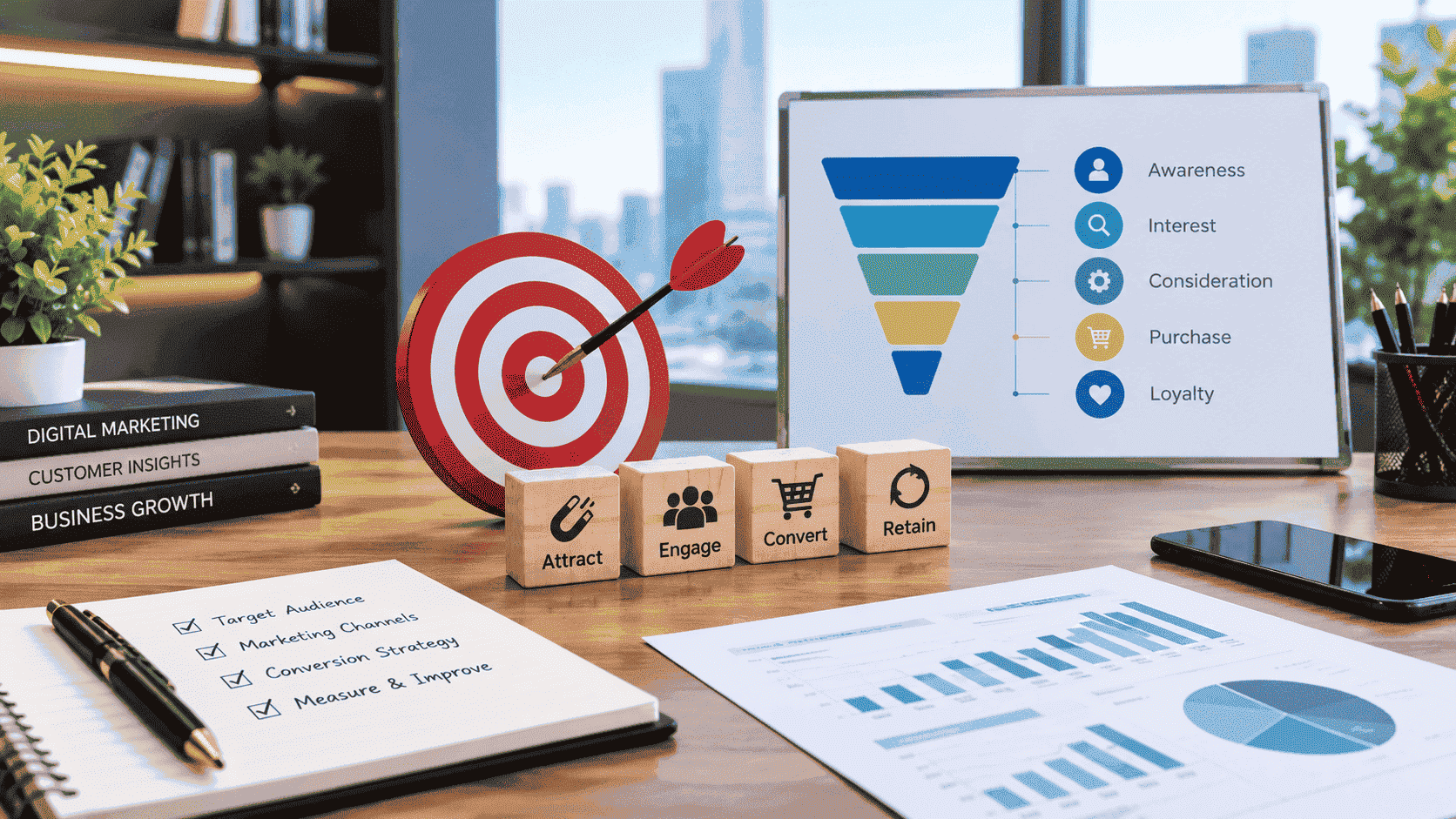
A customer acquisition strategy typically involves three connected activities:
- Attract: Reach people who have a relevant need or problem.
- Convert: Help interested prospects understand the offer and complete the desired action.
- Measure: Evaluate acquisition costs, conversion performance, customer quality, and profitability.
These activities form a continuous process. Results from one campaign should inform decisions about the next.
Why Customer Acquisition Matters for Online Businesses
Customer acquisition creates opportunities to increase sales, reach new markets, and build a more predictable source of revenue. Without a deliberate acquisition process, businesses may depend on occasional referrals, inconsistent advertising results, or a small group of existing customers.
A well-planned strategy helps businesses:
- Generate more consistent demand: Establish repeatable methods for attracting potential buyers.
- Allocate marketing budgets effectively: Identify channels that produce qualified prospects and customers.
- Understand customer behavior: Discover which messages, offers, and experiences influence purchasing decisions.
- Improve conversion rates: Identify and remove unnecessary barriers between initial interest and purchase.
- Support sustainable growth: Evaluate whether acquisition costs are reasonable relative to customer value and margins.
- Diversify customer sources: Reduce the risk of depending entirely on one advertising platform or traffic source.
However, acquiring more customers does not automatically mean earning more profit. If advertising costs rise, margins decline, or customers make only one small purchase, a business may grow its revenue without improving its financial position.
The real objective is to acquire suitable customers at a cost the business can support while delivering a positive customer experience.
1. Define Your Ideal Customer
Before investing in marketing, determine whom your business is trying to reach. A strategy built around an overly broad audience can waste resources on people who are unlikely to need the product, trust the offer, or afford the purchase.
Start by identifying the people or businesses most likely to benefit from your solution.
Create a Customer Profile
A useful customer profile describes the characteristics, needs, and purchasing behavior of your potential buyers.
Consider these factors:
- Demographics and business characteristics: Relevant age ranges, locations, professions, industries, or company sizes.
- Problems and needs: The challenges customers want to solve.
- Buying motivations: The benefits they expect from a product or service.
- Budget: The amount they can reasonably spend.
- Purchase behavior: Whether they research carefully, compare alternatives, or make quick decisions.
- Objections: Concerns about price, quality, trust, convenience, or implementation.
- Preferred channels: Where they search for information, discover products, and evaluate providers.
Use customer interviews, sales records, support questions, genuine reviews, and website analytics when available. If you are starting without customers, treat your initial profile as a hypothesis and refine it as evidence becomes available.
Understand Customer Intent
Not every potential customer is at the same stage of the buying process.
Someone searching for “what is email marketing” may simply want to understand the subject. Someone searching for “best email marketing software for a small online store” is comparing possible solutions. A person checking the pricing of a specific platform may be closer to purchasing.
| Customer Intent | Example Search or Behavior | Suitable Content or Action |
|---|---|---|
| Informational | Learning about a problem | Educational articles and beginner’s guides |
| Problem-aware | Exploring possible solutions | Tutorials, checklists, and practical advice |
| Solution-aware | Comparing available options | Comparison pages, reviews, and demonstrations |
| Purchase-ready | Checking price or availability | Product pages, pricing details, and purchase options |
Matching your message to customer intent helps people find relevant information without forcing them into a sales process before they are ready.
2. Develop a Clear Value Proposition
Your value proposition explains why a potential customer should consider your product or service. It should communicate the problem you solve, the benefit you offer, and what makes your approach relevant.
For example, a general statement such as “We provide high-quality digital marketing services” gives visitors little information about the intended customer or the service’s practical value.
A more specific statement could be:
“We help small online stores improve their product pages, strengthen search visibility, and measure the results of their digital marketing.”
This message identifies a target audience and explains the services offered without promising guaranteed results.
How to Create a Strong Value Proposition
Focus on four elements:
- Relevance: Address a genuine customer need.
- Clarity: Explain the offer in straightforward language.
- Differentiation: Identify a meaningful advantage, such as specialization, convenience, service quality, or a suitable pricing structure.
- Credibility: Support claims with genuine testimonials, demonstrations, transparent policies, or verifiable results.
Avoid vague claims such as “the best service in the world” unless you can substantiate the comparison. Likewise, do not promise guaranteed rankings, sales, or financial outcomes that depend on factors outside your control.
Your value proposition should be consistent across your website, advertisements, social media profiles, email campaigns, and landing pages.
3. Set Measurable Customer Acquisition Goals
A strategy needs clear objectives so that you can determine whether your efforts are producing meaningful business results.
Begin with the outcome you want to achieve. An ecommerce store might aim to acquire new customers while maintaining a minimum contribution margin. A software company might focus on converting qualified trial users into paying subscribers. A service provider might prioritize qualified consultation bookings.
Choose Appropriate KPIs
Key performance indicators (KPIs) help you evaluate progress against your objectives.
Business Objectives & Key Performance Indicators
Track the key metrics that help improve customer acquisition, sales performance, lead quality, and business profitability.
| Business Objective | Primary KPI | Supporting Metric |
|---|---|---|
| Acquire More Customers | Number of New Customers | Qualified Traffic |
| Improve Acquisition Efficiency | Customer Acquisition Cost (CAC) | Cost per Qualified Lead |
| Increase Website Sales | Purchase Conversion Rate | Checkout Completion Rate |
| Generate Better Leads | Number of Qualified Leads | Lead-to-Customer Conversion Rate |
| Improve Profitability | Contribution Profit After Acquisition Costs | Customer Lifetime Value (CLV) |
| Improve Paid Campaign Performance | Cost per New Customer | Revenue and Margin by Campaign |
Set targets based on your current performance, budget, business model, and available resources. Do not choose arbitrary numbers simply because they appear ambitious.
For example, a goal of acquiring 100 customers per month may be unsuitable if your business has the capacity to serve only 30 customers without compromising quality.
Review the metrics regularly, but allow enough time and data to evaluate results fairly. A campaign with a long sales cycle may require a different evaluation period from a low-priced product sold directly through a website.
4. Choose the Right Customer Acquisition Channels
Different acquisition channels serve different purposes. The best choice depends on your audience, product price, competition, buying cycle, budget, and ability to manage each channel effectively.
Rather than trying to use every available platform, start with a small number of channels that match your customers’ behavior.
Search Engine Optimization (SEO)
SEO helps potential customers discover your website through relevant organic search results.
Useful activities include publishing helpful articles, optimizing product and service pages, improving site structure, answering customer questions, and creating relevant internal links.
SEO can be valuable when customers actively research problems or compare solutions. However, it requires ongoing effort, and meaningful results may take time.
Content Marketing
Content marketing attracts and educates potential customers through articles, guides, videos, tutorials, comparison pages, and case studies.
Effective content answers genuine questions and helps readers make decisions. For example, a company selling accounting software could publish guides about bookkeeping workflows, software comparisons, and common accounting challenges.
Content should provide real value rather than repeat general advice simply to target keywords.
Social Media Marketing
Social media can help businesses build awareness, demonstrate products, answer questions, and develop relationships with potential customers.
Choose platforms based on where your audience is active and whether the format suits your offer. Track qualified visits, inquiries, and purchases rather than relying solely on likes, views, or follower counts.
Paid Advertising
Search ads, social media advertisements, and other paid placements can help businesses reach selected audiences and test offers.
Paid advertising can generate early feedback, but results depend on targeting, messaging, landing-page quality, competition, and customer economics. Set spending limits and measure new-customer conversions before expanding campaigns.
Email Marketing
Email marketing allows businesses to communicate with people who have chosen to receive relevant messages.
Businesses can use email to deliver requested resources, explain product benefits, nurture leads, announce suitable offers, and help new customers get started.
Respect consent requirements, maintain accurate subscriber records, and provide a clear way to unsubscribe.
Referral and Partnership Marketing
Referrals introduce your business to potential customers through existing customers or professional contacts. Partnerships allow you to reach relevant audiences through complementary businesses, creators, or industry organizations.
Both approaches work best when the audience is a good fit and the recommendation is credible. Track the cost, conversion rate, and quality of referred customers rather than assuming every referral is valuable.
How to Prioritize Channels With a Limited Budget
Use a simple process:
- Identify where your ideal customers look for solutions.
- Select one primary acquisition channel and one supporting channel.
- Create a relevant offer and a clear conversion path.
- Establish baseline performance before increasing investment.
- Expand only when you have the resources and evidence to justify doing so.
For example, a consultant might start with useful SEO articles, a professional social profile, and a consultation page. An ecommerce store might prioritize product-page optimization, a controlled advertising campaign, and an email follow-up process.
The aim is to build a manageable acquisition system rather than maintain a weak presence on every platform.
5. Build a Conversion-Focused Website
Your website is often where prospective customers evaluate your business and decide whether to take the next step. Even a well-targeted marketing campaign can underperform if the website is confusing, difficult to use, or unclear about the value of the offer.
Your website should answer three questions quickly:
- What does the business offer?
- Why might this offer be useful to me?
- What should I do next?
Essential Elements of a High-Converting Website
Clear headlines: Explain the product, service, or main benefit without unnecessary jargon.
Relevant landing pages: Match the page to the advertisement, search query, or referral that brought the visitor.
Visible calls to action: Use clear instructions such as “Get a Consultation,” “View Pricing,” or “Shop Now,” depending on the visitor’s needs.
Trust signals: Include genuine customer reviews, accurate business information, clear contact details, and transparent policies where appropriate.
Mobile usability: Ensure visitors can read content, navigate pages, complete forms, and make purchases on mobile devices.
Transparent pricing and policies: Explain relevant charges, delivery terms, subscription conditions, and refund policies before customers commit.
Identify Friction in the Customer Journey
A typical ecommerce customer journey may involve discovering a product, evaluating its benefits, adding it to a cart, completing checkout, and receiving post-purchase support.
If many visitors view a product but few add it to their carts, investigate product information, pricing, delivery costs, and customer concerns. If many shoppers begin checkout but do not complete it, review payment options, unexpected charges, form complexity, and technical problems.
Use analytics and customer feedback to identify potential issues. Test improvements rather than assuming you know the reason for every abandoned purchase.
6. Create a Lead Generation and Nurturing System
Not every visitor is ready to purchase immediately. Some need more information, time to compare options, approval for a budget, or reassurance that a product meets their requirements.
A lead generation system gives interested prospects a relevant next step.
Offer a Useful Resource or Experience
Depending on your business, this could include:
- A practical checklist or downloadable guide.
- A product demonstration or free trial.
- A consultation or introductory assessment.
- A calculator that helps estimate costs or outcomes.
- An educational webinar or workshop.
- A sample or preview of a digital product.
The offer should solve a real problem and connect naturally with your main product or service.
Build a Lead Nurturing Sequence
Once someone has requested information or opted in to receive communications, provide useful follow-up messages.
| Stage | Communication | Purpose |
|---|---|---|
| Initial Contact | Deliver the requested resource | Meet expectations |
| Education | Share useful guidance | Help the prospect understand the problem |
| Evaluation | Explain features, pricing, and differences | Support informed comparison |
| Conversion | Present a relevant offer or next step | Make purchasing easier |
| Follow-up | Answer questions and clarify concerns | Help the prospect make a decision |
For example, a company selling project management software might provide a project planning template, send a tutorial about organizing tasks, explain its product features, and invite interested prospects to a demonstration.
The sequence should reflect customer needs. Avoid repeatedly sending aggressive sales messages or contacting people without an appropriate legal basis or consent where required.
7. Use Content Marketing to Attract Qualified Customers
Content marketing supports acquisition when it helps potential customers solve problems, understand options, and evaluate relevant products or services.
A useful content plan reflects the customer’s buying journey rather than focusing only on popular keywords.
Create Content for Different Buying Stages
Awareness stage: Explain a problem through educational articles, beginner’s guides, and explanatory videos.
Consideration stage: Help readers evaluate solutions through comparison articles, detailed tutorials, reviews, and decision-making checklists.
Decision stage: Address purchasing concerns with pricing pages, product specifications, demonstrations, service descriptions, and genuine case studies.
Post-purchase stage: Help customers use their purchase through onboarding instructions, tutorials, and troubleshooting guides.
Connect Content With the Next Step
Every important article should offer a relevant next action where appropriate.
For example, an article about choosing email marketing software could link to a detailed comparison guide, which then directs interested readers to pricing pages or product demonstrations.
A business offering professional services could publish an article about a common industry problem and invite readers to request a consultation.
Measure qualified organic traffic, relevant page engagement, assisted conversions, and new customers. Traffic volume alone does not demonstrate commercial success.
8. Test Paid Advertising Carefully
Paid advertising can help businesses reach prospective customers without relying exclusively on organic traffic. However, spending money before validating an offer or conversion process can lead to unnecessary losses.
Begin with a controlled test.
- Choose a specific audience and customer problem.
- Create an offer that matches the audience’s needs.
- Write an advertisement that communicates a clear benefit.
- Direct visitors to a relevant landing page.
- Track meaningful actions, including qualified leads and completed purchases.
- Compare acquisition costs with contribution profit and expected customer value.
- Adjust or pause campaigns based on sufficient evidence.
Test meaningful variables such as the headline, audience, creative, offer, or landing-page design. Where practical, change one major variable at a time so that results are easier to interpret.
Do not judge a campaign solely by impressions, clicks, or low cost per click. An inexpensive visitor may have little interest in buying.
Also consider the time required for conversion. A high-value service may need several follow-up conversations, while a low-priced product may be purchased during the first visit.
9. Calculate Customer Acquisition Cost Correctly
Customer acquisition cost (CAC) measures the average cost of acquiring a new customer during a defined period.
The basic formula is:
CAC=TotalAcquisitionCostsNumberofNewCustomersAcquired
Depending on your reporting method, acquisition costs may include advertising, campaign management, marketing software, content production, agency fees, and relevant sales expenses.
Use a consistent reporting period, clearly define the costs included, and avoid counting expenses twice.
Customer Acquisition Cost Example
Suppose an online business incurs the following acquisition costs in one month:
| Expense | Cost |
|---|---|
| Advertising | $1,800 |
| Content and creative production | $700 |
| Marketing tools and campaign management | $500 |
| Total Acquisition Costs | $3,000 |
The business acquired 60 new customers during the same period.
\[ \text{CAC}=\frac{\$3,000}{60}=\$50 \]
The average acquisition cost is $50 per new customer under the stated cost definition.
This figure does not automatically tell you whether the business is profitable. You must compare CAC with the contribution generated by customers after relevant product costs, fulfillment, payment fees, refunds, and other variable expenses.
For example, a $70 order does not necessarily produce $20 in profit after a $50 acquisition cost. If the product and fulfillment cost $35, the business would have only $35 remaining before deducting the $50 CAC and any other unaccounted expenses.
Compare Acquisition Costs Across Channels
| Acquisition Channel | Costs to Include Where Relevant | Key Question |
|---|---|---|
| SEO | Content production, tools, and labor | Are organic visitors becoming customers? |
| Paid Advertising | Media spending, creative production, and management | Is the cost per new customer sustainable? |
| Email Marketing | Software, content, and campaign management | Does email generate incremental purchases? |
| Referral Marketing | Incentives, program administration, and tracking | Are referred customers valuable after costs? |
| Partnerships | Fees, commissions, and campaign resources | Does the partnership reach suitable buyers? |
| Social Media | Content creation, management, and paid promotion | Does activity generate qualified leads or sales? |
Compare channels using consistent definitions. Some customers interact with several channels before purchasing, so assigning every sale to a single source can oversimplify the customer journey.
10. Measure Customer Lifetime Value and Profitability
Customer lifetime value (LTV or CLV) estimates the value a customer generates over the course of their relationship with a business.
It helps you evaluate acquisition decisions, but estimates should reflect actual customer behavior where possible. Future purchases, retention, and spending are uncertain, particularly for new businesses with limited historical data.
Estimate Customer Lifetime Revenue
For a business with repeat purchases, a simple revenue estimate is:
\[ \begin{aligned} \text{Lifetime Revenue}={}&\text{Average Order Value}\\ &\times\text{Purchase Frequency}\\ &\times\text{Customer Lifespan} \end{aligned} \]
Suppose a customer spends an average of $40 per order, places six orders per year, and remains active for an estimated two years.
\[ \$40\times6\times2=\$480 \]
The estimated lifetime revenue is $480 per customer.
This is a revenue estimate, not profit. It does not deduct product costs, shipping, payment fees, refunds, service expenses, or acquisition costs.
Estimate Lifetime Contribution
For acquisition decisions, a more useful measure is the expected contribution generated by the customer after relevant variable costs.
For a simplified business model:
\[ \begin{aligned} \text{Lifetime Contribution}={}&\text{Lifetime Revenue}\\ &-\text{Lifetime Variable Costs} \end{aligned} \]
Suppose the business earns $480 in lifetime revenue and incurs $240 in total variable costs associated with those purchases.
\[ \$480-\$240=\$240 \]
The estimated lifetime contribution is $240 before acquisition costs and any fixed overhead not included in the calculation.
If CAC is $50, the estimated contribution remaining after acquisition costs is:
\[ \$240-\$50=\$190 \]
This simplified example assumes the revenue and costs cover the same customer relationship and period. Actual calculations should account for refunds, discounts, churn, variable service costs, and the timing of cash flows where relevant.
Understand the LTV-to-CAC Ratio
The LTV-to-CAC ratio compares customer lifetime value with acquisition cost. For a financially meaningful comparison, use a clearly defined value measure, preferably lifetime contribution before acquisition costs rather than revenue alone.
Using the example above:
\[ \text{Contribution-to-CAC Ratio} =\frac{\$240}{\$50}=4.8:1 \]
The estimated lifetime contribution is 4.8 times the acquisition cost.
After deducting the $50 CAC, the estimated contribution remaining is $190. This is not necessarily net profit because fixed overhead, taxes, financing costs, and other expenses may still apply.
If you instead divide lifetime revenue of $480 by CAC of $50, the result is 9.6:1. That is a revenue-to-CAC ratio, not a contribution-to-CAC ratio.
This distinction matters because revenue-based ratios can make an acquisition strategy appear more attractive than its actual economics justify.
There is no universal LTV-to-CAC target that guarantees success for every business. Appropriate targets depend on gross margin, customer retention, cash flow, payback time, business model, and uncertainty in the estimates. New businesses should be especially cautious about projecting the behavior of new customers from limited data.
11. Use Analytics and Tracking Tools
Analytics helps you connect marketing activity with meaningful business outcomes. You do not need a complicated technology stack from the beginning; choose tools that answer specific questions and expand as the business grows.
| Tool or Category | Main Purpose | Acquisition Use |
|---|---|---|
| Google Analytics 4 | Website and event analytics | Evaluate traffic sources, behavior, and tracked conversions |
| Google Tag Manager | Tag management | Manage supported analytics and marketing tags |
| Google Search Console | Organic search reporting | Review search queries, impressions, clicks, and indexing |
| CRM Software | Lead and customer management | Track prospects, sales stages, and follow-ups |
| Email Marketing Platform | Subscriber communication | Manage lead nurturing and email performance |
| Advertising Platform Analytics | Paid campaign reporting | Review campaign results and attributed conversions |
| Reporting Dashboards | Consolidated performance reporting | Compare KPIs across channels |
A small consultancy may need basic analytics, a simple CRM, and an email platform. A larger ecommerce business may require more advanced attribution and integrations.
Establish Reliable Conversion Tracking
Before launching major campaigns, define the actions that matter to your business.
Examples include completed purchases, qualified lead submissions, consultation bookings, subscription activations, and trial-to-paid conversions.
Use appropriate event tracking and campaign parameters to measure these actions consistently. Check that purchases, transaction values, and lead submissions are recorded accurately.
Duplicate events, missing conversions, and inconsistent campaign naming can distort reports. Consent settings, browser restrictions, attribution windows, and cross-device behavior may also limit what analytics platforms can observe.
Treat analytics as a decision-making tool, not a complete record of every customer interaction. Where possible, compare platform reporting with order records, CRM data, and actual business results.
12. Improve Conversion Rates Through Testing
More traffic is not always the most effective way to increase sales. Improving the percentage of relevant visitors who convert can produce better results without requiring a proportional increase in traffic spending.
The conversion rate formula is:
ConversionRate=NumberofConversionsNumberofRelevantVisitorsorOpportunities100
The denominator should match the conversion being measured. For example, website purchase conversion rate may use sessions or visitors, while a lead-to-customer conversion rate uses qualified leads.
Conversion Rate Example
Suppose a landing page receives 2,000 relevant visitors and generates 40 purchases.
\[ \frac{40}{2,000}\times100=2\% \]
The purchase conversion rate is 2%.
After making improvements, the page generates 60 purchases from the same 2,000 visitors.
\[ \frac{60}{2,000}\times100=3\% \]
The conversion rate has increased from 2% to 3%, an improvement of one percentage point or 50% relative to the original rate.
This does not automatically mean profit increased by 50%. Average order value, product margins, refunds, customer quality, and additional costs can also affect profitability.
What Should You Test?
Focus on changes that address likely customer concerns:
- Headlines and value propositions.
- Calls to action and their placement.
- Product descriptions and images.
- Pricing presentation and offer structure.
- Form length and required information.
- Checkout steps and payment options.
- Delivery details, refund policies, and trust signals.
- Mobile layout and page performance.
Use observed behavior and customer feedback to prioritize tests. Where possible, run controlled A/B tests with a predefined success metric and enough data to make a reasonable comparison.
If traffic is limited, usability reviews and customer interviews can reveal obvious problems. However, findings from a very small sample should be treated as directional rather than conclusive.
13. Use Retargeting and Follow-Up Responsibly
Some visitors leave without purchasing because they need more information, want to compare alternatives, or are not ready to commit.
A suitable follow-up process may recover some of these opportunities.
Examples include:
- Sending an abandoned-cart email where the customer has appropriately opted in or the communication is otherwise permitted.
- Showing retargeting advertisements to eligible website visitors.
- Following up with qualified leads who requested a demonstration.
- Providing a comparison guide to prospects evaluating different products.
- Sharing useful information with subscribers who have not yet purchased.
Retargeting should be relevant and proportionate. Avoid excessive advertising frequency, intrusive messages, or tracking that conflicts with applicable privacy requirements.
Measure incremental results where possible. A customer who would have purchased anyway should not automatically be considered a sale caused by a retargeting campaign.
14. Build a Referral and Partnership Program
Referrals can introduce your business to people who already have a relevant need. Partnerships can help you reach potential customers through complementary businesses, creators, and professional organizations.
However, a referral program needs more than an incentive. Customers must have a reason to recommend your business, and the process must be straightforward.
Create a Practical Referral System
- Deliver a product or service that customers are comfortable recommending.
- Explain the referral process and eligibility requirements.
- Provide an easy way to share a referral link or introduction.
- Offer an appropriate incentive if it fits your business model and margins.
- Track referred leads, new customers, and program costs.
- Review customer quality, fraudulent referrals, and profitability.
For example, an accounting software provider might partner with bookkeeping consultants, while a specialist ecommerce supplier might work with relevant creators or complementary stores.
Choose partners whose audiences overlap with your target market. A large audience does not necessarily produce qualified prospects or profitable customers.
15. Reduce Customer Acquisition Costs Without Sacrificing Quality
Lowering CAC should not mean choosing the cheapest marketing activity regardless of results. The goal is to acquire suitable customers more efficiently while maintaining service quality and sustainable business economics.
Refine audience targeting. Focus on people whose needs, budgets, and buying intent match your offer.
Improve landing pages. Address the concerns that prevent qualified visitors from converting.
Invest in useful organic content. Build resources that can continue attracting relevant visitors, while recognizing that content production and maintenance still require time and money.
Improve lead qualification. For service businesses, identify prospects who fit your offer before investing substantial sales time.
Eliminate wasted spending. Review irrelevant search terms, weak placements, duplicate campaigns, and low-quality traffic.
Strengthen onboarding. Help customers receive value from their purchases and understand how to use your product or service.
Measure contribution margin. Evaluate what remains after relevant variable costs instead of optimizing for revenue alone.
Improve retention where appropriate. Repeat purchases may improve acquisition economics, but measure retention separately from the acquisition of genuinely new customers.
A lower CAC is beneficial only when customer quality and profitability remain acceptable. Cutting spending in ways that damage customer experience may produce worse long-term results.
16. Build a Practical 90-Day Customer Acquisition Plan
A structured 90-day plan provides time to research your audience, establish measurement, test acquisition channels, and improve the conversion process.
The timeline below is a planning framework, not a guarantee of profitability within three months.
Days 1–30: Research and Preparation
- Define your ideal customer and their main problems.
- Review existing customer, sales, and website data where available.
- Develop a clear value proposition and relevant offer.
- Select one primary and one supporting acquisition channel.
- Configure conversion tracking and record baseline metrics.
- Review important landing pages and purchase steps.
Goal: Establish a clear audience, offer, measurement system, and manageable acquisition plan.
Days 31–60: Launch and Test
- Publish relevant content or launch a controlled advertising campaign.
- Create landing pages that match your selected audience.
- Introduce a simple lead nurturing or follow-up sequence.
- Review lead quality, conversion rates, and acquisition costs.
- Gather feedback from prospects and new customers.
- Identify technical issues and weak points in the customer journey.
Goal: Gather useful evidence about how potential customers respond to your offer and channels.
Days 61–90: Optimize and Evaluate
- Compare channel performance using consistent metrics.
- Test the most important landing-page or offer improvements.
- Pause activities that consistently underperform.
- Assess contribution margins, customer quality, and acquisition costs.
- Document your process and reporting routine.
- Increase investment only when the evidence supports doing so.
Goal: Identify the strongest opportunities and decide what to improve, maintain, or scale.
SEO, enterprise sales, seasonal businesses, and high-value products may require considerably longer evaluation periods. Use the 90-day plan as a starting structure and adapt it to your actual sales cycle.
17. Common Customer Acquisition Mistakes to Avoid
Even a well-designed strategy can underperform when a business makes avoidable mistakes.
| Mistake | Why It Causes Problems | Better Approach |
|---|---|---|
| Targeting Everyone | Messaging becomes too broad | Focus on specific customer needs |
| Choosing Channels by Popularity | The audience may not be suitable | Prioritize channels based on customer behavior |
| Measuring Only Clicks | Clicks do not establish sales or profit | Track meaningful conversions and business outcomes |
| Ignoring Acquisition Costs | Revenue growth may hide financial losses | Calculate CAC and contribution profit |
| Sending All Traffic to the Homepage | Visitors may not find relevant information | Match landing pages to campaign intent |
| Scaling Campaigns Too Quickly | Poor performance can become more expensive | Validate results before increasing spending |
| Ignoring Customer Feedback | Important objections remain unresolved | Use feedback to improve offers and messaging |
| Depending on One Channel | Platform or cost changes can disrupt growth | Develop additional channels gradually |
| Making Unsupported Promises | Trust and credibility may suffer | Use transparent, verifiable claims |
| Ignoring the Post-Purchase Experience | Customer satisfaction and repeat purchases may suffer | Provide effective onboarding and support |
A customer acquisition strategy should not remain unchanged forever. It should evolve as customer needs, business economics, competition, and marketing performance change.
Frequently Asked Questions
What is a customer acquisition strategy for an online business?
A customer acquisition strategy is a structured plan for attracting potential customers and converting them into paying buyers. It typically includes audience research, a value proposition, marketing channels, conversion processes, and performance measurement.
How do I build a customer acquisition strategy from scratch?
Start by defining your ideal customer and understanding their needs. Develop a clear offer, choose suitable marketing channels, create a straightforward conversion path, establish tracking, and measure acquisition costs. Use actual performance data to improve your approach before expanding your investment.
Which customer acquisition channels are best for online businesses?
SEO, content marketing, paid advertising, social media, email marketing, referrals, and partnerships can all support customer acquisition. The best combination depends on your audience, business model, budget, purchase cycle, and available resources.
How much should an online business spend on customer acquisition?
There is no universal budget suitable for every online business. Set a budget based on available cash, expected margins, conversion data, and the maximum acquisition cost your business can reasonably support. Begin with controlled experiments and increase spending when the results justify it.
How do you calculate customer acquisition cost?
Divide the total relevant acquisition costs by the number of new customers acquired during the same reporting period. Define which costs are included, use a consistent time frame, and avoid counting existing customers as new acquisitions.
What is the difference between customer acquisition and customer retention?
Customer acquisition focuses on bringing new customers into a business. Customer retention focuses on keeping existing customers engaged and encouraging continued purchases or subscriptions. Both matter because acquisition creates new customer relationships, while retention can increase the value generated by those relationships.
How can I acquire customers without paid advertising?
You can focus on SEO, useful content, organic social media, professional communities, partnerships, and customer referrals. These approaches may reduce direct advertising expenses, but they still require time, expertise, and ongoing work. Results depend on the market and execution.
How long does it take to see results from a customer acquisition strategy?
The timeline depends on the channel, competition, offer, buying cycle, and quality of execution. Paid campaigns can generate early feedback, while SEO and relationship-based marketing often require longer-term effort. Reliable conclusions require enough data and consideration of the time customers take to purchase.
What is a good customer acquisition cost?
A good CAC is one the business can support while generating acceptable contribution profit and maintaining sufficient cash flow. Compare acquisition cost with customer lifetime contribution, payback time, retention, and business expenses rather than relying on a universal industry benchmark.
How can a small business improve customer acquisition?
A small business can start by narrowing its target audience, clarifying its offer, choosing one or two suitable marketing channels, improving conversion pages, and measuring results. Concentrating limited resources on a few well-executed activities is often more manageable than trying to use every channel at once.
Conclusion
Building a customer acquisition strategy for an online business requires more than attracting website traffic or launching advertisements. It involves understanding your audience, communicating a clear value proposition, choosing suitable marketing channels, improving the customer journey, and measuring the financial results of acquisition activities.
Start with a focused plan. Identify your ideal customers, select channels that match their behavior, create a straightforward path to purchase, and establish reliable conversion tracking. Then evaluate customer acquisition cost, conversion rates, contribution margins, and customer lifetime value to determine whether your approach supports sustainable growth.
Be careful not to confuse revenue with profit, or attributed sales with sales genuinely caused by a campaign. Use consistent calculations, realistic assumptions, and sufficient data before making major investment decisions.
A disciplined customer acquisition strategy turns disconnected marketing activities into a measurable process for attracting suitable customers and building a stronger online business.