


Introduction
For local businesses, being visible in search results is only one part of the challenge. Customers also need accurate information about where a business is located, how to contact it, what services it provides, and whether it can be trusted. This is where Local Citation Building becomes an important part of local SEO.
A local citation is an online mention of a business’s key information, such as its name, address, and phone number. Citations can appear on business directories, local websites, industry platforms, review websites, social networks, mapping services, and other relevant online resources.
However, successful citation building is not about submitting a business to hundreds of random directories. Quality, accuracy, relevance, consistency, and ongoing management are much more important than sheer quantity.
This guide explains what local citations are, why they matter, how to build them, which types are useful, how to maintain them, common mistakes to avoid, and practical strategies for developing a stronger local search presence.
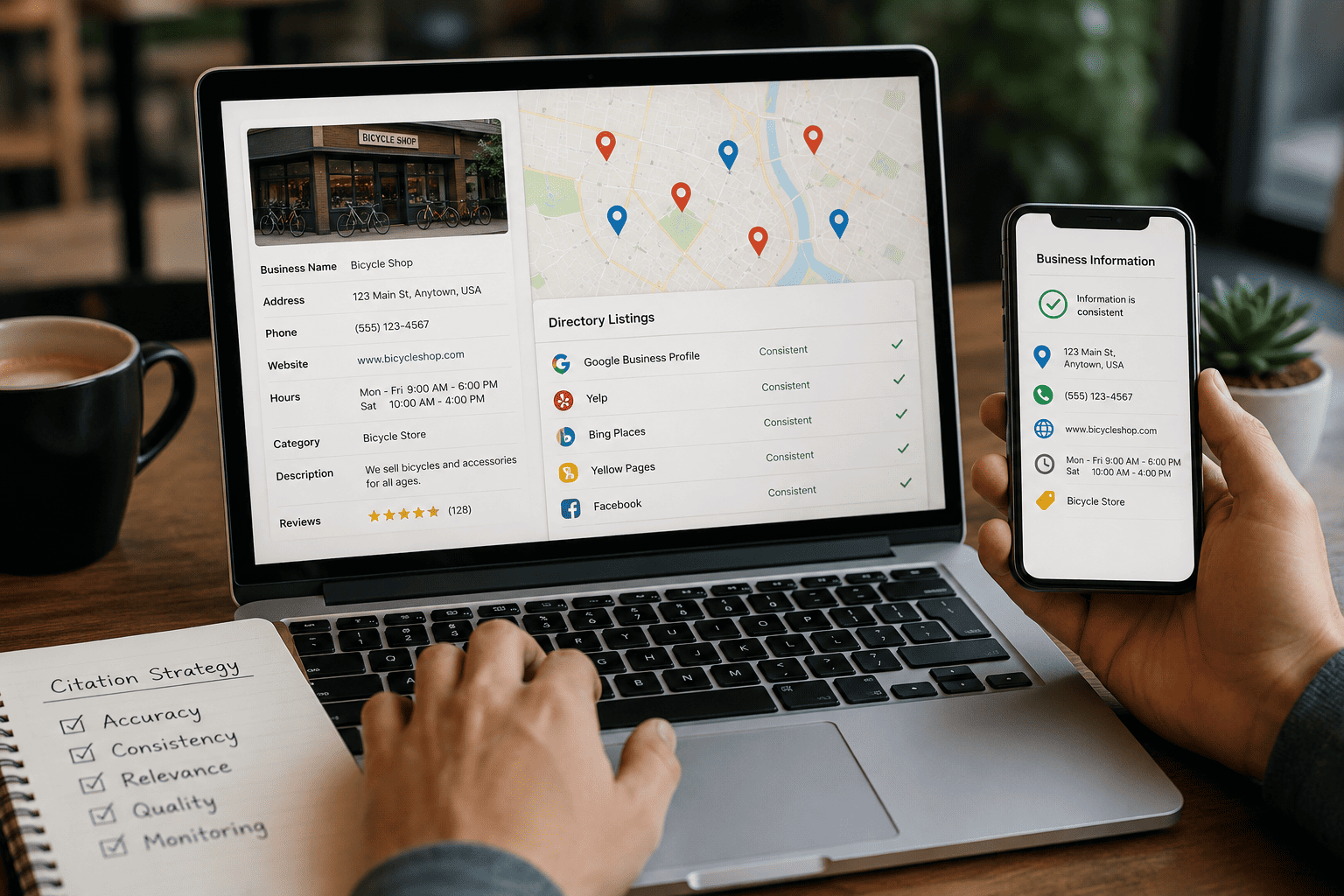
Local Citation Building at a Glance
| Citation Element | What It Means | Why It Matters |
| Business name | Official business name | Establishes identity |
| Address | Physical business location or eligible service-area information | Helps customers find the business |
| Phone number | Primary contact number | Supports communication and consistency |
| Website | Official business website | Connects citations to the business |
| Business category | Main type of business | Improves relevance |
| Business description | Explanation of services | Helps customers understand the business |
| Business hours | Operating schedule | Prevents customer confusion |
| Reviews | Customer feedback | Builds trust |
| Photos | Authentic business images | Improves presentation |
| Citation consistency | Matching information across platforms | Reduces confusion |
What Is a Local Citation Building?
Local Citation Building is the process of creating, correcting, and managing online business listings across relevant directories, platforms, websites, and local resources.
A basic citation may contain:
Business Name + Address + Phone Number (NAP)
However, modern business listings can include much more information, such as:
- Website URL
- Business category
- Hours
- Services
- Products
- Photos
- Business description
- Social profiles
- Reviews
- Service areas
For example, a local bakery might have listings on major business platforms, food-related websites, local directories, and community websites.
The objective is to ensure that customers and search engines can consistently discover accurate information about the business.
Quick Answer: What Is the Best Way to Build Local Citations?
The best approach is to build accurate, relevant, and trustworthy citations rather than creating as many listings as possible.
Start with major platforms that customers in your market actually use. Then identify reputable local directories, industry-specific websites, regional organizations, and other relevant sources.
Your business name, address, phone number, website, category, and other important details should be accurate and consistent.
A strong citation strategy should also include regular monitoring. Businesses move, change phone numbers, update hours, add services, and sometimes acquire duplicate listings. Citation management should therefore be treated as an ongoing SEO activity rather than a one-time submission project.
Why Local Citation Building Matters
1. It Supports Local Search Visibility
Accurate business information across relevant online platforms can help establish a consistent digital presence for a local company. Google explains that local results are primarily influenced by relevance, distance, and prominence, and that complete and accurate business information can help Google understand and match a business to relevant searches. Google’s local ranking guidance
Search engines can use information from various sources to better understand businesses and their locations.
However, citations should be viewed as one part of a broader local SEO strategy rather than a guaranteed ranking shortcut.
2. It Helps Customers Discover Your Business
Customers may discover businesses through directories, review platforms, local websites, and industry-specific resources.
A citation can therefore generate visibility even when the customer does not initially find the business through the company’s website.
3. It Improves Information Consistency
Imagine a company has three different phone numbers across five websites.
A potential customer may not know which number is correct.
Consistent citations reduce this type of confusion.
4. It Builds Business Credibility
A legitimate business with accurate listings across relevant platforms can present a stronger online presence.
Industry associations, local organizations, and reputable directories can also provide useful context about a company.
5. It Can Generate Referral Traffic
Some directories receive substantial traffic from people actively searching for businesses.
A well-optimized listing can therefore send potential customers directly to your website.
6. It Supports Brand Discovery
Even when a citation does not directly generate a customer, it can increase the number of places where people encounter your brand.
Repeated exposure can contribute to stronger brand recognition over time.
Types of Local Citations
Not every citation is the same. Understanding the different types can help you prioritize your efforts.
Structured Citations
Structured citations appear in organized business directories or listing platforms.
They commonly include fields for:
- Business name
- Address
- Phone
- Website
- Category
- Hours
These listings are usually easy for customers to understand.
Unstructured Citations
An unstructured citation is a business reference within ordinary content.
For example, a local newspaper might publish an article saying:
Green Valley Plumbing serves residential customers throughout the local area.
The article may mention the business without using a traditional directory format.
Unstructured mentions can come from:
- News articles
- Blogs
- Local organizations
- Sponsorship pages
- Community websites
- Industry publications
Industry-Specific Citations
These are listings on websites related to a particular industry.
For example:
- Restaurants → food and dining platforms
- Hotels → travel platforms
- Lawyers → legal directories
- Contractors → home-service platforms
- Healthcare businesses → relevant healthcare directories
Industry relevance can make these citations particularly useful for discovery.
Local Citations
Local citations are listings or mentions associated with a specific geographic market.
Examples include:
- Local business directories
- Chamber of commerce websites
- Community organizations
- Regional publications
- Local blogs
These can be especially useful for businesses serving a particular city or region.
How to Build Local Citations Step by Step
Step 1: Audit Your Existing Citations
Before creating new listings, find out where your business already appears.
Search for combinations such as:
“Business Name” + City
“Business Name” + Phone Number
“Business Name” + Address
Look for:
- Duplicate listings
- Incorrect addresses
- Old phone numbers
- Incorrect business names
- Missing websites
- Outdated hours
- Wrong categories
This gives you a starting point.
Step 2: Create a Master Business Information Sheet
Prepare one document containing your official business details.
Include:
- Exact business name
- Address
- Phone number
- Website
- Business category
- Business description
- Opening hours
- Holiday hours
- Service areas
- Main services
- Social media profiles
This reduces mistakes when creating multiple listings.
Step 3: Start With Major Platforms
Prioritize important platforms that are relevant to your target customers and geographic market.
Do not start by submitting your business to hundreds of unknown websites.
Focus on quality first.
Step 4: Find Industry-Specific Directories
Search for directories related to your industry.
For example, a marketing agency could look for:
- Marketing agency directories
- Digital marketing associations
- Business service directories
- Local professional networks
A restaurant could prioritize relevant food and hospitality platforms.
Step 5: Find Local Directories
Search for legitimate websites covering your city, region, or community.
Potential sources include:
- Local business directories
- Community websites
- Regional organizations
- Chambers of commerce
- Local publications
Make sure the platform is legitimate and relevant before creating a listing.
Step 6: Complete Every Important Field
When a legitimate directory provides useful fields, complete them accurately.
Add:
- Correct business information
- Appropriate category
- Website
- Description
- Hours
- Services
- Photos where appropriate
A complete listing is more useful than a profile containing only a name and phone number.
Step 7: Keep NAP Information Consistent
NAP means:
Name + Address + Phone Number
Your core business information should be consistent across important listings.
For example, avoid using:
125 Main Street
on one platform and:
125 Main St.
on another if the difference creates confusion or reflects inconsistent business information.
More importantly, ensure that the actual business details are correct everywhere.
Step 8: Add Your Website
Where a directory legitimately allows a website field, add the official business website.
Make sure the destination page works correctly and represents the same business.
Step 9: Add Business Categories Carefully
Choose categories that accurately describe your business.
Do not select unrelated categories simply because they have more search demand.
Relevance should guide your decisions.
Step 10: Add Authentic Photos
Where appropriate, use real images of:
- Business exterior
- Interior
- Team
- Products
- Services
- Completed projects
Authentic photography can help customers recognize and trust the business.
Step 11: Manage Customer Reviews
Some citation platforms also provide customer review functionality.
Monitor reviews and respond professionally.
Do not create fake reviews or attempt to manipulate ratings.
Step 12: Track Your Listings
Create a spreadsheet containing:
| Directory | URL | Status | Business Information | Last Checked |
| Directory A | Listing URL | Active | Correct | August 2026 |
| Directory B | Listing URL | Needs Update | Phone incorrect | August 2026 |
| Directory C | Listing URL | Duplicate | Needs Review | August 2026 |
This makes citation management much easier.
Local Citation Building Strategies
1. Prioritize Quality Over Quantity
You do not need hundreds of low-quality listings.
A smaller collection of relevant, trustworthy citations can be more useful than a large collection of questionable directories.
2. Focus on Relevance
A local business directory that serves your market is generally more relevant than a random website with no connection to your industry or location.
3. Build Citations Naturally
Citation building should be part of a broader local marketing strategy.
Do not attempt to create thousands of listings within a short period simply to increase numbers.
4. Look for Local Organizations
Consider legitimate organizations such as:
- Business associations
- Chambers of commerce
- Community organizations
- Local professional groups
- Industry associations
Membership or participation may create legitimate opportunities for business mentions.
5. Earn Unstructured Citations
You can also increase brand mentions through legitimate activities such as Digital PR for SEO, local sponsorships, community events, expert contributions, local news coverage, and industry interviews.
- Local sponsorships
- Community events
- Expert contributions
- Local news coverage
- Industry interviews
- Original research
These activities can generate mentions beyond traditional directory listings.
Local Citation Building and Local SEO
Citation buildings should not operate independently.
A strong local SEO strategy can include:
Google Business Profile Optimization
Maintain accurate business information and keep the profile updated as part of your Google Business Profile Optimization strategy.
Website Optimization
Create useful website content that clearly explains your services and location.
Local Content
Publish content that genuinely helps people in the communities you serve.
Reviews
Encourage genuine customer feedback and respond professionally.
Internal Linking
Connect related local and service pages where appropriate.
Local Authority Building
Develop legitimate relationships with relevant local and industry websites and support them with a broader link building strategy where appropriate.
Together, these activities create a more complete local search strategy.
Examples of Local Citation Building
Example 1: Local Restaurant
A restaurant discovers that its phone number is different on several food directories.
The owner creates a citation audit and identifies:
- Two incorrect phone numbers
- One outdated opening schedule
- One duplicate listing
- Several missing photos
The business corrects the information and maintains a central record of its listings.
The result is a cleaner and more reliable online presence.
Example 2: Plumbing Company
A plumbing company operates in one metropolitan area.
Its citation strategy focuses on:
- Major business directories
- Relevant home-service platforms
- Local business websites
- Industry associations
- Community organizations
Rather than submitting to hundreds of unrelated websites, the company prioritizes platforms that potential customers are likely to use.
Example 3: Marketing Agency
A marketing agency builds citations through:
- Business directories
- Local professional associations
- Industry platforms
- Local business publications
- Community partnerships
It also publishes original marketing research that earns legitimate mentions from industry websites.
This combines structured and unstructured citation opportunities.
Benefits of Local Citation Building
A well-managed citation strategy can provide several benefits.
Better Business Information
Customers can more easily find accurate details.
Increased Local Discovery
Relevant platforms can expose the business to potential customers.
More Referral Opportunities
Some listings can generate direct website visits or inquiries.
Stronger Brand Presence
Your business appears in more relevant online locations.
Improved Reputation Management
Review and directory monitoring helps identify incorrect or outdated information.
Better Local SEO Foundation
Consistent business information supports other local search efforts.
Best Practices for Local Citation Building
Maintain a Consistent Business Identity
Use your legitimate business information across important platforms.
Keep Information Updated
Review listings whenever your business changes its:
- Address
- Phone
- Website
- Hours
- Services
- Business name
Use Relevant Categories
Select categories that accurately describe what you do.
Avoid Low-Quality Directories
Do not create listings simply because a website accepts submissions.
Monitor Duplicate Listings
Duplicate profiles can confuse customers and make business information harder to manage.
Use Professional Descriptions
Write descriptions for people first. Explain your services clearly without keyword stuffing.
Keep Records
Maintain a citation management spreadsheet so you know where your business is listed.
Review Your Citations Periodically
Citation building is not a one-time task. Schedule regular audits.
Common Local Citation Building Mistakes
Creating Too Many Low-Quality Citations
More listings do not automatically mean better local SEO.
Quality and relevance matter.
Using Incorrect Business Information
An old phone number or address can create customer frustration.
Keyword Stuffing Business Names
Do not add location or service keywords to a business name unless they are genuinely part of the real-world business name.
Choosing Irrelevant Categories
A business should not claim categories that do not accurately describe its services.
Ignoring Duplicate Listings
Duplicate listings can create confusion and should be reviewed and resolved where appropriate.
Using Fake Reviews
Fake reviews can damage reputation and violate platform policies.
Forgetting to Update Holiday Hours
Seasonal changes can make otherwise accurate listings misleading.
Focusing Only on Directory Links
Citations are about business visibility and information consistency, not simply collecting backlinks.
How to Measure Local Citation Building
Track the following metrics:
| Metric | Purpose |
| Number of active citations | Measures listing coverage |
| Citation accuracy | Identifies incorrect information |
| Duplicate listings | Shows management problems |
| Referral traffic | Measures visitors from directories |
| Calls or inquiries | Measures potential customer actions |
| Profile views | Indicates listing exposure |
| Review activity | Tracks reputation engagement |
| Local search visibility | Evaluates broader local SEO performance |
Remember that citation quantity alone is not a meaningful success metric.
A better question is:
Are the right customers finding accurate information about my business?
Frequently Asked Questions
What is a Local Citation Building?
Local Citation Building is the process of creating, correcting, and managing online business listings and mentions across relevant directories, websites, platforms, and local resources.
What is NAP in local SEO?
NAP stands for Name, Address, and Phone Number. These are core business details that should be accurate and consistent across important online listings.
Are local citations still important for SEO?
Yes, citations can still play a useful role in local SEO, particularly for business information consistency and local discovery. However, they should be combined with other local SEO activities.
How many local citations does a business need?
There is no universal number. The appropriate number depends on the business, industry, location, and available reputable platforms. Focus on relevant and trustworthy citations rather than an arbitrary target.
What are the best local citation websites?
The best platforms depend on your market and industry. Start with major platforms used by your customers, then expand into reputable local and industry-specific directories.
Do local citations need backlinks?
Not necessarily. A citation can mention a business’s name, address, or other information without functioning as a traditional SEO backlink.
How often should I audit local citations?
A business should review its important citations periodically and immediately after major changes such as moving locations, changing phone numbers, or updating its business name.
Can local citations improve Google Maps visibility?
Accurate and relevant citations can support a business’s overall local search presence, but they do not guarantee a particular position in Google Maps. Local visibility depends on multiple factors.
Are directory submissions enough for local SEO?
No. A strong local SEO strategy should also consider your website, business profile, reviews, local content, reputation, and overall online presence.
Should I pay for local citation services?
Paid services can save time, but quality varies. Before hiring a provider, understand exactly which platforms they use and avoid services promising guaranteed rankings or thousands of low-quality links.
Conclusion
Local Citation Building is a practical component of a broader local SEO strategy. By creating accurate listings on relevant platforms and maintaining consistent business information, companies can make it easier for customers to discover and trust them online.
The strongest strategy is not based on submitting a business to every directory available. Instead, focus on reputable platforms, industry-specific resources, local websites, accurate NAP information, genuine reviews, and useful business details.
Start with an audit of your existing citations, correct inaccurate information, remove or resolve duplicates where appropriate, and build new listings selectively.
Most importantly, treat citation building as an ongoing process. Business information changes, platforms evolve, and new opportunities for local visibility appear over time.
Call to Action
Ready to strengthen your local search presence?
Start by auditing your existing business listings today. Check your business name, address, phone number, website, category, hours, and other important information. Correct outdated details first, then identify the most relevant local and industry directories for your business.
Build accurate citations, maintain your online presence, and make it easier for local customers to find your business.