

On-Page vs Off-Page SEO is one of the first topics every website owner needs to understand. Whether you run an online store, a news site, or a personal blog, knowing how on-page vs off-page SEO works helps you improve rankings and earn steady organic traffic.
Many beginners focus only on content or only on backlinks. The best approach to on-page vs off-page SEO is to use both, because a site with great content but little authority may struggle to rank, and a site with strong backlinks but weak pages rarely holds its rankings.
This guide explains the differences, benefits, and best practices of both, and shows how technical SEO supports them.
On-Page vs Off-Page SEO: Quick Comparison
| Aspect | On-Page SEO | Off-Page SEO |
|---|---|---|
| Where it happens | Inside your website | Outside your website |
| Main goal | Improve relevance | Improve trust and authority |
| Controlled by | You | Other websites and users |
| Key elements | Content, titles, URLs, images, internal links | Backlinks, brand mentions, digital PR |
| Time to see results | Often weeks | Often months |
| Cost | Mostly time and effort | Often outreach and marketing budget |
Quick Answer
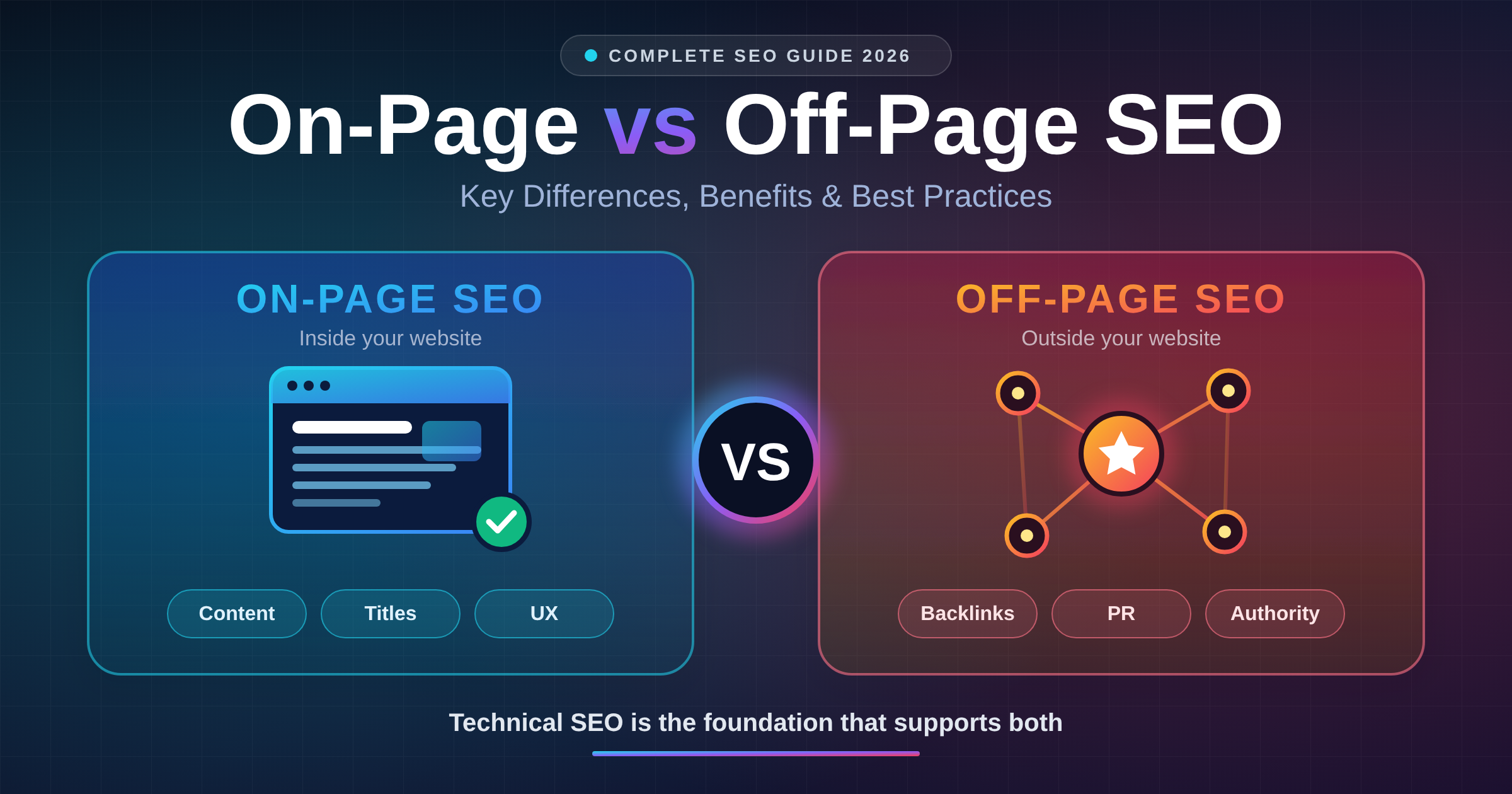
On-page SEO means optimizing things on your own website: content quality, title tags, meta descriptions, headings, images, internal links, and user experience.
Off-page SEO means activities outside your site that build authority and credibility: quality backlinks, digital PR, brand mentions, influencer partnerships, and reputation management.
In the on-page vs off-page SEO debate, neither side wins alone. On-page work helps search engines understand your content, and off-page work gives them reasons to trust it.
What Is On-Page SEO?
On-page SEO (also called onsite SEO) is the process of optimizing individual pages so that search engines and users clearly understand what they are about. It covers everything you directly control on the page: what you write, how you structure it, and how easy it is to use. To see which signals matter most right now, read Google ranking factors in 2026.
Why On-Page SEO Matters
Search engines evaluate your page before deciding where it should rank. Good optimization helps them understand what the page is about, which keywords it targets, whether users find it valuable, and how easy it is to navigate. Without it, even excellent content may not rank well. These are the essential elements to get right:
1. High-Quality, People-First Content
Content is the foundation. It should solve a real problem, match search intent, be accurate and original, stay up to date, and include helpful visuals. In 2026, show real experience and expertise (E-E-A-T): add author names, first-hand examples, and sources.
2. Title Tag Optimization
The title tag is an important ranking signal and the first thing users see in results. Include the primary keyword, keep it under about 60 characters, and make it compelling. Example: On-Page vs Off-Page SEO: Differences & Best Practices 2026. A strong title also earns more clicks, and the position 1 vs position 3 CTR data shows how much a higher spot is worth.
3. Meta Descriptions
They are not a direct ranking factor, but a good one improves click-through rate. Include the keyword naturally, explain the page’s value, and invite the click.
4. Header Tags (H1, H2, H3)
Use one H1 per page, then logical H2 and H3 sections. Clear structure helps readers scan and helps search engines understand the page.
5. URL Structure
Good: example.com/on-page-vs-off-page-seo. Bad: example.com/page?id=12345.
6. Internal Linking
Internal links help users find related content and help search engines crawl your site and understand how pages relate. Use descriptive anchor text, not “click here.”
7. Image Optimization
Compress files, write descriptive alt text, use meaningful file names, and use modern formats such as WebP. This helps both speed and accessibility.
8. Mobile-Friendly Design
Google uses mobile-first indexing, so pages must load quickly, fit every screen, use readable fonts, and have touch-friendly buttons.
9. User Experience (UX)
Clear navigation, readable typography, and a logical layout reduce frustration and keep visitors engaged.
What Is Off-Page SEO?
Off-page SEO covers everything you do outside your website to build reputation, authority, and trust. Instead of optimizing pages directly, you earn credibility across the web through backlinks, brand mentions, and digital PR.
Why Off-Page SEO Matters
Search engines trust sites that other reputable sites recommend. Without authority signals, even well-optimized pages struggle in competitive niches. These are the most important techniques:
1. Link Building
Backlinks remain one of the strongest ranking signals, and quality matters far more than quantity. Focus on editorial links, resource pages, broken link building, and digital PR. Here is a complete broken link building guide if you want to start with a proven method.
2. Brand Mentions
Even unlinked mentions help build recognition. Earn them through expert interviews, news coverage, industry discussions, and podcast appearances.
3. Guest Blogging
Writing for reputable sites can bring a backlink, referral traffic, and brand awareness. Choose relevant sites, not link farms. Our guest posting guide for quality backlinks explains how to do it properly.
4. Digital PR
Original research, surveys, and data studies often earn links from news and industry sites. For example, a survey of 500 local businesses can be cited by dozens of blogs. Learn more about digital PR for SEO and earning backlinks.
5. Social Media Marketing
Social signals are not a direct ranking factor, but sharing helps content get seen and linked to.
6. Influencer Outreach
Collaborating with industry experts expands reach and strengthens credibility. A quote or joint webinar can earn mentions and links.
7. Local SEO Citations
Keep your business name, address, and phone number consistent across directories, listings, and maps.
Where Does Technical SEO Fit?
Technical SEO is the foundation under both. It makes sure search engines can crawl, index, and understand your site. Key elements include:
- Crawlability and indexing (fixing errors, correct robots.txt)
- XML sitemaps
- Core Web Vitals and page speed
- Structured data (Schema markup)
- HTTPS and mobile performance
Speed, mobile-friendliness, and Core Web Vitals are technical issues that also affect on-page experience, so they overlap. A simple rule: if it affects how search engines access your site, it is technical; if it affects what a visitor sees on a page, it is on-page.
In short: technical SEO is the foundation, on-page SEO is the content and design, and off-page SEO is the reputation.
Key Differences in On-Page vs Off-Page SEO
| Aspect | On-Page SEO | Off-Page SEO |
|---|---|---|
| Control | Full | Limited |
| Main ranking signal | Content quality and relevance | Backlinks and trust |
| Typical timeline | Weeks | Months |
| Typical cost | Lower | Often higher |
Benefits of On-Page and Off-Page SEO
Benefits of On-Page SEO
Better keyword rankings, improved user experience, higher click-through rate, better crawlability, more organic traffic, and higher conversions.
Benefits of Off-Page SEO
Higher domain authority, better visibility, increased trust, stronger brand reputation, more referral traffic, and long-term ranking gains.
How On-Page vs Off-Page SEO Work Together
Imagine two sites publishing similar guides on “best SEO tools.”
- Website A: excellent content, fast, mobile-friendly, good internal links, but no backlinks.
- Website B: similar content, hundreds of quality backlinks, strong brand.
Website B will often rank higher because search engines trust it more. But if B’s content is weak and A keeps improving while earning links, A can eventually overtake it. This example shows why on-page vs off-page SEO should never be treated as an either-or choice.
Best Practices for On-Page and Off-Page SEO
On-Page SEO Best Practices
- Write helpful, original content that matches search intent.
- Optimize titles and meta descriptions.
- Use descriptive headings and add internal links.
- Optimize images and improve Core Web Vitals.
- Make pages mobile-friendly.
- Refresh old content regularly.
- Use structured data where it fits.
Off-Page SEO Best Practices
- Earn backlinks naturally through useful content.
- Publish original research and unique insights.
- Build relationships with industry websites.
- Promote content on social media.
- Prioritize relevant, authoritative sites.
- Monitor your backlink profile.
- Encourage genuine reviews and brand mentions.
- Use Google’s disavow tool only for a large pattern of spammy links or when you have a manual action. Google says most sites do not need it.
SEO in 2026: What Has Changed
AI Overviews and Zero-Click Searches
AI answers can reduce clicks, so clear, well-structured, trustworthy content is more valuable than ever. Zero-click searches make it even more important to earn the click with a strong title and description.
E-E-A-T
Experience, expertise, authoritativeness, and trust reward real authors, real examples, and cited sources.
Brand Mentions and Reputation
Brand mentions and reputation increasingly support visibility, not just links.
Common SEO Mistakes and How to Fix Them
| Mistake | Why It Hurts | Fix |
|---|---|---|
| Keyword stuffing | Hard to read, can hurt rankings | Write naturally, use synonyms |
| Buying low-quality backlinks | Damages reputation, risks penalties | Earn links through content and PR |
| Ignoring search intent | Page does not answer the query | Study top results, match the format |
| Thin content | Little value, rarely ranks | Add depth, examples, visuals |
| Duplicate content | Confuses search engines | Write originally, use canonical tags |
| Slow speed | Higher bounce rates | Compress images, use caching and a CDN |
| Poor internal linking | Hard to crawl and navigate | Link related pages with descriptive anchors |
Frequently Asked Questions
Which is more important in on-page vs off-page SEO?
Both. On-page SEO provides relevance, and off-page SEO provides the authority needed to rank higher.
Can I rank without backlinks?
Yes, for low-competition keywords. In competitive niches, backlinks become much more important.
How long does SEO take?
Many sites see measurable improvement within about 3 to 6 months, though competitive niches can take longer.
What is the difference between onsite and offsite SEO?
Onsite SEO is another name for on-page SEO: optimizing content, titles, meta descriptions, internal links, images, and speed. Offsite SEO is off-page SEO: earning backlinks, brand mentions, digital PR, and social promotion to build authority.
How many backlinks do I need?
There is no fixed number. A few relevant, high-quality links beat many low-quality ones.
Does social media improve SEO?
Not directly, but it increases visibility, brings visitors, and can help earn natural backlinks.
How often should I update my content?
Review important pages every 6 to 12 months, or sooner when information changes.
Conclusion
Understanding on-page vs off-page SEO is the key to a balanced strategy. On-page SEO makes your site relevant and easy to use, off-page SEO makes it trusted, and technical SEO keeps everything accessible. Rather than choosing one, invest in all three: publish valuable content, optimize every page, fix technical issues, and build genuine authority over time. For a deeper look at the fundamentals, read Google’s official SEO Starter Guide.
Next Step
Audit one important page today. Check its title, headings, internal links, and speed, then plan one outreach action to earn a quality backlink. Want to publish your own SEO article and earn a relevant backlink? Write for Linkvexa and read our guest post guidelines before you submit.