

Introduction
Search engine optimization (SEO) has become one of the most important digital marketing strategies for businesses, bloggers, and website owners. Whether you run an eCommerce store, a news website, or a personal blog, understanding the difference between On-Page SEO vs Off-Page SEO is essential for improving search engine rankings and driving consistent organic traffic.
Many beginners focus only on creating content or building backlinks without realizing that both on-page and off-page SEO work together. A website with excellent content but poor authority may struggle to rank, while a website with strong backlinks but poor optimization may also fail to achieve sustainable rankings.
This guide covers the key differences between On-Page SEO and Off-Page SEO while also explaining how Technical SEO supports both strategies through crawlability, indexing, Core Web Vitals, structured data, XML sitemaps, and overall website performance.
On-Page SEO vs Off-Page SEO Comparison Table
| Feature | On-Page SEO | Off-Page SEO |
| Focus | Optimizing website pages | Building website authority |
| Controlled By | Website owner | External websites and users |
| Main Goal | Improve relevance | Improve trust and authority |
| Includes | Content, titles, URLs, images, internal links | Backlinks, mentions, PR, social signals |
| Results Speed | Faster | Usually slower |
| Cost | Mostly time and effort | Often requires outreach and marketing |
| Impact | Improves user experience | Builds domain authority |
| Importance | Essential | Equally essential |
Quick Answer
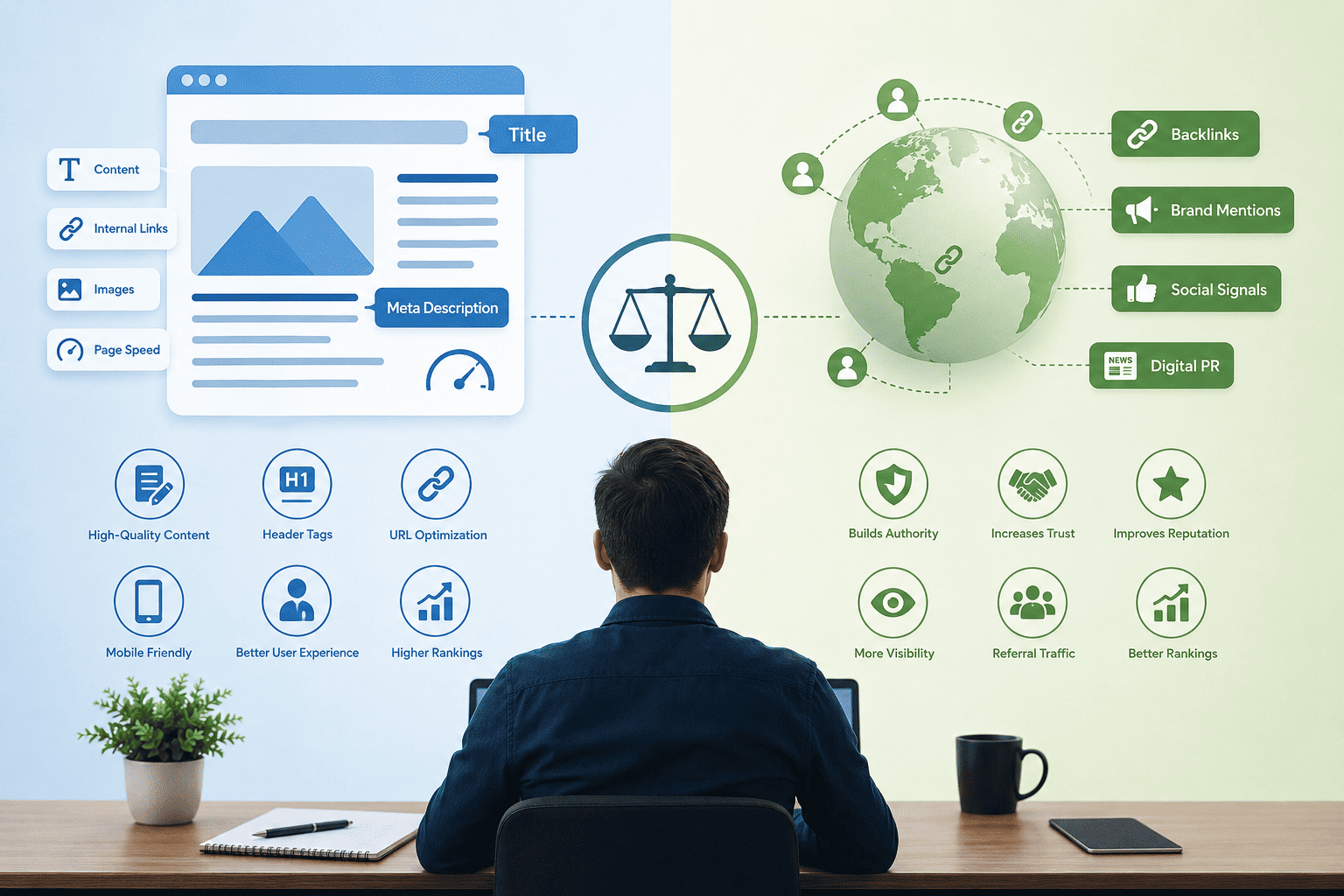
On-Page SEO refers to all optimization activities performed directly on your website, such as improving content quality, optimizing headings, title tags, meta descriptions, images, page speed, internal linking, and user experience.
Off-Page SEO refers to activities performed outside your website that improve its authority and credibility. These include acquiring high-quality backlinks, digital PR, brand mentions, influencer marketing, social media promotion, and online reputation management.
The best SEO strategy combines both. Strong on-page optimization helps search engines understand your content, while effective off-page SEO builds trust and authority that improve rankings.
What is On-Page SEO?
Understanding 100+ SEO Statistics Every Marketer Should Know can help you make smarter optimization decisions and improve your website’s search performance. These data-driven insights reveal how search engines rank webpages, how users interact with search results, and which SEO strategies deliver the best outcomes. By applying these statistics alongside proven optimization techniques, you can increase search visibility, attract more organic traffic, and build a stronger online presence.
Why On-Page SEO Matters
Search engines evaluate your content before deciding where it should rank.
Proper optimization helps search engines understand:
- What your page is about
- Which keywords it targets
- Whether users find it valuable
- How easy it is to navigate
- Whether it provides a good user experience
Without proper on-page optimization, even excellent content may fail to rank well.
Essential Elements of On-Page SEO
1. High-Quality Content
Content is the foundation of SEO.
Great content should:
- Solve user problems
- Answer search intent
- Be accurate
- Be original
- Stay updated
- Include helpful visuals
2. Title Tag Optimization
Your title tag is one of the strongest ranking signals.
Example:
On-Page SEO vs Off-Page SEO: Complete Guide for Beginners
Best practices:
- Include the primary keyword
- Keep under 60 characters
- Make it compelling
3. Meta Description
Although not a direct ranking factor, an optimized meta description improves click-through rate.
Good meta descriptions:
- Include keywords naturally
- Explain page value
- Encourage clicks
4. Header Tags (H1, H2, H3)
Organized headings improve readability.
Structure example:
- H1
- H2
- H3
Search engines better understand well-structured content.
5. URL Optimization
Good URL:
example.com/on-page-seo-vs-off-page-seo
Bad URL:
example.com/page?id=12345
6. Internal Linking
Internal links help users discover related content while distributing authority across your website.
Benefits include:
- Better crawling
- Improved navigation
- Increased page authority
- Longer session duration
7. Image Optimization
Always optimize:
- File size
- Alt text
- Image names
- Responsive formats
Optimized images improve page speed and accessibility.
8. Page Speed
Fast websites rank better and provide a superior user experience.
Ways to improve speed:
- Compress images
- Enable caching
- Use CDN
- Minify CSS and JavaScript
9. Mobile Friendliness
Since Google uses mobile-first indexing, responsive design is no longer optional.
Your website should:
- Load quickly
- Fit every screen
- Use readable fonts
- Have touch-friendly buttons
10. User Experience (UX)
Good UX reduces bounce rates and increases engagement.
Improve UX through:
- Clear navigation
- Readable typography
- Logical layout
- Fast loading pages
What is Off-Page SEO?
Understanding Google Ranking Factors 2026 is essential for building a successful SEO strategy. Off-page SEO includes all activities performed outside your website to improve its reputation, authority, and trustworthiness. Instead of optimizing pages directly, off-page SEO focuses on building credibility across the web through high-quality backlinks, brand mentions, digital PR, and other authority signals that positively influence Google rankings.
Why Off-Page SEO Matters
Search engines trust websites that others recommend.
Quality backlinks and brand mentions signal that your website is valuable and trustworthy.
Without authority, even perfectly optimized pages may struggle to compete in competitive niches.
Important Off-Page SEO Techniques
1. Link Building
Backlinks remain one of Google’s strongest ranking signals.
Focus on:
- Editorial backlinks
- Guest posting
- Resource pages
- Broken link building
- Digital PR
Quality matters far more than quantity.
2. Brand Mentions
Even unlinked mentions of your brand help establish authority.
Encourage mentions through:
- Expert interviews
- News coverage
- Industry discussions
- Podcasts
3. Guest Blogging
Publishing quality articles on reputable websites can:
- Build backlinks
- Increase traffic
- Improve brand awareness
- Generate leads
4. Digital PR
Newsworthy campaigns often earn links from authoritative publications.
Examples:
- Research reports
- Surveys
- Industry statistics
- Case studies
5. Social Media Marketing
While social signals are not direct ranking factors, they help content gain visibility and attract backlinks naturally.
6. Influencer Outreach
Collaborating with industry experts expands your reach and improves brand credibility.
7. Local SEO Citations
Businesses should maintain consistent information across:
- Business directories
- Local listings
- Maps
- Industry-specific directories
Where Does Technical SEO Fit?
Technical SEO serves as the foundation that supports both On-Page SEO and Off-Page SEO. While On-Page SEO focuses on optimizing content and Off-Page SEO builds website authority, Technical SEO ensures that search engines can efficiently crawl, index, and understand your website.
Key technical SEO elements include improving website crawlability, fixing indexing issues, optimizing Core Web Vitals, enhancing page speed, implementing structured data (Schema Markup), maintaining XML sitemaps, configuring robots.txt correctly, and ensuring mobile-friendly performance. A technically optimized website helps search engines access your content more effectively, making both your on-page and off-page SEO efforts significantly more successful.
Key Differences Between On-Page SEO and Off-Page SEO
| Aspect | On-Page SEO | Off-Page SEO |
| Optimization Location | Inside website | Outside website |
| Main Objective | Improve relevance | Improve authority |
| Ranking Signal | Content quality | Backlinks and trust |
| Full Control | Yes | Limited |
| Time to See Results | Weeks | Months |
| Cost | Lower | Often higher |
Benefits of On-Page SEO
- Better keyword rankings
- Improved user experience
- Higher click-through rate
- Better crawlability
- Increased organic traffic
- Higher conversion rates
Benefits of Off-Page SEO
- Higher domain authority
- Better search visibility
- Increased trust
- Stronger brand reputation
- More referral traffic
- Long-term ranking improvements
How On-Page and Off-Page SEO Work Together
Imagine building a house.
On-Page SEO creates a strong foundation with quality content, technical optimization, and user experience.
Off-Page SEO acts as recommendations from others, proving that your house is trustworthy and worth visiting.
Without one, the other becomes significantly less effective.
Real-Life Example
Suppose two websites publish identical guides about “Best SEO Tools.”
Website A
- Excellent content
- Fast loading
- Mobile optimized
- Internal links
- No backlinks
Website B
- Similar quality content
- Hundreds of quality backlinks
- Strong brand authority
Website B will often rank higher because search engines trust it more.
However, if Website B has poor content and Website A consistently improves quality while earning backlinks, Website A can eventually outrank it.
Best Practices for On-Page SEO
- Write helpful, original content.
- Match user search intent.
- Optimize titles and meta descriptions.
- Use descriptive headings.
- Add internal links.
- Optimize images.
- Improve Core Web Vitals.
- Make pages mobile-friendly.
- Update old content regularly.
- Use structured data where appropriate.
Best Practices for Off-Page SEO
- Earn backlinks naturally.
- Publish research and unique insights.
- Build relationships with industry websites.
- Promote content through social media.
- Focus on authoritative websites.
- Monitor your backlink profile.
- Remove or disavow harmful links when necessary.
- Encourage genuine reviews and brand mentions.
Common SEO Mistakes to Avoid
Keyword Stuffing
Repeating keywords unnaturally makes content difficult to read and may hurt rankings.
Buying Low-Quality Backlinks
Spammy links can damage your website’s reputation.
Ignoring Search Intent
Ranking is difficult if your content doesn’t answer what users are actually searching for.
Thin Content
Very short pages with little value rarely perform well.
Duplicate Content
Copying content from other websites can negatively affect visibility.
Slow Website Speed
Slow pages increase bounce rates and reduce user satisfaction.
Poor Internal Linking
Disconnected pages make it harder for users and search engines to navigate your site.
Frequently Asked Questions (FAQ)
1. Which is more important: On-Page SEO or Off-Page SEO?
Zero-Click Searches 2026 make both on-page and off-page SEO essential. On-page SEO improves content relevance, while off-page SEO builds the authority needed to rank higher in search results.
2. Can I rank without backlinks?
Yes, it’s possible for low-competition keywords, but backlinks become increasingly important in competitive industries.
3. How long does SEO take?
Most websites begin seeing measurable improvements within 3–6 months, though highly competitive niches can take longer.
4. What is the difference between onsite and offsite SEO?
On-Page SEO (also known as Onsite SEO) involves optimizing elements within your website, such as content, title tags, meta descriptions, internal links, images, and page speed.
Off-Page SEO (also known as Offsite SEO) focuses on activities outside your website, including earning high-quality backlinks, brand mentions, digital PR, and social media promotion to improve your site’s authority and search rankings
5. How many backlinks do I need?
There is no fixed number. A few high-quality, relevant backlinks are generally more valuable than many low-quality ones.
6. Does social media improve SEO?
Social media does not directly boost rankings, but it can increase content visibility, attract visitors, and help earn natural backlinks.
7. How often should I update my content?
Review important pages every 6–12 months, or sooner if the information changes significantly.
Conclusion
Understanding the difference between On-Page SEO vs Off-Page SEO is essential for building a successful SEO strategy. On-page SEO ensures that your website is optimized for both search engines and users through high-quality content, technical improvements, and a strong user experience. Off-page SEO complements these efforts by increasing your site’s authority through backlinks, brand mentions, and external signals of trust.
Rather than choosing one over the other, the most effective approach is to invest in both. Publish valuable content, optimize every page, improve technical performance, and consistently build genuine authority over time. This balanced strategy is far more likely to deliver sustainable rankings, steady organic traffic, and long-term business growth.
Call to Action (CTA)
Ready to improve your website’s search rankings? Start by auditing your on-page SEO, strengthening your content, and building high-quality backlinks through ethical off-page strategies. A balanced SEO approach today can lead to stronger visibility, more qualified traffic, and lasting success in search engines.