

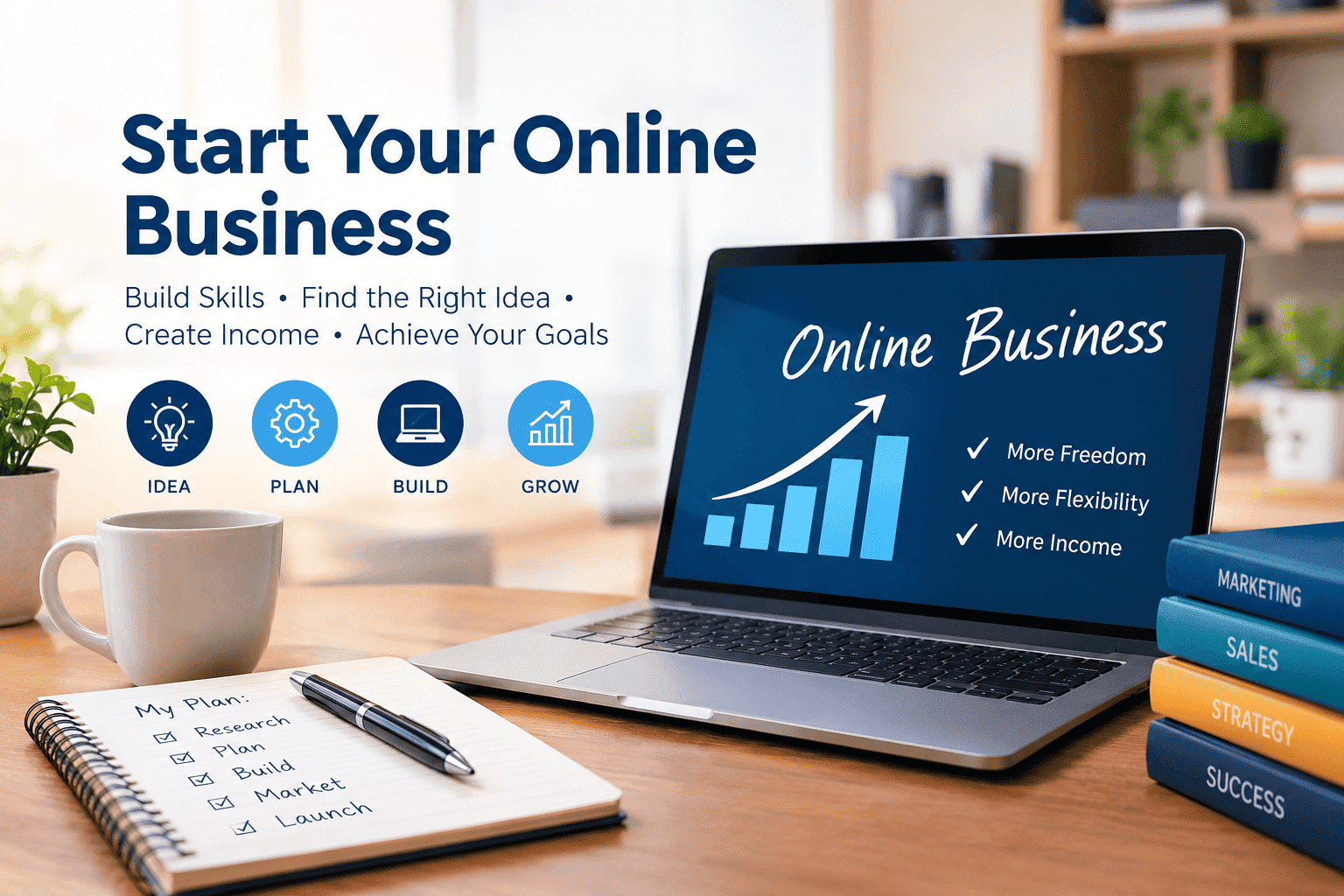
Starting an online business from scratch gives you the opportunity to turn your skills, knowledge, or product ideas into a real business. You do not always need a large investment, a physical shop, or an established audience to get started. What matters most is identifying a genuine customer need, choosing a suitable business model, and building a practical plan to reach potential buyers.
However, running an online business involves more than creating a website or posting products on social media. You must understand your target audience, determine whether customers are willing to pay, calculate your costs, establish a reliable payment and delivery process, and develop a marketing strategy that supports long-term growth.
The best approach is to start with a manageable idea, test it with real customers, and improve your offer using feedback and business data. This reduces the risk of spending too much before you understand what the market needs.
In this guide, you will learn how to start an online business from scratch, explore suitable business ideas, estimate startup costs, choose a platform, attract customers, measure profitability, and create a practical 30-day launch plan.
What Is an Online Business?
An online business is a business that uses the internet to sell products, deliver services, connect with customers, or generate revenue. It may operate through a dedicated website, an online marketplace, social media, email, or a combination of these channels.
Online businesses include freelance services, ecommerce stores, digital products, online education, affiliate marketing, subscription services, and software businesses.
For example, a freelance writer might offer SEO content services through a portfolio website, while an entrepreneur could sell handmade products through an online store. Someone with specialized knowledge might create downloadable templates or educational resources for a specific audience.
Each model has different requirements. A service business may depend primarily on skills and time, while a physical product business may require inventory, packaging, shipping, and customer support.
Understanding these differences helps you choose a business that fits your resources and goals.
Step 1: Choose an Online Business Idea
Your first task is to identify what you want to sell and why someone would buy it. A strong business idea solves a specific problem, serves an identifiable audience, and has a realistic path to profitability.
Start by reviewing your skills, interests, experience, available budget, and the amount of time you can commit. Then look for customer problems that match your abilities.
Online Business Ideas for Beginners
| Business Model | What You Can Offer | Main Requirements | Important Challenge |
|---|---|---|---|
| Freelancing | Writing, design, programming, or consulting | Marketable skills and work samples | Finding consistent clients |
| SEO Services | Keyword research, content optimization, and technical audits | SEO knowledge and a clear service offer | Demonstrating value to clients |
| Ecommerce | Physical products for a specific market | Product sourcing and fulfillment | Inventory costs and competition |
| Digital Products | Templates, ebooks, guides, and design assets | Useful knowledge and product development | Creating something people will pay for |
| Affiliate Marketing | Relevant product recommendations | Content and an audience | Converting traffic into commissions |
| Online Tutoring | Lessons, coaching, or workshops | Subject knowledge and teaching ability | Finding suitable students |
| Virtual Assistance | Administrative and operational support | Organization and communication | Managing time and client expectations |
| Print-on-Demand | Custom-designed products | Original designs and a fulfillment provider | Profit margins and delivery quality |
| Content Publishing | Articles, videos, newsletters, or educational content | Consistent publishing | Building an audience and monetization |
| Software Products | Digital tools or subscription applications | Technical capability or a development partner | Development, maintenance, and customer acquisition |
These are possible business models, not guaranteed sources of income. Their suitability depends on customer demand, competition, costs, and your ability to deliver a quality product or service.
How to Select the Right Idea
Evaluate potential ideas using five practical questions:
- Demand: Are people actively looking for a solution to this problem?
- Capability: Can you provide the product or service at an acceptable quality level?
- Affordability: Can you start without taking on unnecessary financial risk?
- Competition: Can you offer a meaningful advantage or serve an overlooked audience?
- Profitability: Can your expected revenue cover delivery costs and operating expenses?
Avoid choosing a business solely because it appears popular online. A business model that works for someone with an established audience or substantial capital may not be appropriate for a beginner.
For example, if you have SEO writing skills, you could initially offer blog writing to a defined group of businesses. You would need relevant writing samples, a clear service description, and a process for finding clients. This is a more manageable test than immediately building a large agency with multiple services.
Step 2: Research Your Target Market
Once you have an idea, investigate whether a real market exists for it. Market research helps you understand potential customers, their problems, the alternatives they already use, and the prices they may be willing to pay.
The U.S. Small Business Administration’s market research guidance explains how research and competitive analysis can help businesses understand demand and identify opportunities. Although its regulatory guidance is U.S.-specific, the research principles are broadly useful.
Define Your Ideal Customer
Describe the people or businesses most likely to purchase your offer. Depending on the product, relevant factors may include their industry, location, budget, buying habits, problems, and preferred communication channels.
For instance, a general service such as “digital marketing” may be difficult to position because it covers many needs. A more specific offer, such as “SEO content optimization for small ecommerce businesses,” makes the intended audience and service clearer.
Analyze Competitors
Examine businesses offering similar products or services. Review their websites, pricing, product descriptions, customer reviews, service packages, and marketing methods.
| Research Area | What to Investigate | How It Helps |
|---|---|---|
| Customer Needs | Questions, frustrations, and desired outcomes | Helps shape your offer |
| Competitor Pricing | Prices and package inclusions | Provides market context |
| Customer Reviews | Repeated complaints and positive feedback | Reveals possible improvements |
| Product Quality | Features, materials, or service scope | Helps establish your standards |
| Marketing Channels | Search engines, social platforms, and referrals | Identifies possible ways to reach buyers |
| Buying Experience | Website usability, checkout, and support | Highlights opportunities to reduce friction |
The goal is to understand the market rather than copy another business.
Validate Demand Before Spending Heavily
Research alone cannot prove that customers will purchase your offer. Test your assumptions with real people.
You can interview potential customers, offer a small paid pilot, publish a simple landing page, or present a limited product range. Track meaningful responses, such as qualified inquiries, paid orders, and requests for proposals.
Social media engagement and website visits may indicate interest, but they do not necessarily translate into revenue.
Use the results to improve your offer before committing to expensive tools, large inventory purchases, or substantial advertising campaigns.
Step 3: Choose a Business Model
Your business model explains how you will deliver value and generate revenue. Select one that fits your resources and the way your customers prefer to buy.
Service-Based Business
A service business sells skills, expertise, or time. Examples include SEO consulting, content writing, web development, graphic design, and virtual assistance.
This model can be suitable for beginners who already have a marketable skill because it may not require inventory. However, you must account for unpaid administrative time, customer communication, revisions, and client acquisition.
Product-Based Business
A product business sells physical goods through a website, marketplace, or another sales channel. Revenue depends on sales volume and the margin remaining after product costs, shipping, payment fees, returns, and other expenses.
Before launching, investigate suppliers, test product quality, calculate delivery costs, and establish a process for managing orders.
Digital Product Business
Digital products include ebooks, templates, design resources, downloadable guides, and educational materials.
Digital delivery can reduce the need for physical inventory, but product development, marketing, customer support, and competition still require attention.
Affiliate Marketing
Affiliate marketing involves recommending third-party products and earning commissions on qualifying purchases or other specified actions.
Success depends on relevant content, audience trust, suitable affiliate programs, and the ability to attract potential buyers. Disclose affiliate relationships clearly and follow the applicable program rules and advertising requirements.
Subscription Business
A subscription business charges customers recurring fees for ongoing access to a product, service, software tool, or membership.
Recurring billing can support more predictable revenue, but customers must continue receiving enough value to justify renewal. Plan for customer support, cancellations, retention, and ongoing product improvements.
Which model is best? If you have a marketable skill and limited startup capital, consider testing a service first. If you have access to suitable suppliers and understand product demand, ecommerce may be appropriate. If you have expertise that can be packaged into a useful resource, consider a digital product.
Choose based on evidence and your ability to execute, not on promises of effortless income.
Step 4: Create a Simple Business Plan
A business plan helps you organize your idea, budget, customer acquisition strategy, and operational priorities. It does not need to be lengthy at the beginning.
Write a concise plan that answers these questions:
| Element | What to Define |
|---|---|
| Business Concept | What will you sell? |
| Target Audience | Who is most likely to buy it? |
| Customer Problem | What needs will you address? |
| Value Proposition | Why should customers choose your offer? |
| Revenue Model | How will the business earn money? |
| Pricing | What will customers pay? |
| Marketing | How will potential buyers discover you? |
| Costs | What are the initial and recurring expenses? |
| Operations | How will you deliver orders or services? |
| Goals | What measurable milestones will you pursue? |
A lean business plan is often sufficient for an early-stage idea. You can expand it when you need financing, hire employees, enter a new market, or manage more complex operations.
Define Your Value Proposition
Your value proposition explains who you serve, what you provide, and why the offer is useful.
A simple format is:
“I help [target audience] achieve [desired outcome] through [product or service].”
For example: “I help small businesses improve their organic search visibility through practical SEO content and on-page optimization.”
Keep the promise realistic. Explain what your service includes and avoid guaranteeing outcomes that depend on factors outside your control.
Step 5: Calculate Startup Costs and Set a Budget
Your startup budget should include both the money needed to launch and the costs of operating the business. Spending too much before validating demand can create unnecessary financial pressure.
Common expenses include domain registration, website hosting, software, product samples, inventory, packaging, marketing, payment processing, and applicable registration or professional fees.
Estimate Your Initial Expenses
| Expense | Examples | Planning Consideration |
|---|---|---|
| Website | Domain, hosting, or platform subscription | Choose according to business needs |
| Branding | Logo, colors, and design assets | Start with a consistent, simple identity |
| Software | Research, accounting, or project management | Use free options where practical |
| Product Development | Samples, materials, or digital content | Test quality and usefulness |
| Inventory | Products purchased for resale | Avoid overstocking before demand is established |
| Marketing | Content creation and advertising | Set a controlled budget |
| Payments | Transaction and withdrawal fees | Verify provider eligibility and current charges |
| Compliance | Registration, tax, licenses, or professional advice | Check the requirements for your location |
| Fulfillment | Shipping, packaging, or service delivery | Include the actual cost of completing each sale |
The costs vary by country, platform, supplier, and business model. Check current prices before making financial commitments.
Calculate Your Break-Even Point
Your break-even point is the sales level at which revenue covers the relevant costs, leaving neither a profit nor a loss.
For a business selling one product, use this formula:
Break-even units = Fixed costs ÷ (Selling price per unit − Variable cost per unit)
Consider this illustrative example:
- Selling price per order: $40
- Variable cost per order: $25
- Monthly fixed costs: $300
- Contribution per order: $15
The calculation is:
300÷(40 − $25) = 20 orders.
Under these assumptions, the business needs 20 orders in the month to cover the $300 in fixed costs. This example excludes any costs not included in the figures, so it is not a profit forecast.
The SBA’s startup-cost guidance provides additional guidance on estimating expenses and using break-even analysis to make business decisions.
Keep Business Finances Organized
Record revenue, expenses, outstanding invoices, refunds, and available cash. Where practical and legally appropriate, separate business transactions from personal spending.
Remember that revenue is not the same as profit. A business may generate substantial sales but still struggle if product costs, advertising, or operating expenses consume its margins.
Step 6: Choose a Business Name and Establish Your Brand
Choose a business name that is memorable, appropriate for your audience, and easy to use across your website and communication channels.
Before committing to a name, check domain availability, existing businesses, and relevant trademark records. A domain registration does not automatically provide trademark protection.
Start with a simple brand identity that includes:
- A clear business name
- A consistent logo or wordmark
- A small, coordinated color palette
- Readable typography
- A consistent communication style
- Professional contact information
Your branding should help customers understand and recognize your business. Expensive design work is not a substitute for a useful offer or reliable service.
Step 7: Build Your Website or Online Store
A website can serve as your main business destination. It gives customers a place to learn about your offer, review details, contact you, and complete purchases.
However, you do not always need a full ecommerce store immediately. A freelancer may begin with a portfolio, while a product seller may test demand through a suitable marketplace or a simple sales page.
Choose the Right Platform
| Platform | Best Suited For | Main Consideration |
|---|---|---|
| WordPress | Content websites and flexible business sites | Hosting, maintenance, and configuration |
| Shopify | Dedicated ecommerce stores | Subscription and applicable transaction costs |
| WooCommerce | Ecommerce websites built on WordPress | Hosting, extensions, and maintenance |
| Online Marketplaces | Sellers seeking an existing marketplace | Fees, competition, and platform policies |
| Website Builders | Beginners seeking a simpler setup | Subscription costs and customization limits |
| Portfolio or Landing-Page Tools | Freelancers and service businesses | Additional features may be needed as the business grows |
Compare current pricing, available payment methods, customization options, and maintenance requirements before choosing.
Essential Website Pages
Homepage: Explain what you offer, who you serve, and what customers should do next.
About page: Share relevant experience, business information, and the values behind your offer.
Products or services page: Describe what customers receive, including scope, pricing where appropriate, and purchasing steps.
Contact page: Provide a reliable way to ask questions or request a quotation.
Privacy policy: Explain how personal information is collected, used, and handled, in line with applicable requirements.
Terms and policies: Include relevant terms, refund or return information, delivery details, and other necessary disclosures.
Additional pages, such as FAQs and shipping information, may be useful depending on your business.
Make Your Website Search-Friendly
Use descriptive page titles, logical headings, relevant internal links, and helpful content. Make sure pages work on mobile devices and that important information is accessible to users.
For an ecommerce website, test product pages, checkout, payment methods, shipping calculations, and order confirmation messages before launch.
Google’s official guide, How to Launch a New Ecommerce Website, explains how to help Google discover a new store and monitor its indexing. Verify site ownership, submit a sitemap when appropriate, and check indexing progress rather than assuming that publishing a page guarantees visibility in search results.
Step 8: Set Up Payments, Delivery, and Customer Support
Customers need a reliable way to pay for your offer and receive what they purchased. Your payment and fulfillment process should be clear before you begin accepting orders.
Choose Appropriate Payment Methods
Depending on your business location and customer market, available options may include card payments, bank transfers, digital wallets, marketplace payment systems, or other supported services.
If you operate from Pakistan and plan to serve international customers, verify the current eligibility requirements, withdrawal methods, fees, settlement times, and documentation requirements of each payment provider. Availability should be confirmed directly with the provider rather than assumed.
Clearly communicate the accepted payment methods and any applicable fees before customers place orders.
Establish a Delivery Process
Your process will depend on what you sell.
- Services: Define the scope, deadlines, deliverables, revisions, and payment terms.
- Physical products: Confirm stock, quality, packaging, delivery estimates, and returns.
- Digital products: Test download links, access permissions, and delivery emails.
- Subscriptions: Explain billing frequency, renewal terms, cancellation, and access conditions.
Create a practical procedure for answering customer questions, handling complaints, and resolving delayed orders. Reliable communication helps customers understand what to expect.
Step 9: Set Prices and Understand Profitability
Your pricing should cover the costs of delivering your offer while remaining appropriate for your target market.
Common Pricing Methods
Cost-based pricing: Calculate the cost of providing the product or service and add a suitable margin.
Value-based pricing: Consider the value customers place on the outcome, the importance of the problem, and the benefits your offer provides.
Competitor-informed pricing: Review comparable offers to understand market expectations, while accounting for differences in quality and scope.
Tiered pricing: Offer multiple packages with clearly defined features and levels of support.
For example, an SEO consultant might offer a basic website audit, a more detailed optimization package, and ongoing monthly support. Each package should state what is included so that customers can compare options fairly.
Do not set prices only by copying competitors. Your costs, experience, delivery time, and target customers may differ.
Track Revenue, Profit, and Cash Flow
These measures describe different aspects of business performance.
- Revenue: Money generated from sales before expenses are deducted.
- Profit: The amount remaining after the relevant expenses are deducted.
- Cash flow: Money entering and leaving the business over a given period.
A business can make sales and still experience cash-flow problems when customers pay late or expenses are due before incoming payments arrive.
Review these figures regularly to understand whether the business is financially sustainable.
Step 10: Develop a Customer Acquisition Strategy
Your business needs a reliable way to reach potential customers. Start with one or two marketing channels that match your audience, offer, and available resources.
Search Engine Optimization
SEO helps search engines understand your pages and can help people discover your business through relevant searches.
Focus on:
- Understanding the questions your target audience searches for
- Creating useful product, service, and informational pages
- Writing descriptive titles and headings
- Connecting related pages with relevant internal links
- Improving mobile usability and page performance
- Monitoring relevant search queries, clicks, and conversions
SEO does not guarantee immediate traffic or specific rankings. Results depend on competition, website quality, content usefulness, and other factors.
Google’s guidance on helpful, reliable, people-first content is a useful reference when planning content. Prioritize material that genuinely helps readers rather than creating pages solely to manipulate search rankings.
Content Marketing
Content marketing uses useful information to attract and educate potential customers. Examples include blog articles, tutorials, comparison guides, videos, case studies, and checklists.
A business selling home-office products could publish a guide to choosing desk accessories, while an SEO consultant might explain how to identify common website optimization problems.
Each piece of content should address a real audience need and provide a relevant next step when appropriate.
Social Media Marketing
Social platforms can help you demonstrate expertise, introduce products, answer questions, and build relationships with potential customers.
Choose platforms according to where your audience spends time and the type of content you can create consistently.
Track meaningful results, such as qualified inquiries, website visits, and sales, rather than relying entirely on likes or follower counts.
Email Marketing
Email allows you to communicate with people who have agreed to receive messages from your business.
Use it to share useful information, announce relevant offers, send order updates, and encourage repeat purchases. Collect addresses transparently, follow applicable consent and privacy requirements, and provide an appropriate way to unsubscribe from marketing emails.
Paid Advertising and Partnerships
Paid advertising can help you test offers or reach selected audiences, but it creates costs before profitability is established.
Begin with a controlled budget, define the campaign objective, and measure conversions and customer acquisition costs. Avoid increasing spending simply because a campaign receives clicks.
You can also develop partnerships with complementary businesses, participate in relevant professional communities, and encourage satisfied customers to refer others. These methods can extend your reach without making paid advertising your only acquisition channel.
Step 11: Measure Performance With Relevant Metrics
Once your business is operating, use data to identify problems and decide where to invest your time.
| Metric | What It Measures | Why It Matters |
|---|---|---|
| Website Traffic | Visits to your website | Indicates audience reach |
| Conversion Rate | The share of visitors completing a defined action | Helps evaluate the sales process |
| Customer Acquisition Cost | Average cost of acquiring a customer | Helps assess marketing efficiency |
| Average Order Value | Average revenue per order | Helps explain purchasing behavior |
| Gross Profit Margin | Gross profit as a percentage of revenue | Helps assess product economics |
| Lead-to-Customer Rate | The share of leads that become customers | Helps evaluate sales effectiveness |
| Repeat Purchase Rate | The share of customers who buy again during a defined period | Helps assess repeat business |
| Refund or Return Rate | The share of orders or sales refunded or returned, using a consistent definition | Can reveal product or expectation problems |
| Cash Flow | Money entering and leaving the business | Supports day-to-day financial planning |
Not every metric is equally important for every business. A freelancer may prioritize qualified leads, proposal acceptance, and project profitability. An ecommerce store may focus on conversion rate, average order value, returns, and repeat purchases.
Choose a small group of metrics connected to your current business goals. Review them consistently and use the findings to guide improvements.
Step 12: Improve Your Business Before Scaling
Scaling should follow evidence that your offer has demand and that you can deliver it reliably. Increasing sales before resolving operational problems can create more complaints, higher costs, and unnecessary pressure.
Improve the Customer Experience
Ask customers what influenced their decision, what they found confusing, and what could be improved. Review complaints, refunds, cancellations, and recurring support questions.
Prioritize repeated problems because they may indicate a weakness in the product, service, website, or communication process.
Standardize Repeated Tasks
Create checklists and templates for recurring activities such as client onboarding, order fulfillment, content publishing, and customer follow-ups.
Suitable automation can reduce repetitive work, but important customer interactions and quality checks may still require human judgment.
Expand Based on Evidence
When the business has a reliable sales process, consider adding related products, introducing new service packages, investing more in effective marketing, or hiring assistance.
Base these decisions on customer demand, financial capacity, profit margins, and delivery quality. Expansion should strengthen the business rather than create complexity without a clear benefit.
Common Mistakes to Avoid When Starting an Online Business
Choosing an Idea Without Validating Demand
An attractive idea does not necessarily have a paying market. Speak with potential customers and test a small offer before making major commitments.
Spending Too Much Before Launch
Expensive websites, premium branding, and advanced software do not guarantee sales. Begin with the essentials and upgrade when the business has a clear need.
Targeting Too Broad an Audience
Trying to appeal to everyone can make your message unclear. Start with a defined audience and explain how your offer addresses its specific needs.
Setting Prices Without Calculating Costs
Include delivery, transaction fees, software, returns, marketing, and other relevant expenses. Review the margin remaining from each sale rather than judging success by revenue alone.
Relying on One Marketing Channel
Depending entirely on one platform creates exposure to changes in its policies, algorithms, or costs. Develop additional suitable acquisition channels as the business grows.
Ignoring Customer Service
Unclear policies, delayed responses, and unreliable fulfillment can damage customer trust. Establish a process for answering questions and resolving problems.
Expecting Guaranteed or Immediate Results
Some businesses make early sales, while others require extended testing and improvement. Treat income claims and exceptional success stories cautiously, and avoid spending money based on promises of guaranteed results.
Overlooking Legal and Tax Obligations
Registration, taxes, consumer protection, privacy, licensing, and other requirements depend on your jurisdiction and business activities. Research the rules that apply to your location and intended customer markets, and seek qualified professional advice when necessary.
A Practical 30-Day Plan to Start an Online Business
Use this schedule as a starting framework. Some businesses can test an offer quickly, while others need more time for product development, technical work, or regulatory requirements.
| Period | Main Priority | Suggested Actions | Target Outcome |
|---|---|---|---|
| Days 1–7 | Research | Compare ideas, identify customer problems, review competitors, and speak with potential buyers. | A defined business idea and audience |
| Days 8–14 | Planning | Create the offer, estimate costs, evaluate pricing, and outline delivery. | A workable offer and initial budget |
| Days 15–21 | Setup | Choose a name, prepare a sales page or website, arrange payments, and test fulfillment. | A basic sales process ready for testing |
| Days 22–26 | Marketing | Prepare useful content, contact suitable prospects, and establish basic tracking. | A focused customer acquisition plan |
| Days 27–30 | Launch and Review | Promote the offer, respond to inquiries, collect feedback, and evaluate the results. | Early market feedback and a list of improvements |
These are suggested milestones, not guaranteed business outcomes. A business that requires manufacturing, complex software development, or special approvals may need a longer preparation period.
At the end of the month, review what you learned. If potential customers show interest but do not purchase, investigate pricing, the offer, trust barriers, or the buying process. If demand appears weak, consider changing the audience or testing a different solution before investing further.
Frequently Asked Questions About Starting an Online Business
Can I start an online business from scratch with no money?
Some businesses can be tested with very little upfront spending. Freelancing, writing, virtual assistance, and certain consulting services may be possible if you already have the necessary skills and equipment. However, internet access, payment processing, software, registration, or other costs may still apply. Starting with limited money does not mean operating a business is entirely free.
What is the easiest online business to start for beginners?
A service-based business can be a practical option for someone who already has a marketable skill. Examples include content writing, graphic design, SEO, tutoring, and virtual assistance. These businesses may not require inventory, but finding clients and delivering consistent work still require effort.
How much money do I need to start an online business?
There is no universal startup budget. A freelancer using existing equipment may need little additional investment, while an ecommerce business may require product samples, inventory, packaging, and shipping arrangements. Calculate initial expenses, recurring costs, and working capital before choosing a model.
How long does it take to make money from an online business?
The timeline depends on your business model, demand, pricing, marketing, and delivery capabilities. A freelancer may secure an early client, while a content website or new product business may need considerably longer to generate consistent revenue. No particular income timeline is guaranteed.
Do I need a website to start an online business?
Not always. You may initially sell through a suitable marketplace, present your services through a portfolio, or test an offer using a simple landing page. A dedicated website can provide more control over your brand, content, and customer experience as your business develops.
Which online business is suitable for students?
Students may consider freelancing, tutoring, content writing, graphic design, virtual assistance, or digital products, depending on their skills and available time. Choose a model that fits your schedule and allows you to meet customer commitments without neglecting other responsibilities.
How can I get my first online customer?
Create a clear offer, prepare relevant samples, and identify people or businesses that genuinely need your service or product. Contact suitable prospects professionally, participate in relevant communities, and publish useful content. Make it easy for potential customers to understand your offer and contact you.
Is an online business profitable?
An online business can be profitable when its revenue exceeds its relevant expenses over an appropriate period. Results depend on pricing, demand, customer acquisition costs, competition, and operating efficiency. Track your expenses and margins instead of judging performance by sales alone.
Do I need to register my online business?
Requirements depend on your country, business structure, activities, and customer markets. Registration, tax documentation, licenses, or other compliance measures may apply. Check the rules relevant to your situation before launching, particularly if you sell regulated products or serve international customers.
How can I grow an online business after my first few sales?
Review customer feedback, identify which channels generate qualified buyers, and calculate the profitability of your sales. Improve your offer and delivery process before increasing marketing expenditure. Once your sales process is repeatable and your finances support expansion, consider adding products, services, or operational assistance.
Conclusion
Learning how to start an online business from scratch begins with understanding your customers and choosing a business model that fits your skills, budget, and goals. Research demand, develop a clear offer, estimate your costs, and establish a reliable way to accept payments and deliver what you promise.
Next, create a suitable online sales channel and focus on marketing methods that reach your target audience. Measure relevant business metrics, listen to customer feedback, and improve your offer before investing heavily in expansion.
You do not need a perfect website, an expensive brand identity, or a complicated business plan to begin testing a sensible idea. You need a clear understanding of the problem you want to solve and a practical way to find out whether customers value your solution.
Start small, make decisions using evidence, and improve your business consistently. This approach will not guarantee success, but it can help you manage risk, use your resources more carefully, and build a stronger foundation for long-term growth.