

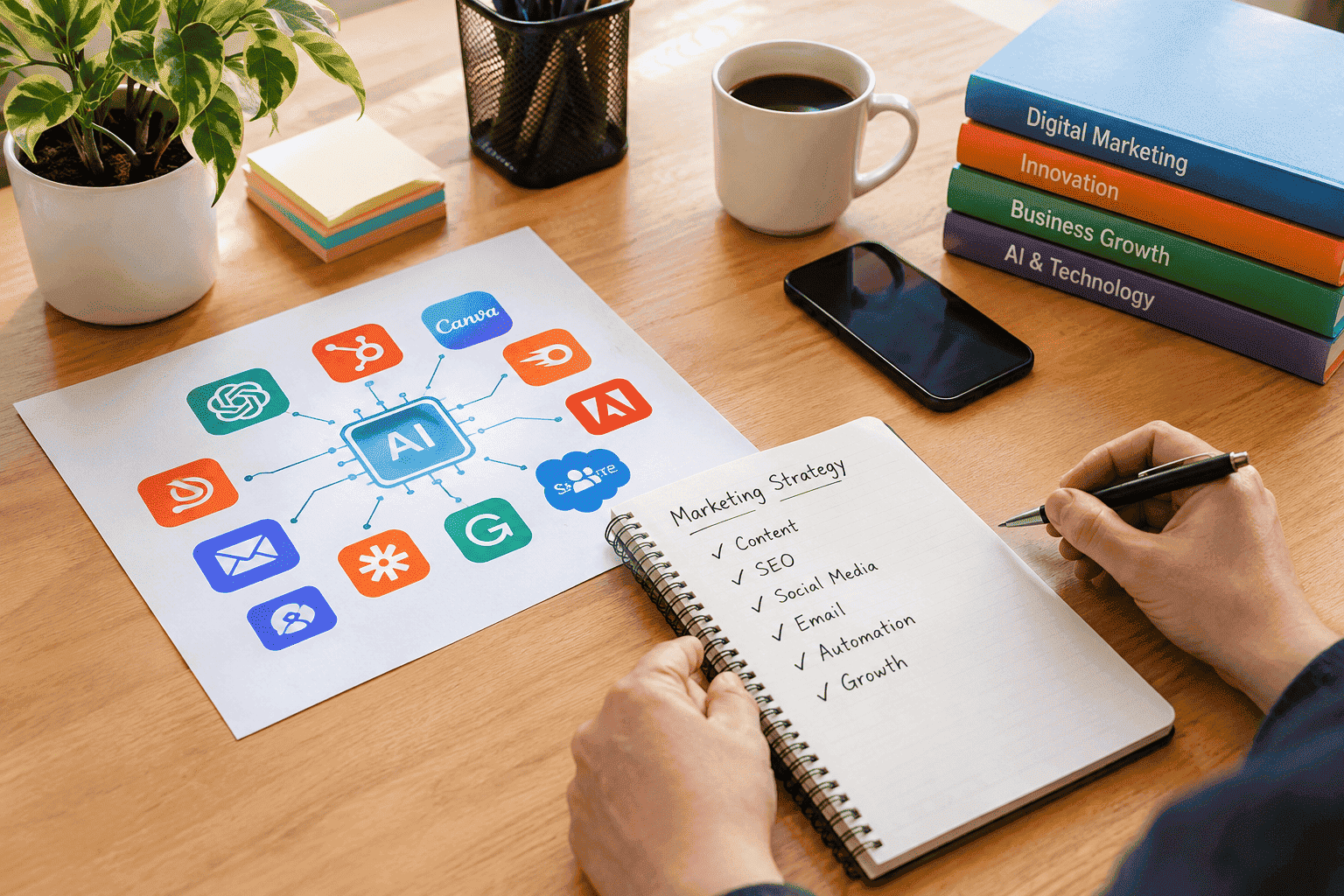
Artificial intelligence is changing how businesses approach marketing. What once required several hours of research, writing, design, analysis, and repetitive manual work can now be supported by AI-powered software.
In 2026, businesses can use AI marketing tools to create content, research customers, improve SEO, design visual campaigns, personalize emails, automate workflows, analyze marketing data, and identify opportunities across different channels.
However, having access to more AI tools does not automatically mean having a better marketing strategy. The real challenge is choosing tools that solve genuine business problems without creating unnecessary complexity.
Some platforms are designed for content and research. Others focus on SEO, visual design, CRM, email automation, analytics, or workflow management. The right choice depends on your business model, marketing goals, team size, budget, and existing technology stack.
This guide explores the best AI marketing tools for businesses in 2026, what each platform can help you accomplish, who can benefit from it, and how to build an effective AI marketing workflow without relying on automation for everything.
What Are AI Marketing Tools?
AI marketing tools are software applications that use artificial intelligence to support marketing activities.
Depending on the platform, they can help businesses with:
- Content research and creation
- SEO and search visibility
- Social media content
- Email marketing
- Customer segmentation
- Campaign planning
- Graphic design
- Marketing automation
- Customer relationship management
- Data analysis
- Personalization
- Reporting and optimization
AI marketing software can therefore support different stages of the customer journey, from initial research and awareness to conversion, retention, and reporting.
The important distinction is that AI is generally most useful as an assistant within a marketing workflow, rather than as a complete replacement for human strategy and judgment.
For example, ChatGPT can help marketing teams move from campaign ideas and research to content creation and performance analysis, while OpenAI’s own guidance emphasizes human review for accuracy, nuance, and final decisions.
Why Businesses Are Using AI Marketing Tools in 2026
Marketing teams are dealing with increasing amounts of content, customer information, campaign data, and communication channels.
AI can help reduce repetitive work and make information easier to process.
A marketer, for example, can use AI to:
- Research a target audience.
- Develop campaign ideas.
- Create an initial content brief.
- Produce several copy variations.
- Adapt the campaign for different channels.
- Analyze the resulting performance.
- Identify areas for improvement.
This does not eliminate the need for marketing expertise. Instead, it can reduce the time spent on repetitive tasks and allow marketers to spend more time on strategy, creativity, testing, and customer understanding.
Zapier’s 2026 review also highlights a growing problem: businesses can end up with too many overlapping AI tools. Its research found that 26% of professionals cited overlapping tools as a barrier to getting value from AI spending.
That makes tool selection especially important.
Best AI Marketing Tools for Businesses in 2026
The following tools cover different areas of marketing rather than attempting to rank every platform against the same criteria.
1. ChatGPT for Marketing Research and Content
ChatGPT is a flexible AI assistant that can support many parts of the marketing process.
Marketing teams can use it for:
- Campaign brainstorming
- Content briefs
- Blog outlines
- Email drafts
- Landing-page copy
- Advertising concepts
- Customer research
- Competitor research
- Content repurposing
- Data analysis
- Campaign summaries
OpenAI’s marketing guidance specifically describes use cases such as creating campaign content, researching competitors, generating messaging variations, analyzing campaign performance, and turning scattered information into practical marketing actions.
One advantage is flexibility. Instead of being limited to one marketing function, ChatGPT can be used at several stages of a campaign.
However, important marketing content should still be reviewed before publication. AI-generated information can require fact checking, editing, and adjustment to match the brand’s voice.
Best for: Businesses, agencies, content teams, freelancers, and marketers who need a flexible AI assistant for multiple tasks.
2. HubSpot Breeze for CRM and Marketing Automation
HubSpot combines CRM, marketing, sales, customer service, and automation capabilities, with AI features available through its Breeze system.
This makes it particularly relevant for businesses that want AI to work alongside customer and marketing data rather than operate as a separate writing tool.
Breeze can support activities such as content creation, campaign work, CRM-related tasks, and marketing workflows.
The biggest benefit comes when marketing information and customer information already live within the HubSpot ecosystem.
Best for: Growing businesses and marketing teams that want CRM, marketing automation, and AI capabilities within one platform.
3. Canva for AI-Powered Visual Marketing
Visual content is important for social media, advertising, websites, presentations, email campaigns, and other marketing channels.
Canva’s Magic Studio brings AI-powered features into its design platform. These include tools such as Magic Write, Magic Edit, Magic Eraser, and Magic Grab.
Businesses can use Canva to create:
- Social media graphics
- Advertisements
- Presentations
- Marketing banners
- Promotional materials
- Visual content variations
For smaller businesses without a dedicated designer, this can make routine visual production easier.
The platform is particularly useful when a marketing team needs to produce multiple assets while maintaining consistent branding.
Best for: Small businesses, startups, social media teams, creators, and marketing departments that frequently need visual content.
4. Semrush for SEO and Search Visibility
SEO remains an important source of organic visibility, but search is becoming more complex as users increasingly interact with AI-generated answers alongside traditional search results.
Semrush provides tools for keyword research, competitor analysis, technical SEO, rank tracking, content optimization, and other search-related activities.
Its AI Toolkit also tracks how brands appear in AI-generated answers across platforms such as ChatGPT, Google AI, Gemini, and Perplexity, according to its 2026 coverage in Zapier’s review.
This makes Semrush useful for businesses that want to monitor both conventional search performance and emerging AI-search visibility.
Best for: SEO professionals, agencies, publishers, SaaS companies, content teams, and businesses investing heavily in organic search.
5. Adobe Express for AI-Assisted Content Creation
Adobe Express is designed for creating visual marketing content without requiring every user to work inside more complex professional design software.
Businesses can use it for:
- Social media graphics
- Marketing designs
- Presentations
- Promotional materials
- Short-form visual content
- Image editing
Adobe has also continued adding AI-assisted capabilities to Express, making it easier to create and modify marketing assets through AI-supported workflows.
This can be useful for businesses that already use Adobe products or want a more accessible entry point into Adobe’s creative ecosystem.
Best for: Marketing teams, small businesses, creators, and organizations that need recurring visual content.
6. Salesforce Marketing AI for Customer-Focused Campaigns
Salesforce is particularly relevant to organizations that manage complex customer relationships and large amounts of CRM data.
Its AI capabilities can support marketing activities involving customer information, personalization, campaign creation, and customer engagement.
The advantage of this type of system is that AI can work within a broader customer-data environment rather than operating independently from the CRM.
However, Salesforce can be more appropriate for organizations with complex requirements than for a small business looking for a simple content-generation tool.
Best for: Medium-sized businesses and enterprises with sophisticated CRM and customer-data requirements.
7. ActiveCampaign for AI-Assisted Email Marketing
Email marketing becomes more powerful when campaigns respond to customer behavior rather than sending the same message to everyone.
ActiveCampaign combines email marketing, automation, customer segmentation, and behavioral workflows.
Its AI capabilities can assist with activities such as email content creation, campaign development, audience segmentation, predictive sending, and automation workflows. Zapier’s 2026 review identifies ActiveCampaign for AI-assisted email marketing and behavior-based automation.
Businesses can use these capabilities to build different journeys for subscribers, prospects, customers, and inactive contacts.
Best for: Ecommerce businesses, SaaS companies, service businesses, and teams that rely heavily on email automation.
8. Zapier for AI Marketing Automation
Zapier addresses a different marketing problem.
Rather than primarily helping marketers write or design content, it connects applications and automates workflows between them.
For example, a business could build a workflow where:
New lead → AI analysis → personalized email → CRM update → team notification
Zapier’s 2026 marketing-tool review describes integrations across thousands of applications and AI-supported workflow automation.
This is especially useful when employees repeatedly copy information from one platform to another.
Automation can save time, but businesses should first establish that the underlying workflow is actually useful before automating it.
Best for: Businesses with repetitive processes, agencies, sales teams, ecommerce companies, and organizations using multiple marketing applications.
9. Grammarly for Marketing Content and Editing
Marketing content needs to be clear, consistent, and appropriate for its audience.
Grammarly can help marketers identify writing issues, improve clarity, adjust tone, and refine content. Zapier’s 2026 review also highlights its brand-style capabilities and generative AI features.
It can be useful after the initial draft has been created.
For example, a marketer might use one AI tool to develop a first draft and Grammarly to refine grammar, readability, and style.
Best for: Writers, content teams, agencies, businesses producing large amounts of written communication, and professionals who want an additional editing layer.
10. Similarweb for AI Visibility and Market Research
As customers increasingly use AI systems during product research, businesses have a new visibility question:
Does my brand appear when potential customers ask AI systems about my market?
Similarweb has expanded its platform to include AI visibility tracking alongside its broader market and web intelligence capabilities.
Zapier’s 2026 review describes Similarweb’s AI Brand Visibility functionality as a way to monitor AI-related visibility and referral traffic.
This can help businesses understand how their brand is represented across emerging discovery channels.
Best for: Established businesses, SEO teams, agencies, market researchers, and companies interested in AI-search visibility.
11. FeedHive for AI-Assisted Social Media Management
Social media marketing requires a consistent flow of ideas and content.
FeedHive combines social media management with AI-assisted features for content creation, recycling, and conditional posting.
This can be useful when businesses want to reuse strong ideas instead of creating every social post completely from scratch.
For example, one successful piece of content could be adapted into several related posts and scheduled for different stages of a campaign.
Best for: Creators, agencies, social media managers, personal brands, and small businesses.
AI Marketing Tools Compared by Use Case
Choosing a tool becomes easier when you start with the marketing task instead of the software brand.
| Marketing Need | Tool | Main Purpose | Suitable For |
|---|---|---|---|
| Research and Content | ChatGPT | Research, brainstorming, writing, and analysis | Most business types |
| CRM and Marketing | HubSpot Breeze | CRM-connected AI and marketing workflows | Growing businesses |
| Visual Content | Canva | AI-assisted design and content creation | Small businesses and teams |
| SEO | Semrush | SEO, competitor research, and AI visibility | SEO-focused businesses |
| Creative Content | Adobe Express | Visual content and editing | Marketing teams |
| CRM-Driven Marketing | Salesforce | Customer data and personalized marketing | Larger organizations |
| Email Automation | ActiveCampaign | Email and customer journeys | Ecommerce and service businesses |
| Workflow Automation | Zapier | Connects apps and automates processes | Businesses with repetitive workflows |
| Content Editing | Grammarly | Writing quality and brand style | Content teams |
| AI Visibility | Similarweb | AI visibility and market intelligence | Established brands |
| Social Media | FeedHive | Social content and publishing workflows | Social media teams |
How to Choose the Right AI Marketing Tool
The best tool for your business should be selected according to your actual marketing needs.
Start With the Problem
Do not begin by asking which AI platform has the most features.
Begin with the problem.
For example:
- Content takes too long to produce.
- SEO research is inefficient.
- Designers are overloaded.
- Leads are not being followed up consistently.
- Email campaigns are difficult to personalize.
- Employees repeatedly move information between applications.
- Marketing reports take too long to prepare.
Once the problem is clear, the appropriate tool category becomes much easier to identify.
Check Existing Integrations
A new AI platform should ideally fit into your existing technology stack.
Before purchasing, check whether it works with the systems your business already uses, such as:
- CRM software
- Email platforms
- Analytics tools
- Ecommerce systems
- Websites
- Advertising platforms
- Social media channels
- Project-management software
A tool that integrates well with your existing systems can be more useful than a platform with a larger feature list but poor compatibility.
Consider Your Team’s Skill Level
A sophisticated platform is not necessarily the right choice for every team.
Consider:
- How many people will use it?
- How much training is required?
- Does the interface make sense to your team?
- Can non-technical employees use it?
- Does it provide useful documentation?
- Can multiple team members collaborate?
The goal is not simply to buy AI software. The goal is to make marketing work easier.
Review Data and Privacy Requirements
Marketing platforms can handle customer information, business data, campaign results, and other sensitive information.
Before connecting a tool to important business systems, review its:
- Data policies
- Security information
- User permissions
- Integration controls
- Data retention practices
- Compliance requirements
Businesses should avoid putting confidential information into AI systems without understanding how that information is handled.
Calculate the Real Cost
The subscription price is only one part of the cost.
Also consider:
- Implementation time
- Employee training
- Integration work
- Additional usage charges
- Number of required seats
- Existing tools that may become unnecessary
- Time saved by automation
A relatively inexpensive tool may become costly if it creates additional work.
AI Marketing Tools for Different Types of Businesses
Different businesses have different marketing requirements.
Small Businesses
Small businesses often benefit from flexible tools that cover several tasks without requiring a large technology budget.
A practical combination might include:
- AI assistant for research and content
- Design platform for visual assets
- Email or CRM platform
- Automation tool when repetitive workflows become a problem
Ecommerce Businesses
Ecommerce companies often need AI for:
- Product content
- Email marketing
- Customer segmentation
- Personalization
- Social media
- Customer support
- Campaign automation
The focus should be on tools that connect marketing activity with customer behavior and revenue.
SaaS Businesses
SaaS companies may prioritize:
- SEO
- Content marketing
- Lead generation
- CRM
- Email nurturing
- Product messaging
- Customer research
- Analytics
A combination of SEO, content, CRM, and automation tools can support these workflows.
Marketing Agencies
Agencies typically need tools that help them produce work efficiently across multiple clients.
Important requirements may include:
- Content production
- Visual design
- Reporting
- Workflow automation
- Collaboration
- Brand management
- Research
Agencies should also consider whether their tools make client approval and quality control easier.
Enterprise Businesses
Large organizations may require more sophisticated systems for:
- Customer data
- Personalization
- Governance
- Security
- Campaign management
- Analytics
- Automation
- Team collaboration
Enterprise businesses should evaluate AI tools as part of their broader technology architecture rather than purchasing them individually without integration planning.
How to Build an AI Marketing Stack in 2026
A business does not need dozens of AI subscriptions.
A practical AI marketing stack can start with a small number of tools.
Step 1: Identify One Bottleneck
Choose one process that consumes significant time or creates repeated manual work.
Step 2: Select One Appropriate Tool
Choose software specifically designed to improve that process.
Step 3: Create a Repeatable Workflow
Document how the tool will be used.
For example:
Research → AI draft → Human editing → Approval → Publishing → Performance analysis
Step 4: Establish Human Review
Decide which parts require human approval.
Content, advertising claims, customer communication, sensitive data, and important business decisions should not automatically be published or executed without appropriate review.
Step 5: Measure Results
Track meaningful business outcomes rather than simply measuring how much AI-generated content was produced.
Useful metrics can include:
- Leads
- Conversion rate
- Customer acquisition cost
- Revenue
- Organic traffic
- Email engagement
- Qualified opportunities
- Customer retention
Step 6: Add Automation Carefully
Once a workflow has been tested manually and produces reliable results, automate repetitive parts of the process.
Step 7: Remove Overlapping Tools
Regularly review your marketing stack.
If two tools perform nearly the same job, keeping both may add cost and complexity without creating additional value.
Common Mistakes Businesses Make With AI Marketing Tools
Publishing AI Content Without Review
AI can produce fluent content that still contains incorrect or unsuitable information.
Human review remains important for accuracy, originality, tone, and brand alignment.
Buying Too Many AI Tools
A large collection of subscriptions can create duplicated functionality and fragmented workflows.
Start with actual business problems instead.
Ignoring Brand Voice
AI-generated content can become generic if it is not given sufficient information about the business and its audience.
Create clear brand guidelines and review important customer-facing content.
Automating Poor Processes
Automation does not fix a bad workflow.
If the process is confusing before automation, automating it can simply make the problem happen faster.
Measuring AI Activity Instead of Business Results
The number of articles, emails, images, or social posts created by AI is not the same as marketing success.
Measure whether the work contributes to meaningful business outcomes.
Treating AI as a Complete Replacement for Marketers
AI can assist with research, content, analysis, and repetitive work, but strategic decisions still require context and human judgment.
OpenAI’s marketing guidance similarly recommends using AI as a thought partner and applying human judgment to final decisions.
A Practical AI Marketing Workflow
A simple workflow can help businesses introduce AI without disrupting their entire marketing operation.
Research
Use AI to organize market information, customer insights, competitor information, and campaign inputs.
Strategy
Define the target audience, business objective, offer, positioning, and campaign message.
Content Creation
Use AI to develop first drafts, variations, headlines, email concepts, and supporting content.
Human Review
Check facts, tone, brand consistency, originality, and compliance.
Publishing
Adapt the approved content for the appropriate marketing channels.
Measurement
Analyze traffic, engagement, leads, conversions, revenue, and other relevant KPIs.
Optimization
Use performance data to improve the next campaign rather than simply producing more content.
This creates a useful cycle:
Research → Strategy → AI Assistance → Human Review → Launch → Measurement → Optimization
Frequently Asked Questions About AI Marketing Tools
What are the best AI marketing tools for businesses in 2026?
There is no single AI marketing tool that is the right choice for every business. ChatGPT is useful for research, writing, brainstorming, and analysis; HubSpot Breeze connects AI with CRM and marketing workflows; Canva focuses on visual content; Semrush supports SEO and AI-search visibility; ActiveCampaign focuses on email automation; and Zapier connects marketing applications through automated workflows.
Are AI marketing tools useful for small businesses?
Yes. Small businesses can use AI marketing tools to reduce repetitive work, create marketing content, support customer communication, and organize workflows. The key is to choose a small number of tools that solve specific problems instead of subscribing to many overlapping platforms.
Can AI replace a marketing team?
AI can automate and accelerate many marketing activities, but it does not eliminate the need for strategy, customer understanding, creative judgment, fact checking, and quality control. The most practical approach is to use AI to support marketers rather than treating it as a complete replacement for human decision-making.
Which AI tools are useful for content marketing?
General AI assistants such as ChatGPT can support research, brainstorming, drafting, editing, and content repurposing. Specialized tools can add brand controls, SEO optimization, or workflow features. The right choice depends on the volume and type of content your business produces.
Which AI tools are useful for SEO?
Platforms such as Semrush can support keyword research, competitor analysis, technical SEO, content optimization, and monitoring of brand visibility in AI-generated search experiences. AI assistants can complement these platforms with research, content planning, and analysis.
Are AI-generated marketing materials ready to publish?
Not always. AI-generated content should be reviewed for accuracy, brand voice, originality, clarity, privacy, and compliance before publication.
How many AI marketing tools should a business use?
There is no universal number. A small business may only need a general AI assistant, a design platform, and an email or CRM system. Larger businesses may require specialized tools for SEO, analytics, automation, customer data, personalization, and campaign management.
How should businesses evaluate an AI marketing tool?
Start with the business problem it is expected to solve. Then evaluate its features, integrations, usability, data practices, scalability, total cost, and measurable impact on marketing performance.
Conclusion
AI marketing tools have become an important part of modern marketing in 2026. They can help businesses research faster, create content more efficiently, design visual assets, analyze information, personalize customer communication, improve search visibility, and automate repetitive workflows.
But adding AI to a marketing strategy is not simply about purchasing more software.
The most practical approach is to identify a genuine marketing bottleneck, choose a tool that addresses it, create a repeatable workflow, maintain human review, and measure the business results.
For one business, that may mean using ChatGPT for research and content. For another, it may mean combining HubSpot with AI-powered workflows. An SEO-focused company may benefit more from Semrush, while an ecommerce business may prioritize email automation and customer segmentation.
The goal is not to use the largest number of AI tools.
The goal is to build a simple, connected, and measurable marketing system where AI saves time while human expertise continues to guide the important decisions.
AI Overviews and Google Search