


Getting visitors to your website is only the first step toward online growth. The real challenge is turning those visitors into leads, customers, subscribers, or other meaningful business outcomes.
A website can attract thousands of visitors and still generate disappointing results if the traffic is poorly targeted, the user experience is confusing, or visitors cannot easily understand what to do next. A successful website growth strategy connects traffic generation with engagement, conversion, retention, and measurable business results.
This guide explains how to build that system from the ground up. You will learn how to attract relevant traffic, improve your website experience, create stronger conversion paths, measure performance, and turn existing traffic into sustainable business growth.
What Is a Website Growth Strategy?
A website growth strategy is a structured plan for increasing relevant website traffic and turning that traffic into measurable business results.
It brings several areas of digital marketing together, including:
- Search engine optimization
- Content marketing
- Conversion rate optimization
- User experience
- Analytics
- Landing page optimization
- Email marketing
- Paid acquisition
- Customer retention
Instead of focusing only on getting more visitors, the strategy looks at the complete customer journey:
Visibility → Traffic → Engagement → Conversion → Retention → Growth
For example, an SEO article may attract a visitor from Google. That visitor may then discover a relevant service page, explore the offer, and submit a contact form. If the lead is qualified and eventually becomes a customer, the original content has contributed to business growth.
Why Website Traffic Alone Is Not Enough
Traffic is important, but traffic volume does not automatically translate into revenue.
Imagine two websites.
The first receives 30,000 visitors every month but generates very few qualified leads. The second receives 7,000 visitors but has a highly relevant audience and generates significantly more inquiries.
The first website has more traffic, but traffic volume alone does not explain which website is creating more business value.
This is why a website growth strategy should consider:
- Traffic quality
- Visitor intent
- Engagement
- Conversion rate
- Leads
- Sales
- Revenue
- Returning visitors
- Customer value
The goal is not simply to increase the number of people arriving at your website. The goal is to increase the number of relevant people taking valuable actions.
Start With Clear Business Goals

Before changing your website, decide what you actually want it to achieve.
Different businesses need different outcomes.
An ecommerce website may focus on purchases and revenue. A service company may focus on qualified leads and consultation requests. A SaaS company may focus on free trials, demos, and subscriptions.
Common Website Goals
Depending on your business model, your goals may include:
- Generating qualified leads
- Increasing product sales
- Increasing online revenue
- Growing email subscribers
- Increasing consultation requests
- Generating demo bookings
- Increasing free-trial registrations
- Improving repeat purchases
- Increasing returning visitors
A clear goal makes it easier to determine which metrics matter.
Choose Meaningful KPIs
Do not try to make every available metric your primary KPI.
For example:
Your KPI should connect website activity to an actual business objective.
Attract the Right Website Traffic
A strong growth strategy starts with the right audience.
Getting visitors who have no interest in your product or service may increase traffic numbers without improving business performance.
Instead, focus on people who have a genuine need that your website can address.
Understand Search Intent
Search intent describes what a person is trying to accomplish when they enter a query into a search engine.
The major categories include:
- Informational intent
- Commercial investigation
- Transactional intent
- Navigational intent
For example:
Informational:
“What is conversion rate optimization?”
Commercial:
“Best conversion optimization tools”
Transactional:
“Buy conversion optimization software”
Navigational:
“Google Analytics login”
Understanding intent helps you create content that matches what people actually want.
Build Content Around Important Topics
Instead of publishing random articles, organize content around topics that matter to your audience and business.
For a digital marketing website, a broader website growth topic could connect with supporting subjects such as:
- SEO strategy
- Website analytics
- Conversion optimization
- Landing page optimization
- Content marketing
- A/B testing
- Checkout optimization
- Digital growth metrics
This creates a more organized content ecosystem and gives visitors logical paths to discover related information.
Strengthen Your SEO Strategy
SEO can provide a long-term source of relevant website traffic when it is based on useful content and genuine search intent.
A strong SEO strategy should focus on more than inserting keywords into pages.
Perform Relevant Keyword Research
Choose keywords based on:
- Search intent
- Relevance to your audience
- Business value
- Competition
- Topic depth
- Potential conversion opportunities
A keyword with a lower search volume can still be valuable if it attracts visitors who are more relevant to your business.
Create Useful, Search-Focused Content
Every article should have a clear purpose.
Good content should:
- Answer the user’s question
- Explain the topic clearly
- Provide practical information
- Use logical headings
- Include relevant examples
- Link to related resources
- Avoid unnecessary repetition
- Give readers an appropriate next step
The objective is to satisfy the visitor first while naturally making the content understandable to search engines.
Improve Internal Linking
Internal links connect related pages within your website.
For example, an article about website growth could naturally link to pages covering:
- Website Analytics
- Conversion Rate Optimization
- Digital Growth Metrics
- Landing Page Optimization
- SEO Strategy
Use descriptive anchor text that makes sense in context rather than forcing keywords into every sentence.
Create Better Landing Pages
Getting someone to your website does not guarantee that they will take action.
Your landing pages should quickly answer three important questions:
What do you offer?
Why should the visitor care?
What should they do next?
Create a Clear Value Proposition
Visitors should understand the main benefit of your product, service, or resource without having to search through the page.
Avoid vague statements that could apply to almost any business.
Explain:
- The problem you solve
- Who you help
- What you provide
- Why your solution matters
Use Relevant Supporting Information
Depending on the page, useful supporting information may include:
- Features
- Benefits
- Pricing
- Process
- Examples
- Case studies
- Testimonials
- FAQs
- Policies
- Contact information
The amount of information should match the complexity of the offer.
Use a Clear Call to Action
Every important landing page should have a logical next step.
Examples include:
- Request a Quote
- Book a Consultation
- Start a Free Trial
- Request a Demo
- Contact Us
- Buy Now
- Subscribe
- Download the Guide
The CTA should match the visitor’s intent and the purpose of the page.
Improve the Website User Experience
Even excellent content can underperform if the website is difficult to use.
Review the entire user journey and look for unnecessary friction.
Important areas include:
- Navigation
- Page layout
- Readability
- Mobile usability
- Page speed
- Forms
- Buttons
- Search
- Checkout
- Error messages
- Accessibility
Reduce Unnecessary Friction
Suppose a visitor wants to request a quote but encounters a long form asking for information that is not necessary at the first stage.
Some visitors may leave.
Similarly, if an ecommerce checkout contains unnecessary steps, customers may abandon their purchase.
Make important actions as straightforward as possible.
Optimize for Mobile Visitors
Mobile usability should be an important part of your website growth strategy.
Review your website on different screen sizes and check:
- Text readability
- Button sizes
- Navigation
- Forms
- Images
- Page spacing
- Pop-ups
- Checkout
- Loading performance
Visitors should be able to read content, navigate pages, and complete important actions without unnecessary difficulty.
Use Analytics to Understand Visitor Behavior
Analytics should be used to understand what is happening on your website, not simply to report the number of visitors.
Ask questions such as:
- Where are visitors coming from?
- Which pages attract the most relevant traffic?
- Which pages receive strong engagement?
- Which pages generate leads?
- Where do users leave?
- Which channels produce valuable visitors?
- Which landing pages need improvement?
- Which content contributes to conversions?
Connect Traffic With Business Actions
A useful measurement journey can look like:
Traffic Source → Landing Page → Engagement → Key Action → Lead or Sale
For example:
Organic Search → Blog Article → Service Page → Contact Form → Qualified Lead
This helps you understand how different parts of your website contribute to business growth.
Check Your Tracking Setup
Before making strategic decisions, make sure important actions are being measured correctly.
Check:
- Analytics installation
- Form tracking
- Key events
- Ecommerce tracking
- Campaign tracking
- Conversion tracking
- Important landing pages
Incorrect tracking can lead to incorrect conclusions.
Improve Conversion Rates
Conversion rate optimization focuses on increasing the percentage of visitors who complete a desired action.
The basic formula is:
Conversion Rate = Conversions ÷ Visitors × 100
For example, if 4,000 visitors produce 80 conversions:
80 ÷ 4,000 × 100 = 2%
Improving conversion performance can sometimes produce meaningful gains without requiring the same proportional increase in traffic.
Areas to Test
You can test elements such as:
- Headlines
- CTA wording
- Button placement
- Forms
- Page layouts
- Product descriptions
- Pricing presentation
- Trust signals
- Images
- FAQs
- Navigation
- Checkout steps
Each test should have a clear reason behind it.
Connect Content With Conversion Opportunities
Informational content can become more valuable when it provides a natural path toward relevant commercial pages.
For example, someone reading an article about improving website performance may also need information about analytics or conversion optimization.
A logical journey might look like:
Helpful Article → Related Resource → Service Page → CTA
The goal is not to push every visitor toward a sale.
Instead, give visitors the most useful next step based on what they are currently trying to accomplish.
Build Trust With Visitors
Visitors may hesitate to take action if they do not trust the website or business.
Useful trust elements can include:
- Genuine customer reviews
- Testimonials
- Case studies
- Clear pricing
- Transparent policies
- Professional contact information
- Author information
- Credentials
- Real examples
- Product demonstrations
Only use information that is genuine and verifiable.
Avoid fake reviews, fabricated statistics, or exaggerated claims because they can damage credibility.
Use Calls to Action Strategically
A call to action should tell visitors what they can do next.
Examples include:
- Get a Quote
- Book a Consultation
- Start a Free Trial
- Download the Guide
- Request a Demo
- Shop Now
- Subscribe
- Contact Us
- Learn More
Match the CTA to the Customer Journey
A person reading an introductory educational article may not be ready to purchase immediately.
A better next step could be:
Read the Related Guide
or:
Subscribe for More Insights
Someone visiting a detailed service page may be ready for:
Request a Consultation
The CTA should reflect the visitor’s level of intent.
Use Content Updates as a Growth Opportunity
Website growth does not always require publishing new content.
Existing pages may already have:
- Search visibility
- Organic traffic
- Backlinks
- Internal links
- Existing engagement
- Business relevance
Review older pages and look for opportunities to improve them.
What to Update
You may be able to:
- Replace outdated information
- Improve weak sections
- Add useful examples
- Improve headings
- Add relevant internal links
- Strengthen calls to action
- Improve introductions
- Remove unnecessary content
- Add missing FAQs
Improving an existing page can be more efficient than constantly publishing new content without evaluating what is already working.
Diversify Your Traffic Sources
Relying entirely on one traffic source can create unnecessary risk.
Depending on your business, your website may receive visitors from:
- Organic search
- Direct traffic
- Referral websites
- Social media
- Email marketing
- Paid advertising
- Online communities
- Partnerships
- Video platforms
- AI-driven discovery
The right mix depends on your audience, resources, business model, and customer journey.
Use Email to Bring Visitors Back
A website visitor may leave without becoming a customer.
Email marketing can provide a way to maintain a relationship with interested visitors.
You can use email for:
- Newsletters
- New article notifications
- Educational resources
- Product updates
- Follow-up sequences
- Relevant offers
- Industry insights
The goal should be to build a useful relationship rather than simply sending more messages.
Test Website Changes Carefully
A/B testing can help compare different versions of a webpage or element.
For example, you might compare two CTA versions:
Version A: Get Started
Version B: Request a Consultation
You could also test:
- Headlines
- Page layouts
- Form lengths
- Images
- Pricing presentation
- CTA placement
The test should have a clear hypothesis and a meaningful measurement.
Do not declare a change successful simply because it received more clicks if those clicks do not contribute to the actual business objective.
Measure the Right Website Growth Metrics
A useful dashboard should include metrics from different stages of the customer journey.
No single metric tells the entire story.
For example, high traffic with weak conversions may indicate that the audience or landing experience needs improvement. Strong engagement with few conversions may indicate that visitors find the content useful but are not being given a relevant next step.
Prioritize Growth Opportunities
You do not need to change everything at once.
A practical way to prioritize improvements is to consider:
Potential impact × confidence ÷ effort
A high-impact, relatively low-effort improvement may deserve attention before a complicated project with uncertain benefits.
Example Priorities
A business might discover:
- A high-traffic page has no clear CTA.
- A valuable service page receives little internal traffic.
- A contact form contains unnecessary fields.
- Several articles have outdated information.
- Important conversion events are not being tracked.
These issues can then be organized into a practical action plan.
Build a 90-Day Website Growth Plan
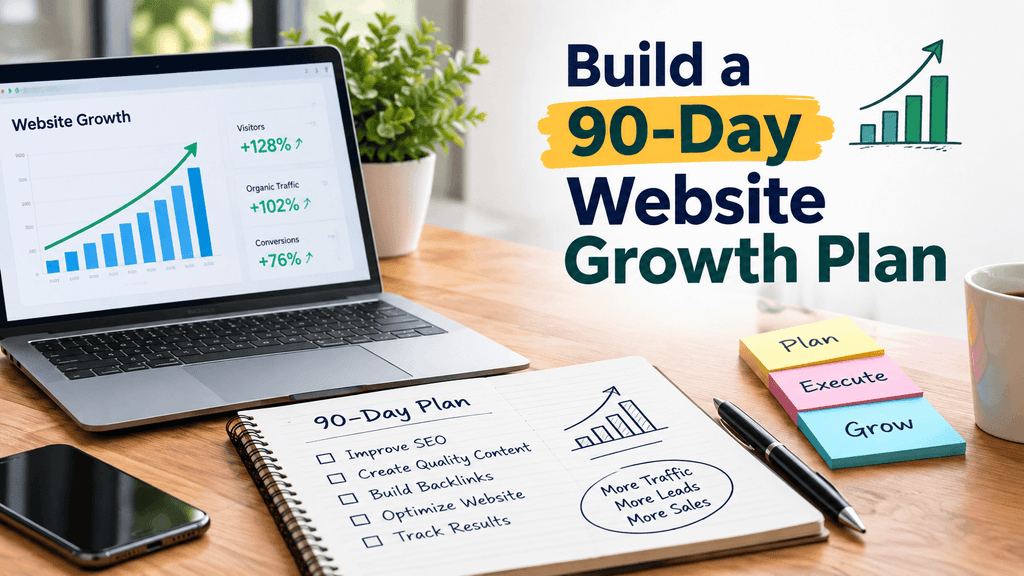
A structured plan makes it easier to turn strategy into action.
Days 1–30: Audit and Fix
Review:
- Analytics
- SEO
- Content
- Technical issues
- Mobile usability
- Conversion paths
- Internal linking
- Landing pages
- Calls to action
Fix important tracking and technical problems first.
Days 31–60: Improve High-Opportunity Pages
Identify pages that already have meaningful traffic or search visibility.
Improve:
- Content quality
- Search intent alignment
- Page structure
- Internal links
- CTAs
- Trust signals
- Conversion paths
Focus on pages where improvements can realistically affect business outcomes.
Days 61–90: Test and Scale
Begin controlled experiments on important pages.
Test:
- Headlines
- CTAs
- Forms
- Landing-page elements
- Content upgrades
- Internal-link paths
Continue improving the strategies that demonstrate useful results.
Common Website Growth Mistakes
Focusing Only on Traffic
More visitors do not automatically mean more customers.
Publishing Without a Clear Strategy
Publishing unrelated articles can create a large website without creating a strong growth system.
Ignoring Existing Content
Older pages may already have valuable search visibility and traffic.
Using Weak Calls to Action
Visitors may leave when they cannot understand what to do next.
Relying on One Metric
Traffic, engagement, conversions, and revenue should be considered together.
Ignoring Mobile Users
A poor mobile experience can create unnecessary friction.
Changing Everything at Once
Making too many changes simultaneously makes it difficult to determine which change affected performance.
Chasing Vanity Metrics
Page views, impressions, and social followers can be useful indicators, but they should not replace business-focused measurements.
A Practical Website Growth Framework
A simple framework can help keep your strategy organized:
1. Attract
Bring relevant visitors through SEO, content, referrals, social media, email, or paid channels.
2. Engage
Provide useful content and an easy-to-use website experience.
3. Convert
Give visitors clear and relevant opportunities to become leads or customers.
4. Measure
Track important actions and business outcomes.
5. Improve
Use the data to identify weaknesses and opportunities.
6. Retain
Give customers reasons to return, purchase again, subscribe, or continue using your service.
This creates a continuous growth cycle instead of a one-time marketing campaign.
How SEO, Content, CRO, and Analytics Work Together
A successful website growth strategy connects multiple activities.
SEO helps people discover your website.
Content answers questions and solves problems.
User experience makes the website easier to navigate.
Conversion optimization helps visitors take meaningful actions.
Analytics shows what users are doing.
Business metrics show whether those activities are producing meaningful results.
The complete journey can be summarized as:
Visibility → Relevant Traffic → Useful Experience → Action → Customer → Business Growth
When one stage is weak, the overall system can underperform.
Website Growth Strategy Checklist
Before considering your strategy complete, review the following:
- Is your website attracting the right audience?
- Does each important page have a clear purpose?
- Does your content match search intent?
- Are related pages connected through internal links?
- Are your landing pages easy to understand?
- Are your CTAs clear?
- Is your website easy to use on mobile devices?
- Are forms and checkout processes simple?
- Is analytics tracking important actions?
- Can you identify your most valuable traffic sources?
- Are high-opportunity pages being improved?
- Are weak pages being diagnosed?
- Are you measuring leads, sales, or another meaningful business outcome?
- Are you testing important changes?
- Are you regularly reviewing your website growth strategy?
FAQs
What is a website growth strategy?
A website growth strategy is a structured plan for attracting relevant visitors, improving their experience, generating meaningful actions, and turning website activity into measurable business growth.
How do I turn website traffic into business growth?
Start by attracting relevant visitors, matching content with search intent, improving landing pages, creating clear conversion paths, building trust, and measuring meaningful business actions.
Is more website traffic always better?
No. Traffic quality and relevance matter. A smaller audience with strong buying intent can be more valuable than a large audience that has little interest in your products or services.
What metrics should I track for website growth?
Useful metrics include users, sessions, traffic sources, engagement rate, engagement time, key events, leads, conversion rate, revenue, and returning users. The right combination depends on your business model.
How does SEO contribute to website growth?
SEO can help your website attract people searching for relevant information, products, and services. When search traffic is combined with useful content and effective conversion paths, it can contribute to long-term business growth.
How can I improve my website conversion rate?
Identify where visitors are leaving or failing to complete important actions. Then review your value proposition, CTAs, forms, trust signals, navigation, landing pages, and checkout process. Test changes systematically where possible.
Should I focus on SEO or paid advertising?
The right approach depends on your goals, audience, budget, competition, and time horizon. SEO can support long-term organic visibility, while paid advertising can provide more controlled acquisition. Many businesses use a combination of channels.
How often should I review my website growth strategy?
Review important performance data regularly and conduct deeper strategic reviews periodically. The appropriate frequency depends on your traffic, business model, campaigns, and how quickly your market changes.
Conclusion
A strong website growth strategy is about much more than increasing traffic. The real objective is to attract the right audience, provide a useful experience, guide visitors toward meaningful actions, and measure the resulting business impact.
Start with clear goals. Build traffic around relevant audiences and search intent. Improve your content, landing pages, internal linking, user experience, and calls to action. Then use analytics to understand what visitors do after they arrive.
Most importantly, treat website growth as an ongoing process.
Your website should continuously attract, engage, convert, measure, and improve. When these elements work together, traffic has a much better opportunity to become leads, customers, revenue, and sustainable business growth.
AI Overviews and Google Search