

If you have ever read an article on a site and noticed the author is not part of the team, you have already seen guest posting. So, what is guest posting, and is it still worth your time in 2026? In short, it is writing an article for another website to share your knowledge with that site’s audience.
This guide answers the question “what is guest posting?” and also covers how it works, who it helps and how to start. You will also see where guest posting goes wrong, because Google has clear rules about it. If you are brand new, read this first, then move on to our guide on how to pitch a guest post.
What Is Guest Posting?
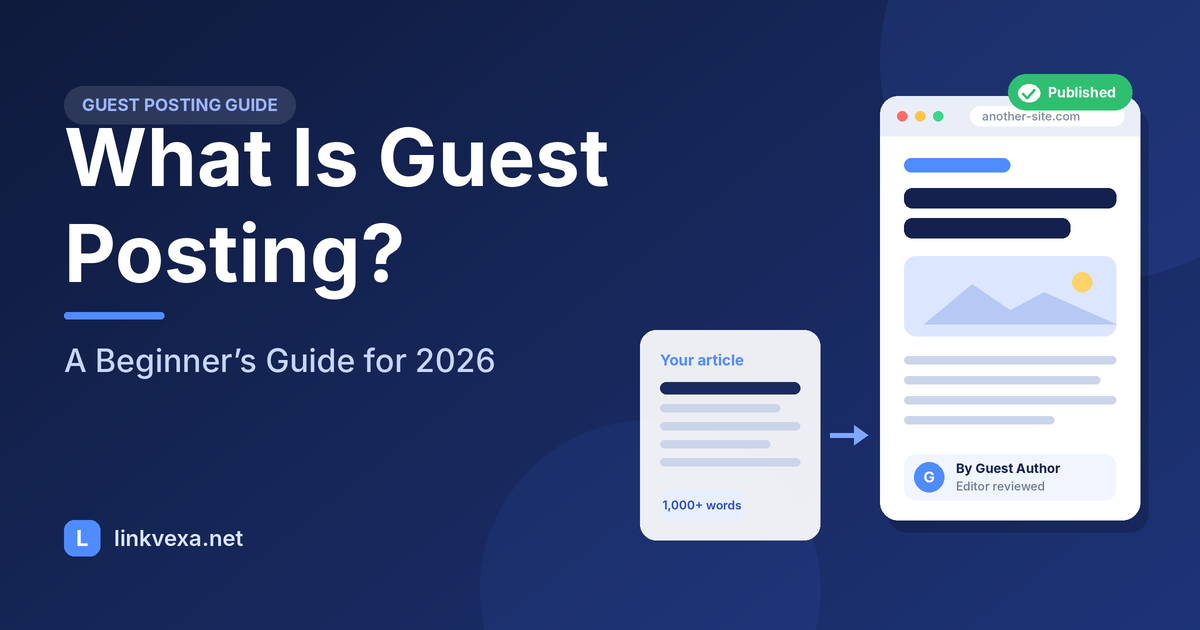
Guest posting (also called guest blogging) means writing and publishing an article on a website that you do not own. The site’s editor reviews it, and if it fits the audience and meets the quality standards, it goes live under your name with a short author bio.
Three things make a real guest post:
- It is original. The article is written for that site and is not published anywhere else.
- It is useful to the readers. The topic helps the site’s audience, not only the author.
- It is edited. A real editor decides what is published and can ask for changes.
The last point matters most. A guest post is a contribution that an editor chose to publish. It is not a purchase, and it is not a way to place links on any page that will take them.
How Guest Posting Works
What is guest posting in practice? The process is the same on almost every publication, even though the details differ:
- The writer finds a fitting site. They read its guidelines and recent articles to see what it publishes.
- The writer sends a pitch. A short email with a title, an outline and proof of expertise. Our guide on how to pitch a guest post has a template.
- The editor approves or declines. Many publications reply within a week or two.
- The writer submits the article. It follows the site’s word count, tone and link rules.
- The editor reviews and edits it. Facts, sources and links are checked, and the writer may revise.
- The article is published. It appears with an author bio and, where allowed, a link to the writer’s own site or profile.
At Linkvexa, the rules for each step are on the Guest Post Guidelines page.
Why People Write Guest Posts
What is guest posting really worth to writers? It is not only about links. For writers, consultants and small businesses, the real benefits are broader:
- A new audience. You reach readers who would never find your own blog.
- Credibility. Being published by an editor-reviewed site shows that someone other than you thinks your work is good.
- A portfolio. Published articles prove you can write and that you know your subject.
- Relationships. You get to know editors, other contributors and people in your field.
- Referral traffic and brand awareness. Readers who like the article may visit your site or look up your name.
A link in your author bio can help people find you, but it should be a side effect of a good article, not the reason for writing it.
Why Websites Accept Guest Posts
Publishers also gain from guest posting, which is why good guest posting exists in the first place:
- They get fresh ideas and real, first-hand experience from practitioners.
- They cover topics and regions that a small in-house team could not.
- They offer readers more than one voice and viewpoint.
- They build a community of contributors who share the articles with their own audiences.
This is why editors who care about quality are open to guest posts, as long as the article is better than what they could write themselves. Our Editorial Standards explain what we expect from every article we publish.
Types of Guest Posting
What is guest posting beyond the basic definition? Not all guest posting is the same, and knowing the types helps you choose the right one.
1. Editorial guest posts. You pitch, the editor chooses, and the article is published on merit. There is no payment for the placement. This is the healthiest model and the one we recommend.
2. Expert columns. Some publications invite specialists to write a regular column. These are usually by invitation and based on reputation.
3. Guest post exchanges. Two site owners agree to publish each other’s articles. This can work when both sites are relevant and the articles are good, but exchanges made only to swap links look like manipulation.
4. Sponsored or paid posts. Some sites sell content placements. These must be clearly labelled, and links in them should use the appropriate link attributes. Paid links that pass ranking credit break Google’s rules, as explained below.
Is Guest Posting Still Worth It in 2026?
Yes, but only the right kind. Guest posting has a mixed reputation because for years some people used it to mass-produce low-quality articles with links. Google addresses this directly in its spam policies on link spam, which cover buying or selling links that pass ranking credit and large-scale article campaigns with keyword-rich anchor text.
That does not mean that guest posting is banned. It means that guest posting done for readers is fine, and guest posting done only to manipulate rankings is a risk. In practice:
- Quality beats quantity. One strong article on a relevant site is worth more than ten thin ones on random sites.
- Relevance matters. A guest post about analytics belongs on a site about analytics, not on an unrelated blog.
- Reputation travels. Your name on good articles builds trust with readers and editors, which may help people find and trust your work wherever they look for answers.
- Links should be natural. Link only when the link helps the reader, and use sources, not only your own pages.
If you treat guest posting as publishing and relationship building, not as link building, it stays useful even as search keeps changing.
What Makes a Good Guest Post?
A good guest post does what the site’s own best articles do. Before you submit, check these points:
- A specific topic. Reader, problem and result are clear. “Why content marketing matters” is too broad; “How a two-person agency planned 90 days of content” is specific.
- First-hand experience. Include something you tested, measured, fixed or learned.
- Accurate, sourced claims. Name your sources and do not make claims you cannot support.
- Clear structure. Short paragraphs, helpful headings and a direct opening.
- No hidden promotion. The article teaches. It does not sell.
- Original writing. It is written by you, for this site only.
These match the principles in Google’s guidance on helpful, people-first content, which asks whether content shows first-hand expertise and is made primarily for people.
Guest Posting Do’s and Don’ts
Do:
- Read the site’s guidelines and recent articles before pitching.
- Pitch a specific angle with an outline.
- Write for the site’s readers.
- Keep your author bio short and honest.
- Promote your published article and thank the editor.
Don’t:
- Send the same email to dozens of sites.
- Ask for a link or a specific anchor text in the first message.
- Submit articles you have already published elsewhere.
- Pay for placement without clear labelling and proper link attributes.
- Stuff the article with links to your own pages.
How to Start Guest Posting as a Beginner
If you are new and still asking “what is guest posting?”, keep the plan simple:
- Choose your topic area. Pick the one or two subjects you know best, based on your real work.
- List five relevant sites. Look for publications that your target readers already trust and that accept contributors.
- Read their guidelines and recent articles. Note word count, tone and topics they have already covered.
- Write one specific pitch for each. Use a short template and mention something real about the site.
- Write the article only after approval. Follow the guidelines exactly and send it on time.
- Learn from every answer. A decline is usually about topic or fit, not about you. Ask whether a different angle would work.
Many contributors are accepted after a few pitches, not on the first one.
Frequently Asked Questions About Guest Posting
What is guest posting in simple words?
It is writing an article for someone else’s website so that its readers see your work. An editor reviews it before it goes live.
Is guest posting the same as guest blogging?
Yes. The two terms mean the same thing: writing an article for a website that you do not own.
Is guest posting good for SEO?
It can help indirectly through visibility, referral traffic and brand recognition. Links in guest posts are only one possible benefit, and Google’s spam policies warn against using guest posts mainly to manipulate rankings.
Do I have to pay to publish a guest post?
Not on editorial sites. Be careful with sites that charge for placement; if you do pay, the content should be clearly labelled as sponsored and links should use the right attributes.
How long should a guest post be?
It depends on the site. Many publications ask for 1,000 words or more. Always follow that site’s guidelines.
Can I guest post if I have no published work?
Yes. Share a sample paragraph, a LinkedIn post or a case study that shows your knowledge, and offer a specific angle based on your own experience.
How many links can I include?
Only as many as help the reader. Many editors allow one or two links in the bio or body, and they will usually ask you to cite other sources as well.
Ready to Write for Linkvexa?
Now you know the answer to “what is guest posting?” and how to do it well. If you work in SEO, content strategy, analytics or AI search and have something you tested yourself, we would like to read your idea. Read our Guest Post Guidelines, see what we publish in Welcome to Linkvexa Contributors, and send your pitch through the Write for Us page.