


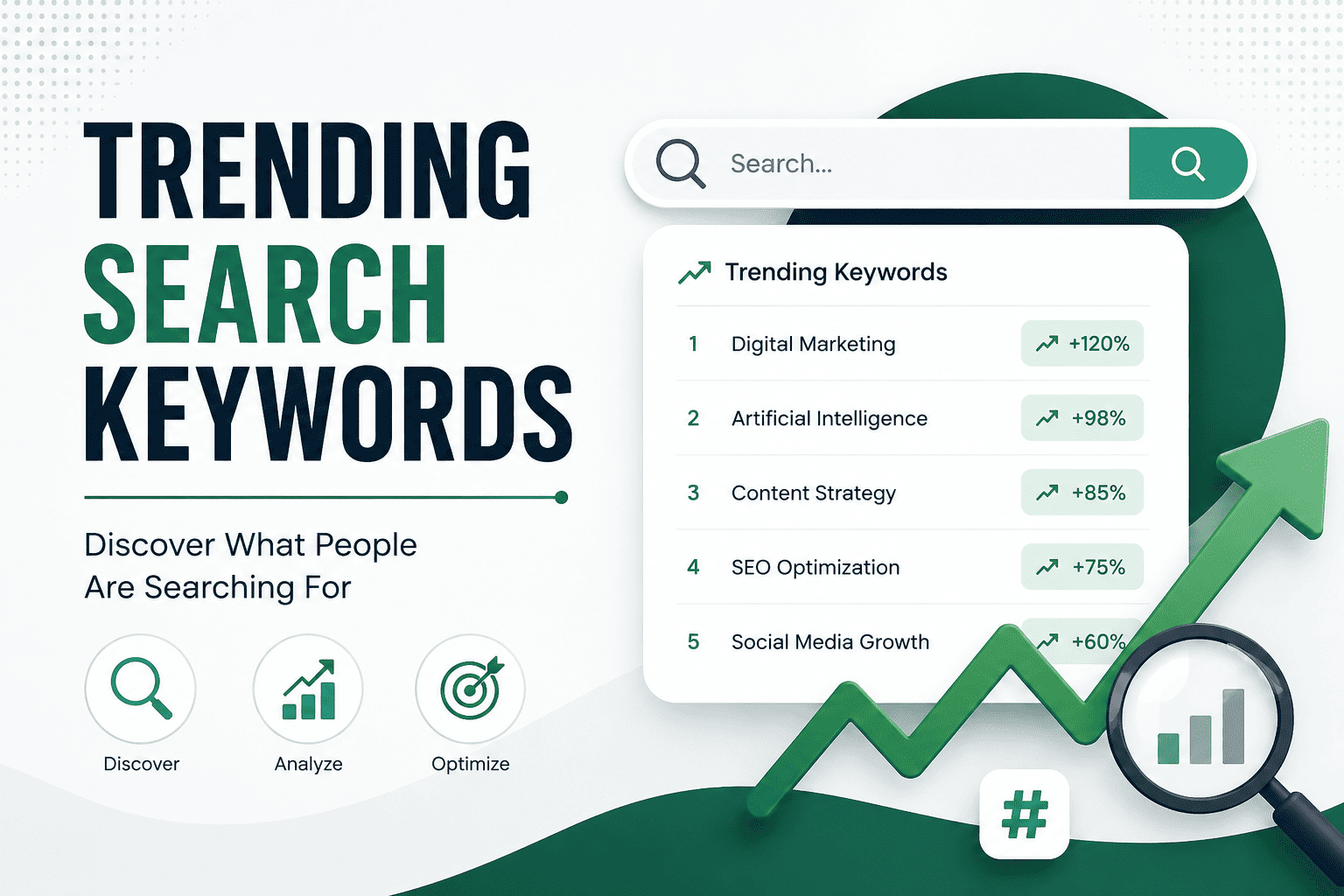
Search behavior can change remarkably quickly. A topic that receives little attention today can become a major search interest tomorrow because of a product launch, breaking news, seasonal event, emerging technology, or a change in consumer behavior.
For SEO professionals, content creators, publishers, and businesses, these changes can reveal valuable opportunities. Keyword research shows what people are increasingly interested in and, more importantly, what they may want to learn, compare, buy, or understand.
However, finding a rising keyword is only the beginning. A trend should be evaluated carefully before it becomes part of a content strategy. You need to understand whether the growth is genuine, seasonal, temporary, geographically limited, or driven by a single event.
This guide explains how to find trending search keywords, interpret Google Trends data correctly, evaluate search intent and competition, and turn worthwhile trends into useful content.
What Are Trending Search Keywords?
Trending search keywords are search queries that experience a noticeable increase in search interest during a particular period.
A trend may be triggered by a breaking-news event, product release, seasonal occasion, cultural moment, technological development, or emerging consumer need.
The important distinction is that trending does not simply mean popular.
A keyword can have consistently high search demand without currently trending. A trending keyword, on the other hand, is associated with a recent or unusual change in search interest.
For example, searches for a major newly released smartphone may rise sharply after its announcement. Searches for holiday-related products may increase at roughly the same time each year. A breaking-news query may spike within hours and then decline just as quickly.
Google Trends can help investigate these patterns. Its data is based on an aggregated and anonymized sample of Google searches and is normalized on a scale from 0 to 100 within the selected comparison. Google Trends Help: FAQ about Google Trends data
Trending Keywords vs. Popular Keywords
Although the terms are related, they represent different types of search behavior.
A popular keyword generally has strong and relatively consistent demand.
A trending keyword is showing a meaningful change in interest over a particular period.
For example, a broad keyword can remain popular throughout the year, while a newly announced product may suddenly become a trending search.
Both types can be valuable. Evergreen keywords can support long-term visibility, while relevant trending keywords can help identify emerging opportunities.
Why Search Trends Change
Search interest changes for many reasons, including:
- Breaking news
- Product launches
- Major events
- Seasonal demand
- New technologies
- Changes in consumer behavior
- Entertainment releases
- Public discussions
- Economic developments
- Unexpected events
Understanding the reason behind a trend is essential because the cause often tells you whether the opportunity is likely to last.
Why Trending Search Keywords Matter
Trending keywords can provide more than ideas for individual articles. When analyzed properly, they can reveal changes in audience interests and help shape a broader content strategy.
Discover Emerging Topics
A rising search can provide an early signal that people are becoming interested in a subject.
For example, a technology website may notice increasing searches around a newly released AI feature. Instead of immediately writing a generic article about the feature, the publisher can investigate related queries to discover what users actually want to know.
The opportunity may turn out to be a tutorial, comparison, review, or troubleshooting guide rather than a general overview.
Find Timely Content Opportunities
Some searches have a limited window of high interest.
A product announcement, major event, or developing story can generate a rapid increase in searches. Publishing useful information while the topic is relevant can make timing an important part of the editorial strategy.
Speed, however, should never replace accuracy. A quickly published article containing incorrect information can damage trust and provide little lasting value.
Understand Audience Interests
Search trends can also reveal the questions and subjects attracting attention within a market.
When combined with customer research and industry knowledge, these insights can help businesses improve:
- Content calendars
- Product education
- Marketing campaigns
- FAQ resources
- Editorial planning
- New content ideas
The strongest use of trend data is therefore not simply “find a keyword and write an article.” It is to understand what changed in audience behavior and why.
How to Find Trending Search Keywords
A reliable trend-research process combines Google Trends with search suggestions, related searches, competitor research, and knowledge of your audience.
Use Google Trends
Google Trends is one of the most useful tools for researching changes in search interest.
Start with a broad topic related to your audience. Then examine:
- Interest over time
- Related topics
- Related searches
- Rising searches
- Geographic interest
- Different comparison periods
Google Trends allows users to explore search interest over time, compare terms, and examine geographic patterns. Google Trends Help
Explore Trending Searches
Google Trends’ Trending Now experience is designed to surface searches experiencing recent surges.
Google states that Trending Now covers more than 100 countries and regions where available and provides recent trend information that is refreshed frequently. Google Trends Help: Trending Now
This can be useful for discovering what is attracting attention right now.
However, not every trending search is an SEO opportunity. Some trends are:
- Too short-lived
- Unrelated to your audience
- Primarily news-driven
- Difficult to cover accurately
- Extremely competitive
- Missing meaningful informational intent
Always validate a trend before turning it into content.
Analyze Rising Searches
Google Trends can show Rising searches associated with a topic.
These searches have experienced significant growth during the selected comparison period. Google may label a query Breakout when its growth exceeds 5,000%. Google Trends Help: Related searches
A crucial point is that percentage growth should not be confused with absolute search volume.
If a query increases dramatically from a very small starting point, its percentage growth can be enormous without representing a large number of searches.
This is why rising-search data should be treated as a growth signal, not a direct measurement of traffic potential.
Compare Search Terms
Comparing closely related terms can help identify differences in search behavior.
For example, if you are researching a new technology topic, compare several related phrases rather than assuming the first keyword you find is the best target.
Look for differences in:
- Growth
- Seasonality
- Geographic interest
- Search wording
- Related queries
This can help you choose terminology that better matches what your target audience is actually searching for.
Use Google Search Suggestions
Google Search suggestions can reveal how people phrase their questions.
Start typing a broad topic and examine the suggested completions.
For example, a website covering home technology might explore variations such as:
- smart home devices
- smart home security
- smart home setup
- smart home automation
These suggestions can uncover useful language and content ideas.
They should not, however, be treated as exact search-volume data.
Analyze Related Searches
Related searches can expose adjacent questions and concepts around your primary topic.
Instead of creating multiple thin pages for tiny keyword variations, use these searches to determine what information belongs together in a comprehensive resource.
They can help you discover opportunities for:
- Tutorials
- Comparisons
- Explanations
- FAQs
- Supporting articles
- Topic clusters
Monitor Industry and Competitor Trends
Competitor research can help identify subjects receiving increasing attention within your industry.
Look for patterns rather than copying individual articles.
If several credible publishers are expanding their coverage of a particular subject, investigate why.
Then ask:
Can I provide information that is more complete, more current, more practical, or better suited to my audience?
That question is more valuable than simply asking which competitor keyword you should copy.
How to Analyze a Trending Keyword
Finding a rising keyword is not enough to justify publishing content.
Before investing resources, evaluate the trend from several angles.
Check Search Interest Over Time
Start by looking at the trend graph.
Ask:
- Is interest rising steadily?
- Was there only one sharp spike?
- Has the keyword appeared before?
- Is the trend declining?
- Does it repeat at the same time each year?
A single spike can represent temporary curiosity. Repeated or sustained growth may indicate a more durable opportunity.
Identify Seasonal Patterns
Some trends are predictable.
Travel, holidays, shopping, education, weather, and certain sporting or cultural events can generate recurring search patterns.
Compare a recent increase with previous years whenever possible.
A keyword that appears to be “suddenly trending” may simply be entering its normal seasonal peak.
Analyze Geographic Interest
Search behavior varies by location.
A trend that is strong in one country may be relatively insignificant elsewhere.
If your business serves a specific market, check whether the trend is relevant to that geographic audience.
This can prevent you from investing in a global trend that has little practical value for your target market.
Understand Why the Keyword Is Trending
This is one of the most important steps.
Ask:
What caused the increase in searches?
Possible reasons include:
- A product announcement
- Breaking news
- A new regulation
- A viral event
- A seasonal occasion
- A major public event
- A change in consumer behavior
Once you know the cause, you can better predict what type of content users need.
Determine Search Intent
Search intent explains what the searcher is trying to accomplish.
A trending query may indicate that users want:
- Information
- Instructions
- A comparison
- A product
- A service
- Current news
- A definition
- A solution to a problem
For example, someone searching for a newly released product may want its price and availability rather than a basic definition.
Your content should answer the underlying need, not merely repeat the search phrase.
Trending Search Keywords vs. High-Volume Keywords
Trending keywords and high-volume keywords measure different aspects of search demand. Understanding the difference can help you choose the right keywords for both timely and long-term content.
| Trending Search Keywords | High-Volume Keywords |
|---|---|
| Focus on changes in search interest | Focus on overall search demand |
| Can rise quickly | Often remain relatively stable |
| May be temporary | Can support evergreen content |
| Often influenced by current events | Usually connected to established topics |
| Useful for emerging opportunities | Useful for long-term content |
Trending keywords and high-volume keywords measure different aspects of search demand.
The two approaches work well together.
A website can use evergreen topics as its foundation and relevant trends to identify new content opportunities.
How to Choose the Right Trending Search Keywords
Not every keyword competition with rising interest deserves a dedicated article.
Use a simple evaluation framework before making a decision.
Check Relevance
Ask whether the trend is directly connected to your audience or area of expertise.
A viral subject can generate enormous attention but still be a poor content opportunity if your website has no meaningful reason to cover it.
Evaluate Growth
Look beyond a single percentage increase.
Check multiple time periods and determine whether the growth is:
- Sustained
- Seasonal
- Event-driven
- Repeating
- Already declining
The shape of the trend can be more informative than the size of one spike.
Understand Search Intent
Read the keyword in context.
Then inspect the current search results.
What are users being shown? News stories? Product pages? Tutorials? Reviews? Definitions?
The existing SERP can provide valuable evidence about what Google believes users want.
Analyze Competition
Review the pages currently ranking.
Consider:
- Are major authoritative sites dominating?
- Are the results current?
- Do they answer the important questions?
- Are there obvious information gaps?
- Can you produce something substantially better?
Do not reject a keyword simply because established websites rank for it. A meaningful content gap can still create an opportunity.
Consider Long-Term Potential
A short-lived trend may deserve a short news-style article.
A trend with long-term potential may justify a comprehensive evergreen guide that can be updated over time.
The content format should match the expected lifespan of the topic.
How to Use Trending Search Keywords in Content
Once you identify a worthwhile opportunity, incorporate the SEO content naturally.
Create Content Around Search Intent
Begin with the questions and problems behind the search.
If users are interested in a newly announced product, they may want:
- Price
- Release date
- Availability
- Features
- Compatibility
- Alternatives
- Limitations
A useful article should prioritize the information readers actually need.
Optimize Titles and Headings Naturally
Use the primary keyword in the title when it accurately describes the page.
Then structure headings around meaningful subtopics and questions.
Avoid inserting the same keyword into every heading simply because it is the target phrase.
Good SEO should be nearly invisible to the reader.
Cover Related Questions and Topics
Use related searches, competitor analysis, and audience questions to identify important subtopics.
This creates depth without repeating the same keyword.
It also helps prevent a common SEO mistake: publishing several low-value pages that each target a tiny variation of the same search.
Update Content as Trends Develop
Some topics change quickly.
If new information becomes available, update the article. If an old claim is no longer accurate, correct or remove it.
For fast-moving subjects, a content update can be more valuable than publishing another page targeting a slightly different keyword.
Common Mistakes to Avoid
Chasing Every Trend
Not every popular topic belongs on every website.
Unrelated trend content may generate temporary impressions but can provide little value to your actual audience.
Confusing Search Interest With Search Volume
Google Trends does not simply report the same type of monthly search-volume number provided by traditional keyword research tools.
Its results are normalized and displayed as relative interest from 0 to 100. A score of 100 represents the highest interest for the selected comparison and does not mean that the term received 100 searches. Google Trends Help: FAQ about Google Trends data
This distinction is essential when evaluating a keyword.
Ignoring Search Intent
A trending keyword does not tell you exactly what format of content to create.
A breaking-news query may require a current report. A how-to query requires instructions. A commercial query may require product or service information.
Always identify the intent before deciding on the content format.
Keyword Stuffing
Repeating a keyword excessively does not make content more relevant.
Use natural language and cover the topic thoroughly.
The reader should never feel that a sentence exists only to place a keyword.
Publishing Thin Content
A trend is not a reason to increase word count.
If the topic requires a short explanation, keep it concise.
If users have multiple important questions, create a comprehensive resource.
Useful content beats artificially long content.
How to Turn Trending Keywords Into a Content Strategy
Trend research becomes significantly more useful when it is connected to a larger editorial plan.
Build Topic Clusters
Instead of treating every trend as an isolated article, organize related searches around a central topic clusters .
For example:
Core topic: Artificial Intelligence
Supporting areas:
- AI tools
- AI productivity
- AI search
- AI automation
- AI image generation
- AI for businesses
This approach lets you respond to emerging interests while maintaining a coherent topical focus.
Combine Trending and Evergreen Content
A healthy content strategy can combine two types of opportunities:
Evergreen content targets subjects with stable, continuing interest.
Trending content responds to emerging topics and changes in audience behavior.
Using both reduces dependence on short-lived traffic spikes while keeping the content strategy responsive.
Create a Repeatable Trend Research Process
You do not need to monitor every trend continuously.
Instead, create a repeatable workflow:
- Find relevant trends.
- Filter them by audience relevance.
- Check historical interest.
- Identify seasonality.
- Investigate why the trend is growing.
- Determine search intent.
- Review the current SERP.
- Identify an information gap.
- Estimate the topic’s lifespan.
- Create genuinely useful content.
- Monitor the topic after publication.
- Update the content when important information changes.
This turns trend research from random keyword hunting into a structured editorial process.
Practical Example: How to Evaluate a Trending Keyword
Imagine you run a technology website and notice that searches for a newly announced device are increasing.
Instead of immediately writing a generic article, apply the evaluation process.
Step 1: Identify the Trend
Enter the product or topic into Google Trends.
Check when interest began increasing and whether the increase is continuing.
Step 2: Validate the Trend
Compare recent interest with longer periods.
Determine whether the increase is:
- New
- Seasonal
- Event-driven
- Repeating
- Already declining
This prevents a temporary spike from being mistaken for a sustainable trend.
Step 3: Analyze the SERP
Search the topic manually.
Study the pages currently ranking and identify the content formats Google is displaying.
For example, the results might include news articles, product pages, reviews, videos, or tutorials SERP analysis.
Step 4: Find the Content Gap
Suppose existing pages explain the device’s features but provide little information about compatibility or availability.
That gap could represent a more useful content opportunity than another generic product overview.
Step 5: Choose the Right Content Format
If the trend is primarily informational, create an explanatory guide.
If users are comparing products, create a comparison.
If they need instructions, create a tutorial.
If the subject is developing rapidly, consider a regularly updated resource.
Step 6: Create and Monitor the Content
Publish accurate information and monitor how the topic develops.
Update important facts when circumstances change.
This approach is stronger than targeting a keyword solely because its trend graph shows a large increase.
Frequently Asked Questions About Trending Search Keywords
What are trending search keywords?
Trending search keywords are search queries experiencing a noticeable increase in search interest during a particular period. They can be influenced by breaking news, product launches, seasonal events, cultural developments, or emerging interests.
Where can I find trending search keywords?
Google Trends is one of the most useful tools for researching search trends. Its Explore and Trending Now experiences can help you investigate recent search interest, related searches, geographic patterns, and emerging queries. Google Trends
Are trending keywords always high-volume keywords?
No.
A keyword can experience a very large percentage increase while still having relatively modest absolute search demand.
Growth and total search volume are different measurements.
How do I know whether a trend is worth targeting?
Evaluate its relevance, growth pattern, seasonality, search intent, geographic importance, competition, content gap, and potential lifespan.
The best opportunities are usually trends where your audience has a clear need and your website can provide meaningful value.
Should I use the exact trending keyword repeatedly?
No.
Use the keyword naturally where appropriate, but focus on explaining the subject clearly and answering the reader’s questions.
Can trending keywords help SEO?
Trending keywords can help identify emerging topics and content opportunities.
However, a trending keyword does not guarantee rankings or traffic. Search intent, content quality, relevance, competition, authority, and many other factors influence organic performance.
Conclusion
Trending search keywords can provide valuable insight into how search behavior is changing.
But successful trend-based SEO is not about chasing every keyword that suddenly becomes popular. It is about identifying the right trend, understanding why interest is increasing, determining what searchers need, and creating content that provides a genuinely better answer.
Use Google Trends to investigate search interest, rising searches, geographic patterns, and seasonality. Then validate those findings with search-intent research, SERP analysis, competitor research, and your own knowledge of the audience.
Most importantly, treat trend data as a signal rather than a shortcut.
The strongest opportunity is not necessarily the keyword with the biggest spike. It is the trend where audience relevance, growing interest, clear intent, and useful content potential come together.
When those factors align, trending search keywords can become a powerful part of a sustainable content and SEO strategy.