

Introduction
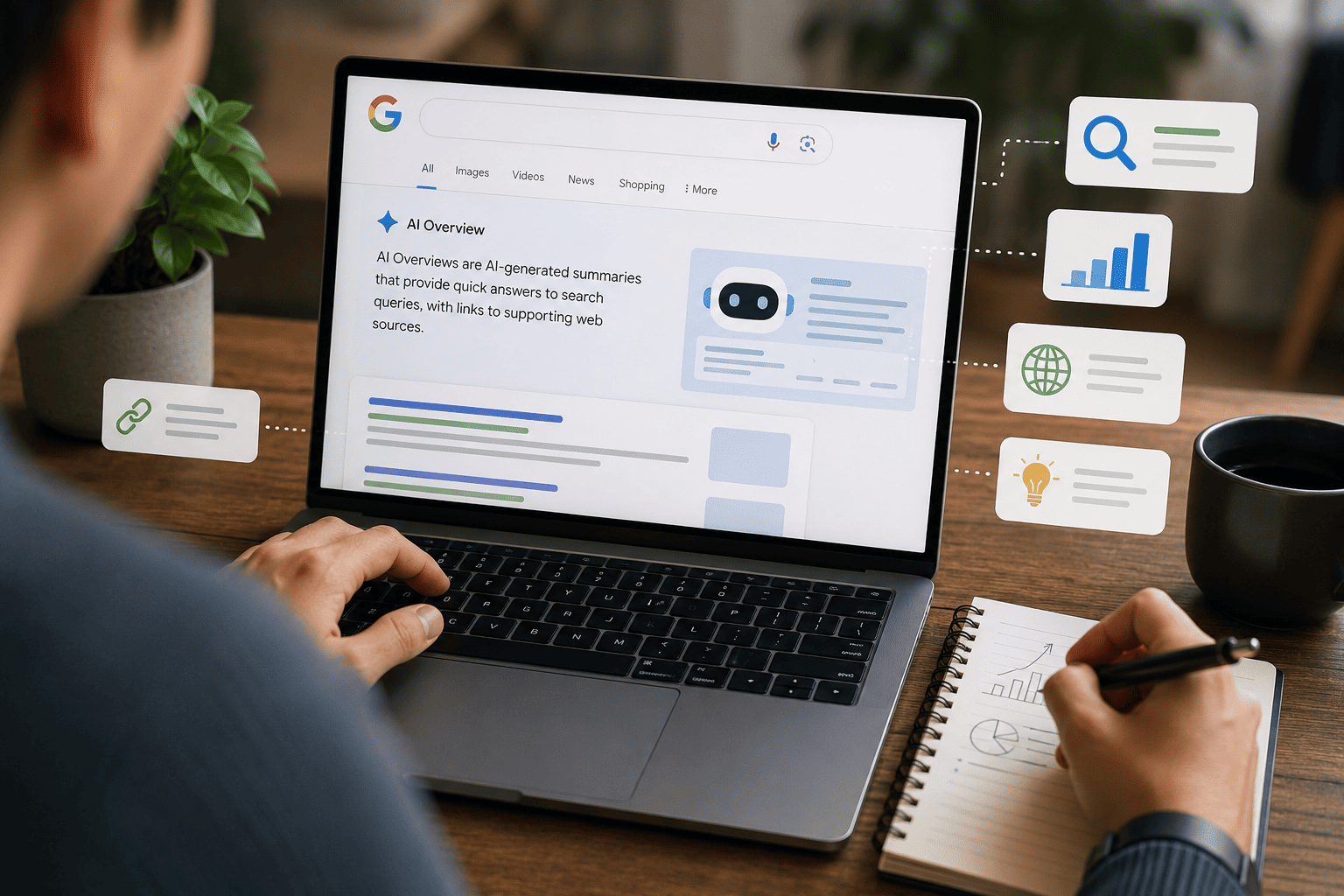
Google Search is changing from a system that primarily presents lists of web links into an increasingly AI-powered search experience. One of the most visible changes is AI Overviews, which provide an AI-generated summary of information directly within Google Search, along with links that allow users to explore supporting websites. Google says AI Overviews appear when its systems determine that generative AI can be particularly helpful for a query, especially when information from multiple sources can help answer the question.
For users, this can make searching faster and more conversational. For website owners, publishers, marketers, and SEO professionals, however, it creates an important question: What happens to organic search visibility when Google answers more questions directly in the search results?
AI Overviews do not mean traditional SEO is disappearing. Instead, they are changing how people discover information and how websites can earn visibility within Google’s evolving search experience. Google has also continued adding links, source visibility, and ways to discover original content within its AI search experiences.
This guide explains what AI Overviews are, how they work with Google Search, how they affect SEO, what opportunities they create for websites, and what practical strategies businesses can use to remain competitive.
AI Overviews and Google Search at a Glance
| Search Element | What It Does | Why It Matters |
| Traditional Organic Results | Displays relevant web pages | Remains an important source of traffic |
| AI Overviews | Summarizes information with supporting links | Changes how users interact with results |
| Featured Content | Highlights useful information | Can increase visibility for relevant sources |
| Supporting Links | Connect users with websites behind the answer | Creates opportunities for qualified visits |
| AI Mode | Enables deeper conversational searching | Expands searches beyond a single query |
| Original Content | Provides firsthand information and perspectives | Can help websites stand out in AI-driven search |
| Search Intent | Determines what users actually need | Remains essential for creating useful pages |
Quick Answer: What Are AI Overviews in Google Search?
AI Overviews are AI-generated summaries that can appear within Google Search results when Google determines that an AI-generated explanation could help answer a user’s query. They provide key information and links to websites where users can explore the subject further.
For SEO, the important change is that users may receive useful information before interacting with traditional organic listings. This can alter the path from search query → result → website into a more complex journey involving AI summaries, supporting sources, follow-up questions, and traditional search results.
However, AI Overviews are not simply a replacement for websites. Google has continued developing ways to connect AI-generated answers with relevant websites and original content. In 2026, Google introduced additional features designed to make relevant links, website context, original voices, and preferred sources easier to discover within AI Search.
What Are AI Overviews?
AI Overviews are a Google Search feature powered by generative AI.
Instead of requiring users to open multiple pages to build an initial understanding of a topic, Google can provide a summarized response directly in Search.
For example, someone searching for:
“How does solar energy work?”
may receive an AI-generated explanation that combines information relevant to the question and provides links for further research.
Google emphasizes that AI-generated responses can contain mistakes, so users should verify important information and review the supporting web sources.
Why Google Introduced AI Overviews
Traditional search works particularly well when users know exactly what information they want.
But modern searches are often more complicated.
Users may ask questions involving:
- Multiple concepts
- Comparisons
- Several conditions
- Follow-up questions
- Research tasks
- Recommendations
- Complex explanations
AI-powered Search is designed to help users explore these types of questions more naturally.
Google’s broader AI Search direction includes both AI Overviews and AI Mode, with AI Mode designed for deeper conversational exploration and follow-up questions.
How AI Overviews Work With Google Search
AI Overviews combine generative AI with Google’s understanding of information available across the web.
A simplified process looks like this:
User searches → Google interprets the query → Relevant information is identified → AI generates a summary → Supporting sources are displayed → User explores further
The exact systems behind individual results are complex and can change over time. Google explains that AI Overviews use generative AI and can make mistakes, which is why users are encouraged to check supporting links and other Search results for important information.
AI Overviews Are Not Traditional Featured Snippets
It is important not to treat AI Overviews as simply a renamed featured snippet.
A traditional featured snippet generally highlights a passage from a webpage.
AI Overviews can instead synthesize information and present a broader AI-generated response with multiple supporting sources.
That means SEO professionals need to think beyond optimizing one paragraph for a single query.
The bigger goal becomes:
Create content that is genuinely useful, clear, trustworthy, well-supported, and relevant to the questions your audience asks.
AI Overviews vs Traditional Google Search
The traditional search experience often looks like:
Query → Organic listings → Website → Answer
AI-powered Search can introduce another layer:
Query → AI Overview → Supporting sources → Follow-up exploration → Website
This changes the way visibility should be evaluated.
A website might benefit from being:
- Listed traditionally
- Referenced as a supporting source
- Included for a specific subtopic
- Discovered through a follow-up search
- Selected because of its original information
Google has said that it continues to develop ways for AI experiences to connect users with relevant websites, including inline links and other source-discovery features.
How AI Overviews Affect SEO
1. Search Visibility Is Becoming More Complex
SEO has traditionally focused heavily on rankings.
But ranking position alone may not fully describe visibility in an AI-powered search environment.
A modern SEO strategy may need to consider:
- Organic rankings
- AI Overview visibility
- Brand mentions
- Source links
- Long-tail queries
- Topical authority
- Original research
- User engagement
- Conversions
This does not make rankings irrelevant. Instead, it makes search visibility more multidimensional.
2. Search Intent Becomes Even More Important
AI Overviews are designed to provide useful answers to user questions.
That means content must closely match what the searcher actually wants.
Consider the keyword:
“best running shoes”
A user may want:
- Product recommendations
- Comparison information
- Price ranges
- Features
- Reviews
- Buying advice
A page that simply repeats the keyword may not satisfy the underlying intent.
Strong content should answer the actual question behind the search.
3. Original Information Can Become More Valuable
If AI systems can summarize common information from many websites, simply repeating information already available elsewhere may provide limited differentiation.
Original value can include:
- Firsthand experience
- Original research
- Surveys
- Testing
- Case studies
- Expert commentary
- Unique comparisons
- Proprietary data
- Detailed examples
Google has increasingly emphasized helping users discover original content and firsthand perspectives within its AI Search experiences.
What Makes Content More Useful for AI-Powered Search?
There is no single guaranteed formula for appearing in an AI Overview.
However, strong content fundamentals remain important.
Clear Answers
Answer the primary question directly instead of forcing readers through unnecessary introductions.
Strong Topical Coverage
Cover the important subtopics users are likely to need.
Reliable Information
Support important claims with trustworthy evidence where appropriate.
Original Value
Add information that goes beyond what competing pages already say.
Logical Structure
Use clear headings, short sections, lists, examples, and helpful explanations.
Firsthand Experience
Where appropriate, include genuine experiences, observations, testing, or professional insights.
Natural Language
Write for people rather than attempting to manipulate an AI system with unnatural keyword repetition.
Benefits of AI Overviews for Search Users
AI Overviews can offer several potential benefits to searchers.
Faster Understanding
Users can receive an initial explanation without immediately opening multiple websites.
Better Exploration
Complex topics can be summarized into several connected concepts.
Multiple Sources
Supporting links can allow users to investigate the information behind an AI-generated response.
Conversational Search
Users can continue exploring a subject through follow-up interactions, particularly as Google connects AI Overviews with AI Mode.
Discovery of Different Websites
Google has reported that AI Overviews can help people discover a broader range of websites for more complex questions.
Challenges of AI Overviews for Website Owners
Potential Changes in Click Behavior
When users receive an answer directly within Search, they may not always need to visit a website for basic information.
This creates concerns for publishers whose pages traditionally depended on informational search traffic.
The impact can vary significantly depending on the query, industry, search intent, and quality of the page.
More Competition for Attention
Traditional organic results already compete with:
- Ads
- Featured snippets
- Images
- Videos
- Local results
- People Also Ask
- Shopping features
AI Overviews add another major layer to the search experience.
AI Can Make Mistakes
Google explicitly warns that AI Overviews can contain inaccurate information.
This creates an ongoing challenge around accuracy, source selection, and user trust.
Less Predictable Search Journeys
A user may move from an AI Overview to a supporting source, return to Search, ask another question, and then visit a completely different website.
SEO therefore becomes less about one fixed click path and more about being visible throughout the user’s research journey.
AI Overviews and Content Strategy
AI-powered Search makes content strategy more important, not less.
Instead of creating hundreds of pages targeting isolated keywords, businesses should consider building comprehensive topic coverage.
For example, a website targeting digital marketing could create related content around:
- Digital marketing strategy
- SEO
- Content marketing
- Email marketing
- Social media marketing
- Conversion optimization
- Analytics
- Marketing automation
Each page can address a specific search intent while contributing to broader topical expertise.
Build Topic Depth
A strong website should demonstrate meaningful knowledge around the subjects it covers.
That means answering the important questions your audience has instead of publishing shallow articles simply because a keyword has search volume.
Practical Examples of AI Overviews and Google Search
Example 1: Informational Query
A user searches:
“What is technical SEO?”
An AI Overview may provide a concise explanation and links to relevant sources.
A technical SEO website can improve its opportunity for visibility by publishing a clear, authoritative guide that explains the concept thoroughly and provides useful examples.
Example 2: Comparison Query
A user searches:
“SEO vs PPC: Which is better for a small business?”
This query requires comparison and context.
A strong page could cover:
- Cost
- Speed
- Long-term benefits
- Competition
- Business goals
- Industry differences
- Examples
A generic definition of SEO and PPC would provide much less value.
Example 3: Product Research
A user searches:
“Best laptop for video editing under $1,500.”
Useful content could include:
- Tested specifications
- Performance comparisons
- Pros and cons
- Real-world use
- Pricing information
- Who each product suits
Original testing and useful comparisons can provide more value than simply rewriting manufacturer specifications.
Best SEO Practices for AI Overviews
1. Focus on Search Intent
Understand why the person is searching.
Ask:
What does the user actually need to know or accomplish?
Then build the page around that need.
2. Answer Questions Clearly
Put useful information where readers can easily find it.
Avoid hiding the answer beneath unnecessary paragraphs.
3. Add Original Insights
Do not simply summarize the same information found on competing pages.
Add something meaningful.
4. Demonstrate Firsthand Experience
When relevant, include:
- Testing
- Screenshots
- Experiments
- Case studies
- Personal observations
- Expert analysis
5. Strengthen Your Website’s Overall Quality
AI Search does not eliminate the importance of a strong website.
Continue improving:
- Site speed
- Mobile usability
- Internal linking
- Navigation
- Technical accessibility
- Content quality
- Author information
- Trust signals
6. Create Content Worth Citing
Instead of asking only:
“How can I rank for this keyword?”
also ask:
“Would another person consider this page a useful source to reference?”
That mindset encourages deeper, more original content.
7. Keep Content Updated
Information can change quickly.
Review important pages periodically and update:
- Statistics
- Product details
- Prices
- Regulations
- Screenshots
- Examples
- Industry developments
Common Mistakes to Avoid
Keyword Stuffing
Repeating a keyword excessively does not create useful content.
Use keywords naturally while focusing on the subject and user intent.
Writing Only for AI
Do not create awkward content simply because you think it will be selected by an AI system.
Write for people first.
Copying Competitors
If your page says essentially the same thing as ten other websites, it has little differentiation.
Add original value.
Publishing Unverified Claims
AI-assisted research can contain mistakes.
Verify important information before publication.
Ignoring Traditional SEO
AI Overviews do not mean you should abandon technical SEO, content optimization, internal linking, crawlability, or traditional organic search.
Google Search continues to include web results alongside its AI experiences.
Chasing a Guaranteed AI Overview Formula
There is no reliable shortcut that guarantees inclusion in an AI Overview.
SEO strategies should focus on sustainable quality rather than attempts to manipulate an AI-generated result.
AI Overviews, AI Mode, and the Future of Google Search
AI Overviews are part of a broader shift toward AI-powered Search.
Google describes AI Mode as a deeper AI search experience that allows follow-up questions and can break complex questions into subtopics to search across the web.
In 2026, Google also announced a closer connection between AI Overviews and AI Mode, allowing users to move from an Overview into a deeper conversational experience while retaining links for further exploration.
For SEO professionals, this means the search journey may become increasingly dynamic.
The future may involve users:
Ask → Explore → Refine → Compare → Verify → Visit
rather than simply:
Search → Click → Read
That makes brand visibility, original expertise, useful content, and strong topical coverage increasingly important.
Frequently Asked Questions
What are AI Overviews in Google Search?
AI Overviews are AI-generated summaries that can appear in Google Search when Google determines that generative AI can help answer a query. They can include key information and links to supporting websites.
Do AI Overviews replace organic search results?
No. AI Overviews are an additional Search experience, and Google continues to provide links to web content and traditional search results. Users can also use Google’s Web filter to view text-based web links without features such as AI Overviews.
Can websites rank in AI Overviews?
There is no guaranteed ranking formula for AI Overviews. However, websites that provide relevant, useful, trustworthy, and original information may have opportunities to be surfaced as supporting sources.
Will AI Overviews reduce website traffic?
They can change how users interact with Search, particularly for queries that can be answered directly in an AI-generated summary. However, Google has also reported that links within AI Overviews can drive visits to supporting websites and has continued developing ways to connect users with relevant web content.
Is traditional SEO still important?
Yes. Technical accessibility, relevant content, search intent, internal linking, user experience, authority, and other established SEO fundamentals remain important.
How should businesses optimize for AI Overviews?
Focus on satisfying search intent, providing accurate information, demonstrating expertise, adding original value, structuring content clearly, and maintaining a technically strong website.
Can AI Overviews make mistakes?
Yes. Google explicitly states that AI Overviews can make mistakes, so important information should be checked against supporting sources and other reliable results.
What is the difference between AI Overviews and AI Mode?
AI Overviews provide an AI-generated snapshot within Search. AI Mode is designed for deeper, more conversational exploration with follow-up questions and more extensive web research.
Should I create content specifically for AI Overviews?
Rather than creating content solely to target AI Overviews, create genuinely useful content that satisfies users and provides original value. This gives your content a stronger foundation across both traditional and AI-powered search.
Conclusion
AI Overviews and Google Search represent a major evolution in how people discover and consume information online.
Instead of relying exclusively on traditional lists of links, Google can now provide AI-generated summaries, supporting sources, and conversational paths for deeper exploration. This can make Search more useful for complex questions while also changing how businesses think about organic visibility.
For website owners and SEO professionals, the answer is not to abandon traditional SEO. It is to expand the strategy.
Focus on:
Search intent → Useful information → Original value → Expertise → Technical quality → Strong user experience → Continuous improvement
The websites most prepared for AI-powered Search will not necessarily be the ones that try to manipulate AI systems. They will be the ones that consistently provide information worth discovering, trusting, citing, and visiting.
Call to Action
Ready to prepare your website for the changing Google Search landscape?
Start by reviewing your most important pages. Identify content that is generic, outdated, poorly structured, or lacking original value. Then improve it with clearer answers, trustworthy information, firsthand insights, useful examples, and stronger topical coverage.
Don’t optimize only for where your page ranks. Optimize for why a searcher would choose your content in the first place.