

Introduction
Email marketing remains one of the most practical ways for businesses to communicate directly with customers. From welcoming new subscribers to promoting products, sharing useful information, and encouraging repeat purchases, a well-planned email strategy can support almost every stage of the customer journey.
However, sending emails regularly does not automatically produce good results. Businesses often struggle with low open rates, weak click-through rates, unsubscribes, poor engagement, or messages that simply get ignored.
The solution is not necessarily to send more emails. Instead, businesses need to focus on relevance, timing, personalization, deliverability, and value.
This guide to Email Marketing Best Practices explains how U.S. businesses can build more effective email campaigns, improve engagement, avoid common mistakes, and turn subscribers into long-term customers.
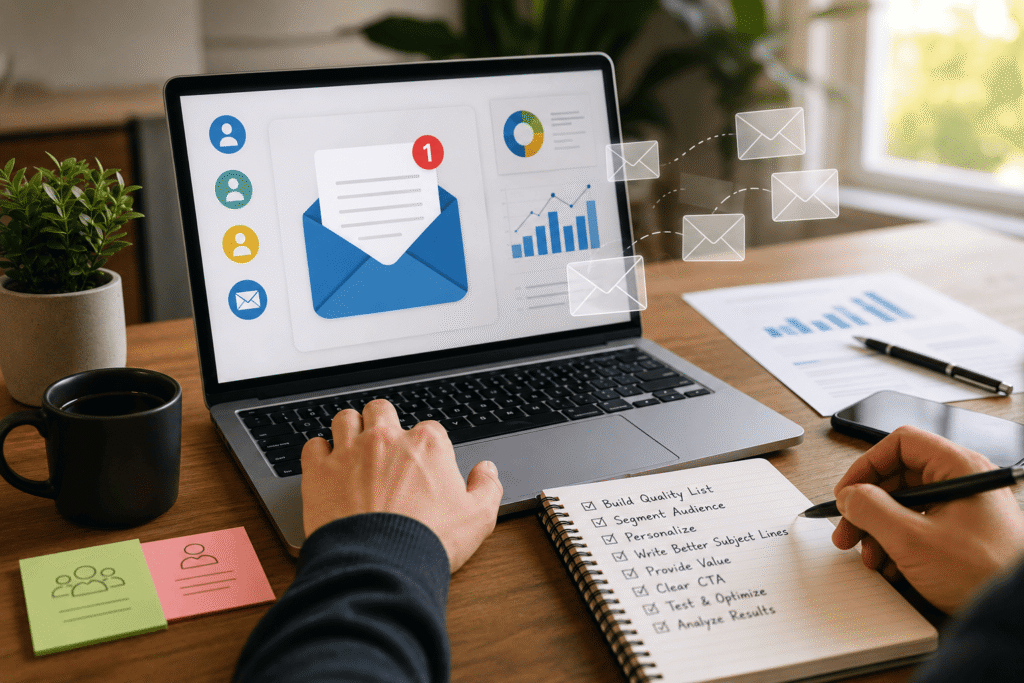
Email Marketing Best Practices at a Glance
| Best Practice | What It Helps With |
| Build a Permission-Based List | Better engagement and trust |
| Segment Subscribers | More relevant messaging |
| Write Strong Subject Lines | Improve opens |
| Personalize Content | Increase relevance |
| Optimize for Mobile | Improve usability |
| Provide Valuable Content | Build loyalty |
| Use Clear CTAs | Increase clicks and conversions |
| Test Campaigns | Identify what works |
| Maintain Deliverability | Reach the inbox |
| Track Performance | Improve future campaigns |
| Respect Privacy | Protect customer trust |
| Automate Where Appropriate | Save time and improve timing |
Quick Answer: What Are Email Marketing Best Practices?
The best email marketing strategy is based on sending the right message to the right subscriber at the right time.
For most businesses, this means building a permission-based email list, segmenting subscribers according to their interests or behavior, writing compelling but honest subject lines, providing useful content, using clear calls to action, and making every email easy to read on mobile devices.
Businesses should also monitor campaign performance rather than relying on assumptions. Metrics such as click-through rate, conversions, unsubscribe rate, bounce rate, and revenue can reveal whether an email strategy is actually contributing to business goals.
Most importantly, email marketing should provide value. If subscribers consistently receive useful information, relevant offers, or helpful resources, they have a stronger reason to remain subscribed and engage with future messages.
Why Email Marketing Still Matters
Email gives businesses something many other marketing channels cannot: a direct communication channel with people who have chosen to hear from the brand.
A social media follower may not see every post. A search visitor may never return. An email subscriber, however, can receive your message directly in their inbox.
For U.S. businesses, email can be particularly useful for:
- E-commerce promotions
- SaaS customer communication
- Local business offers
- B2B lead nurturing
- Newsletters
- Event promotion
- Product launches
- Customer onboarding
- Retention campaigns
- Educational content
The strongest campaigns don’t treat email as a one-way advertising channel. They use it to build an ongoing relationship.
12 Email Marketing Best Practices
1. Build a Permission-Based Email List
One of the most important email marketing principles is simple: send messages to people who have given you permission to contact them.
Avoid purchasing random email lists. Purchased lists often contain outdated, irrelevant, or low-quality addresses and can damage engagement and sender reputation.
Instead, build your list through legitimate channels such as:
- Website signup forms
- Checkout opt-ins
- Lead magnets
- Free resources
- Webinar registrations
- Account creation
- Event registrations
- Newsletter subscriptions
Make it clear what subscribers are signing up for.
For example, instead of a generic “Subscribe” button, consider:
“Get weekly small-business marketing tips.”
This sets an expectation before someone joins the list.
2. Segment Your Subscribers
Sending the same email to everyone is rarely the most effective approach.
Segmentation allows businesses to divide subscribers into meaningful groups based on characteristics or behavior.
Common Segmentation Examples
You can segment subscribers by:
- Location
- Purchase history
- Interests
- Industry
- Customer status
- Engagement level
- Website behavior
- Products viewed
- Signup source
- Lifecycle stage
For example, an online clothing retailer could send different emails to customers interested in men’s apparel, women’s apparel, footwear, or accessories.
More relevant messages generally create a better customer experience than one-size-fits-all campaigns.
3. Write Better Subject Lines
Your subject line is often the first thing a subscriber sees.
A strong subject line should accurately communicate why the email is worth opening.
Effective Approaches
Try:
- Highlighting a clear benefit
- Creating curiosity without misleading readers
- Mentioning a relevant offer
- Asking a useful question
- Making the value obvious
- Keeping the language natural
For example:
Weak:
“Important Newsletter Update”
Stronger:
“3 Ways to Reduce Your Business Software Costs”
The second version immediately communicates a potential benefit.
Avoid misleading clickbait. Getting open through deception may hurt trust and engagement later.
4. Personalize Beyond the First Name
Personalization does not have to mean simply inserting someone’s first name into an email.
More useful personalization considers what the subscriber actually cares about.
For example:
- Recommend products based on previous purchases.
- Send onboarding information based on signup date.
- Recommend relevant resources based on content interests.
- Offer location-specific information when appropriate.
- Send reminders based on customer behavior.
Effective personalization should feel helpful rather than intrusive.
5. Provide Real Value
Every email should answer a basic question:
Why should the subscriber care about this message?
Value could come from:
- Useful information
- Exclusive offers
- Educational content
- Product recommendations
- Early access
- Helpful resources
- Industry insights
- Personalized suggestions
- Important account updates
If every message is a sales pitch, subscribers may become disengaged.
A balanced email strategy can combine promotional and educational content according to the audience and business model.
6. Make Emails Mobile-Friendly
Many people read email on smartphones, so mobile usability should be treated as a priority rather than an afterthought.
Use:
- Responsive email designs
- Readable font sizes
- Short paragraphs
- Clear buttons
- Appropriate spacing
- Optimized images
- Concise copy
Always preview campaigns on different screen sizes before sending them.
A beautifully designed desktop email can still perform poorly if the mobile experience is difficult to navigate.
7. Use One Clear Primary CTA
A common mistake is giving subscribers too many competing actions.
If the primary goal is to promote a product, make the main action obvious.
Examples include:
- Shop Now
- Start Free Trial
- Book a Demo
- Download the Guide
- Read the Full Article
- Claim the Offer
- Register Today
You can include secondary links when necessary, but the main action should be easy to identify.
8. Send Emails at the Right Frequency
There is no universal number of emails that every business should send.
The ideal frequency depends on:
- Audience expectations
- Business type
- Content quality
- Customer lifecycle
- Campaign purpose
A daily promotional email may be appropriate for one business and excessive for another.
The better approach is to establish expectations when subscribers join your list and then monitor engagement.
If unsubscribe rates increase after you increase sending frequency, that may be a signal to reassess your strategy.
9. Use Email Automation
Automation can help businesses deliver timely messages without manually sending every campaign.
Useful Automated Emails
Common examples include:
- Welcome emails
- Abandoned-cart reminders
- Purchase confirmations
- Onboarding sequences
- Birthday or anniversary messages
- Re-engagement campaigns
- Post-purchase follow-ups
- Product recommendations
- Renewal reminders
Automation is particularly powerful because messages can be triggered by subscriber actions rather than sent only according to a fixed calendar.
10. Test Your Campaigns
Email marketing should be treated as an ongoing learning process.
You can test elements such as:
- Subject lines
- CTAs
- Email length
- Images
- Offers
- Layouts
- Send times
- Personalization
- Content formats
For example, an e-commerce company might test two subject lines for the same promotion and compare their performance.
Testing should have a clear purpose. Don’t change ten elements at once if you want to understand which change affected the result.
11. Protect Email Deliverability
An email that never reaches the inbox cannot generate a click or sale.
Deliverability can be affected by factors such as:
- Poor list quality
- High bounce rates
- Spam complaints
- Low engagement
- Sending practices
- Authentication and domain configuration
- Sudden changes in sending volume
Businesses should maintain clean subscriber lists and follow applicable email marketing requirements.
For U.S. businesses, compliance with relevant requirements such as the CAN-SPAM Act should be part of the email marketing process.
When in doubt about legal requirements, consult qualified legal or compliance professionals rather than relying solely on How Digital Marketing Works advice.
12. Monitor the Right Metrics
Open rates can provide useful directional information, but they should not be the only metric you track.
Important measurements include:
Click-Through Rate
Shows how many recipients clicked links in your email.
Conversion Rate
Measures how many recipients completed the desired action.
Unsubscribe Rate
Helps identify whether your content or sending frequency may be causing subscriber dissatisfaction.
Bounce Rate
Shows how many emails could not be delivered.
Revenue
For businesses selling products or services, revenue generated or influenced by email can be much more meaningful than opens alone.
List Growth
Track whether your subscriber base is growing sustainably.
The most useful metrics depend on the campaign’s objective.
Types of Email Marketing Campaigns
Different campaigns serve different purposes.
Welcome Emails
A welcome email introduces your business and sets expectations for future communication.
It can include:
- A thank-you message
- What subscribers can expect
- Helpful resources
- A special introductory offer
- Links to important pages
Promotional Emails
These campaigns are designed to encourage purchases or other commercial actions.
Examples include:
- Seasonal promotions
- New product announcements
- Limited-time offers
- Discounts
- Product bundles
Promotional messages should still provide clear information and avoid misleading urgency.
Educational Newsletters
Newsletters can build long-term relationships by consistently providing useful information.
A marketing newsletter, for example, might include:
- One practical tip
- A recent article
- Industry news
- A useful resource
- A brief product update
Abandoned Cart Emails
E-commerce companies can remind shoppers about products they added to their carts but did not purchase.
The message should be helpful and make it easy for the customer to return to the checkout process.
Re-Engagement Emails
Some subscribers stop interacting with your emails.
A re-engagement campaign can attempt to determine whether they still want to receive messages.
If inactive subscribers remain unresponsive, consider whether continuing to email them makes sense for your list strategy.
Email Marketing Examples for U.S. Businesses
Example 1: Local Restaurant
A local restaurant could send:
Subject: “Your weekend dinner plans just got easier”
The email might feature a new seasonal menu, reservation information, and a simple CTA.
Example 2: E-Commerce Store
An online retailer could segment customers based on previous purchases and send product recommendations related to what they have already bought.
Example 3: B2B Software Company
A SaaS company could create a welcome sequence that helps new users complete setup, understand key features, and reach their first successful outcome.
Example 4: Professional Services Firm
A consulting company could send a monthly newsletter containing industry insights, practical advice, and links to detailed educational resources.
These examples demonstrate an important principle: the best email strategy depends on the customer’s situation and the business objective.
Email Marketing Tips for Better Performance
Keep Your Copy Clear
Avoid unnecessary jargon and long blocks of text.
Write as though you are communicating with one person rather than addressing a massive audience.
Match the Email to the Landing Page
If your email promises a specific offer or resource, the landing page should deliver exactly what the subscriber expects.
A disconnect between the email and landing page can reduce conversions.
Use Consistent Branding
Your emails should feel connected to your website and other marketing channels through consistent:
- Colors
- Typography
- Messaging
- Visual identity
- Brand voice
Make Unsubscribing Easy
A clear unsubscribe option helps maintain trust and supports responsible email practices.
Clean Your List Regularly
Remove or manage invalid addresses and consider strategies for persistently inactive subscribers.
A smaller, engaged audience can be more valuable than a large list that rarely interacts with your emails.
Common Email Marketing Mistakes to Avoid
Buying Email Lists
Purchased lists can create poor engagement and deliverability problems.
Sending Without Permission
Email marketing should respect subscriber expectations and applicable laws.
Overloading Subscribers
Too many emails can lead to fatigue and unsubscribes.
Using Misleading Subject Lines
Short-term openings are not worth sacrificing long-term trust.
Ignoring Mobile Users
An email that is difficult to read on a smartphone creates unnecessary friction.
Focusing Only on Sales
Educational and useful content can help maintain engagement between promotional campaigns.
Not Testing
Assuming you know what subscribers want without testing can limit performance.
Ignoring Analytics
Without measurement, it is difficult to identify successful campaigns and areas for improvement.
Frequently Asked Questions
What are the most important email marketing best practices?
The most important practices include permission-based list building, segmentation, valuable content, effective subject lines, personalization, mobile optimization, clear CTAs, testing, deliverability management, and performance tracking.
How often should a business send marketing emails?
There is no ideal frequency for every business. Your sending schedule should match subscriber expectations, campaign objectives, and the amount of value you can consistently provide.
Should businesses buy email lists?
Generally, businesses should build their own permission-based subscriber lists rather than purchasing lists. A relevant and engaged audience is more valuable than a large list of unknown contacts.
What makes a good email subject line?
A good subject line is clear, relevant, concise, and aligned with the actual content of the email. It should give subscribers a legitimate reason to open the message.
How can I improve email engagement?
Improve relevance through segmentation and personalization, provide useful content, write stronger subject lines, use clear CTAs, optimize emails for mobile, and test different campaign elements.
What is email segmentation?
Email segmentation is the process of dividing subscribers into groups based on characteristics, interests, behavior, purchase history, or other relevant information so you can send more targeted messages.
What is email automation?
Email automation uses predefined triggers or workflows to send messages automatically based on subscriber actions, dates, or lifecycle stages.
What email metrics should businesses track?
Useful metrics include clicks, conversions, unsubscribe rate, bounce rate, list growth, engagement, and revenue. The right metrics depend on the purpose of the campaign.
How can businesses improve email deliverability?
Maintain a clean list, use appropriate authentication and sending practices, avoid spam-like content, monitor complaints and bounces, and focus on sending relevant messages to engaged subscribers.
Conclusion
Effective email marketing is not about filling inboxes with more messages. It is about creating useful, relevant communication that subscribers actually want to receive.
For U.S. businesses, a strong strategy starts with permission-based list building and continues with segmentation, personalization, valuable content, mobile-friendly design, automation, testing, and careful performance measurement.
The most successful email campaigns treat subscribers as people rather than simply as email addresses. When businesses understand their audience and consistently deliver relevant value, email can become a powerful channel for building relationships, generating leads, increasing sales, and encouraging customer loyalty.
The key takeaway: send fewer irrelevant messages and more useful ones.
Call to Action
Ready to improve your email strategy? Start by reviewing your subscriber list, segmenting your audience, and identifying the campaigns that matter most to your customers. Then test one improvement at a time and use your performance data to build a smarter, more effective email marketing program.