

Introduction
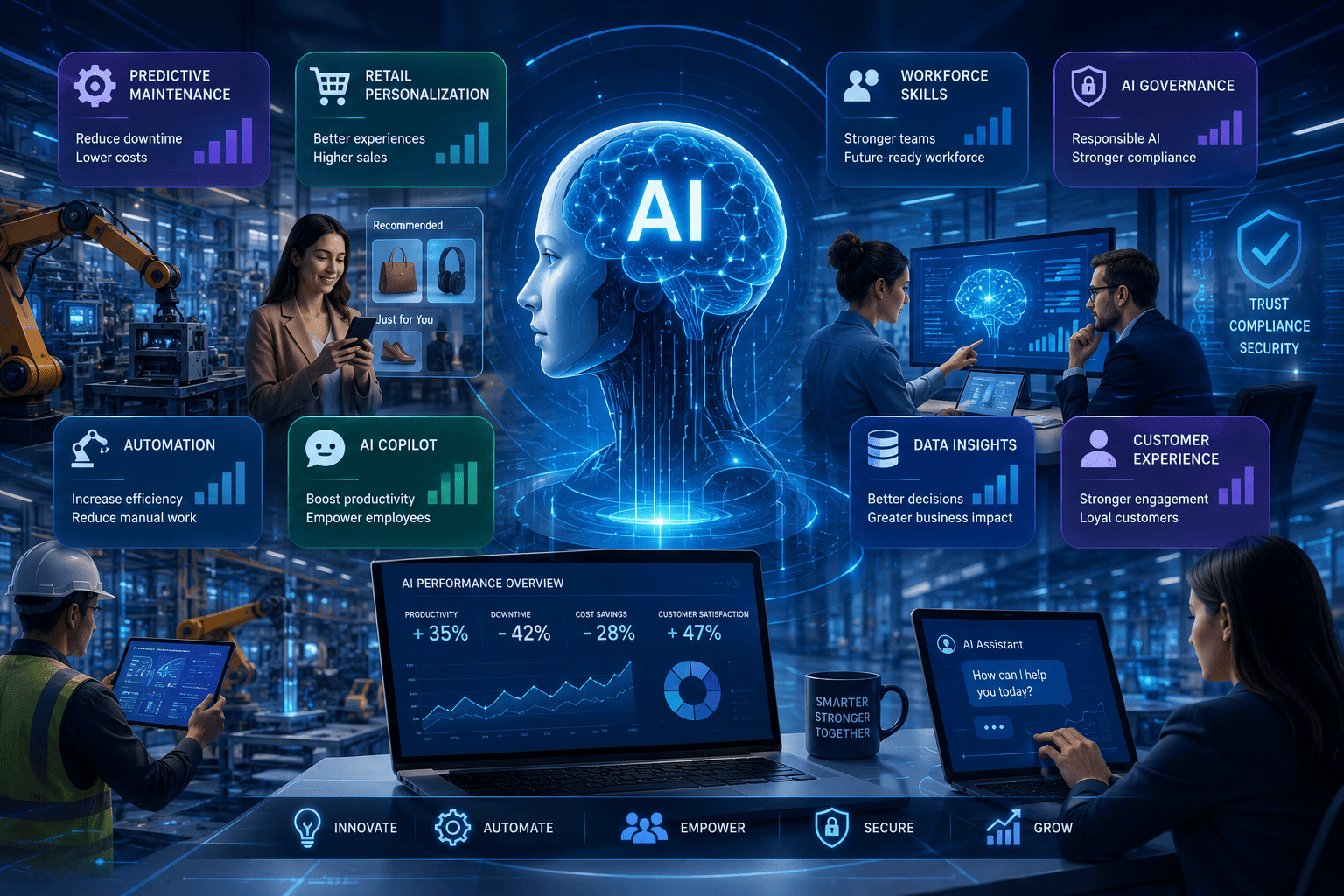
Top 100 Technology Brands has moved beyond experimentation and is now reshaping the way organizations operate, innovate, and compete. Across industries such as manufacturing, retail, software development, healthcare, and customer service, businesses are integrating AI into everyday operations to improve productivity, automate repetitive tasks, strengthen decision-making, and deliver more personalized customer experiences. This section highlights 17 important enterprise AI trends—from predictive maintenance and AI-powered personalization to workforce development, governance, and generative AI Statistics 2026 adoption—that illustrate how AI is becoming a core driver of business transformation in 2026.
Enterprise AI Trends 2026 – Key Focus Areas and Business Benefits
| Enterprise AI Trend | Primary Focus | Business Benefit |
| Predictive Maintenance | AI-powered equipment monitoring | Reduced downtime and lower maintenance costs |
| Retail Personalization | Personalized shopping experiences | Higher customer engagement and sales |
| AI Workforce Skills | AI literacy and technical expertise | Better hiring and workforce readiness |
| Employee AI Training | Responsible AI education | Faster and safer AI adoption |
| Human-AI Collaboration | AI-assisted decision-making | Increased productivity and efficiency |
| AI Governance | Risk management and compliance | Greater trust and regulatory readiness |
| AI Engineering | Building and managing AI systems | Scalable enterprise AI deployment |
| AI Workflow Automation | End-to-end AI process integration | Improved operational efficiency |
| AI-Assisted Coding | Code generation and debugging | Faster software development |
| Data Governance | Data quality, privacy, and security | More reliable AI outcomes |
| Cross-Functional AI Teams | Collaboration across departments | Stronger project execution |
| Generative AI Adoption | Production-ready AI applications | Measurable business value |
| AI Copilots | Workplace productivity assistants | Faster daily task completion |
| Document Automation | AI-generated business documents | Reduced manual workload |
| Enterprise Knowledge Search | AI-powered information retrieval | Quicker access to business knowledge |
| Customer Communication | AI-driven support and engagement | Better customer experience |
19. Manufacturers Continue Expanding Predictive Maintenance Initiatives
Finding
Manufacturing organizations are increasingly deploying AI-driven predictive maintenance systems to monitor machinery, anticipate equipment failures, and reduce unplanned downtime.
Why This Matters
Unexpected equipment failures can significantly disrupt production schedules and increase maintenance costs. AI enables organizations to identify early warning signs through sensor data and machine learning models.
Common Applications
- Industrial IoT monitoring
- Equipment health analysis
- Failure prediction
- Maintenance scheduling
- Spare parts optimization
Business Impact
Predictive maintenance improves operational reliability while extending equipment lifespan and reducing unnecessary maintenance activities.
20. Retailers Continue Investing in AI-Powered Personalization
Finding
Retail organizations increasingly use AI to personalize customer experiences across websites, mobile applications, email campaigns, and physical stores.
Why This Matters
Consumers expect relevant product recommendations and personalized shopping experiences. AI helps businesses analyze purchasing behavior and customer preferences at scale.
AI Applications in Retail
| Business Function | AI Application |
| Product Recommendations | Personalized suggestions |
| Pricing | Dynamic pricing analysis |
| Inventory | Demand forecasting |
| Customer Support | AI chat assistants |
| Marketing | Audience segmentation |
Industry Insight
Personalization has become a competitive differentiator rather than an optional feature.
21. AI Skills Remain Among the Most In-Demand Technical Competencies
Finding
Demand for AI-related skills continues growing across software engineering, data science, cybersecurity, product management, marketing, finance, healthcare, and operations.
Why This Matters
Organizations increasingly seek employees who understand both AI capabilities and practical business applications.
High-Demand Skills
- Machine learning
- Prompt engineering
- Data analysis
- AI governance
- Model evaluation
- Python programming
- Cloud AI platforms
- Responsible AI
Business Perspective
Hiring strategies increasingly emphasize AI literacy alongside traditional technical expertise.
22. Organizations Are Increasingly Investing in AI Training Programs
Finding
Many employers now provide structured AI education to improve workforce readiness and support responsible technology adoption.
Why This Matters
Successful AI implementation depends on employee understanding as much as technological capability.
Common Training Areas
- Responsible AI
- Prompt design
- Data privacy
- AI-assisted productivity
- Security awareness
- Governance policies
Strategic Observation
Organizations investing in continuous AI education are often better positioned to scale adoption while minimizing implementation risks.
23. AI Literacy Is Becoming a Core Business Competency
Finding
AI literacy is expanding beyond technical teams to include executives, managers, marketers, HR professionals, legal teams, educators, and customer service staff.
Why This Matters
As AI becomes embedded in everyday software, employees across departments require a foundational understanding of AI capabilities and limitations.
Industry Analysis
Modern AI literacy includes:
- Understanding AI outputs
- Recognizing hallucinations
- Evaluating source quality
- Protecting sensitive data
- Applying AI ethically
Business Impact
Organizations with AI-literate workforces can adopt new technologies more effectively while reducing misuse and operational risks.
24. AI Increasingly Augments Professional Roles Rather Than Replacing Them
Finding
Current enterprise deployments primarily focus on augmenting human work by automating repetitive tasks and accelerating information processing.
Why This Matters
Most business functions require judgment, creativity, collaboration, and domain expertise that remain difficult to automate completely.
Examples
| Profession | AI Assistance |
| Lawyers | Document review |
| Doctors | Clinical documentation |
| Developers | Code suggestions |
| Marketers | Content drafting |
| Analysts | Data summarization |
Research Perspective
The strongest productivity gains typically occur when humans and AI collaborate rather than operate independently.
25. New AI Governance Roles Continue Emerging
Finding
Organizations are establishing dedicated roles focused on AI governance, compliance, ethics, risk management, and model oversight.
Why This Matters
As AI systems become more influential in business decisions, governance becomes essential for maintaining trust and regulatory compliance.
Common Responsibilities
- AI policy development
- Risk assessments
- Compliance monitoring
- Model documentation
- Audit preparation
- Vendor evaluation
Business Implication
Governance is increasingly viewed as a strategic capability rather than a compliance exercise.
26. AI Engineering Has Become One of the Fastest-Growing Technical Disciplines
Finding
Demand continues increasing for professionals capable of designing, deploying, monitoring, and optimizing production AI systems.
Why This Matters
Building reliable enterprise AI requires expertise extending beyond model development into infrastructure, security, integration, and lifecycle management.
Core Competencies
- Machine learning engineering
- Cloud infrastructure
- Data pipelines
- MLOps
- API integration
- Model monitoring
Industry Insight
AI engineering increasingly combines software engineering principles with advanced data science practices.
27. Prompt Engineering Is Evolving Into AI Workflow Design
Finding
Organizations increasingly emphasize designing complete AI workflows rather than focusing solely on prompt creation.
Why This Matters
Business value depends on integrating AI into operational processes, not merely generating responses.
Workflow Components
- Prompt optimization
- Context management
- Retrieval systems
- Human review
- Automation rules
- Performance evaluation
Strategic Observation
The role of prompt engineering is expanding into broader AI solution architecture and orchestration.
28. AI-Assisted Coding Tools Continue Gaining Adoption
Finding
Software development teams increasingly incorporate AI-assisted coding into daily workflows for code generation, debugging, documentation, and testing.
Why This Matters
AI can accelerate routine programming tasks, allowing developers to focus on architecture, design, and complex problem-solving.
Common Use Cases
- Code completion
- Test generation
- Documentation
- Refactoring
- Bug explanation
- API examples
Business Impact
Organizations often report improvements in developer productivity, though human review remains essential to ensure code quality, maintainability, and security.
29. Data Governance Is Becoming More Important Than Ever
Finding
As AI systems rely on large volumes of organizational data, businesses are placing greater emphasis on data quality, privacy, security, and lifecycle management.
Why This Matters
Poor-quality or biased data can reduce AI accuracy and increase operational and regulatory risks.
Governance Priorities
| Area | Objective |
| Data Quality | Reliable model outputs |
| Privacy | Regulatory compliance |
| Security | Protect sensitive information |
| Metadata | Improved discoverability |
| Access Controls | Responsible usage |
Industry Analysis
Strong data governance has become a foundational requirement for successful AI deployment.
30. Cross-Functional AI Teams Are Becoming the Enterprise Standard
Finding
Organizations increasingly build multidisciplinary teams that combine technical expertise with business knowledge and governance capabilities.
Team Composition
- Data scientists
- AI engineers
- Product managers
- Business analysts
- Legal advisors
- Security specialists
- Compliance professionals
- Domain experts
Why This Matters
Cross-functional collaboration improves AI adoption by ensuring technical solutions align with business objectives and regulatory requirements.
Strategic Observation
Enterprise AI projects increasingly succeed through organizational coordination rather than technology alone.
31. Generative AI Has Progressed Beyond Experimental Pilots
Finding
Many organizations have moved from limited proof-of-concept projects to production deployments supporting daily business operations.
Why This Matters
Production adoption indicates growing confidence in AI’s ability to deliver measurable business value.
Common Enterprise Deployments
- Customer communications
- Internal knowledge assistants
- Software development
- Marketing content
- Meeting summaries
- Business reporting
Business Perspective
Organizations increasingly evaluate generative AI using productivity, quality, and operational efficiency metrics.
32. AI Copilots Are Becoming Everyday Productivity Tools
Finding
AI copilots are increasingly integrated into workplace software, helping employees draft content, summarize information, analyze data, and automate repetitive tasks.
Why This Matters
Embedding AI into familiar applications reduces learning curves and supports organization-wide adoption.
Productivity Applications
| Department | Copilot Function |
| HR | Job description drafting |
| Finance | Report summarization |
| Sales | Email generation |
| Marketing | Campaign planning |
| IT | Code assistance |
Industry Insight
AI copilots increasingly function as collaborative assistants rather than standalone applications.
33. Businesses Are Increasingly Automating Document Creation
Finding
Generative AI is streamlining the creation of routine business documents while enabling employees to focus on higher-value work.
Frequently Automated Documents
- Meeting summaries
- Standard reports
- Product descriptions
- Internal documentation
- Customer emails
- Technical documentation
- Training materials
Why This Matters
Document automation reduces repetitive work and accelerates organizational knowledge sharing.
Business Impact
Organizations generally require human review to ensure factual accuracy, compliance, and consistency before publication or external distribution.
34. AI Is Transforming Enterprise Knowledge Retrieval
Finding
Organizations increasingly deploy AI-powered search systems capable of retrieving and summarizing information from internal documents, policies, technical manuals, and knowledge bases.
Why This Matters
Employees often spend significant time searching for information. AI-powered retrieval can improve efficiency by providing context-aware answers from trusted internal sources.
Enterprise Applications
- HR policy lookup
- Technical documentation search
- Customer support knowledge bases
- Legal document retrieval
- Product documentation
- Research repositories
Industry Insight
Retrieval-augmented AI systems are becoming an important component of enterprise knowledge management strategies.
35. AI Is Enhancing Customer Communication Across Multiple Channels
Finding
Organizations increasingly use generative AI to assist with customer emails, live chat, multilingual support, knowledge articles, and self-service experiences.
Why This Matters
Customers expect timely, consistent, and personalized interactions. AI helps organizations scale communication while maintaining service quality.
AI Communication Use Cases
| Channel | AI Function |
| Draft responses | |
| Live Chat | Automated assistance |
| Support Portals | Knowledge suggestions |
| Social Media | Content recommendations |
| Messaging Apps | Customer support |
Business Perspective
Leading organizations use AI to support communication workflows while retaining human oversight for complex, sensitive, or high-impact customer interactions.
Summary of Statistics 19–35
| Theme | Key Finding |
| Manufacturing | Predictive maintenance continues to expand. |
| Retail | AI personalization has become a strategic priority. |
| Workforce | AI-related skills remain in high demand. |
| Employee Development | Organizations are investing in AI education. |
| AI Literacy | Becoming essential across all business functions. |
| Professional Roles | AI primarily augments rather than replaces workers. |
| Governance | Dedicated AI oversight roles are increasing. |
| AI Engineering | Demand continues to grow across industries. |
| Workflow Design | Prompt engineering is evolving into end-to-end AI orchestration. |
| Software Development | AI-assisted coding is becoming standard practice. |
| Data Governance | High-quality, secure data is foundational for AI success. |
| Enterprise Teams | Cross-functional collaboration improves AI outcomes. |
| Production AI | Generative AI is moving beyond experimentation. |
| AI Copilots | Becoming integrated into everyday workplace software. |
| Document Automation | AI is streamlining routine business documentation. |
| Knowledge Management | AI-powered enterprise search is improving information access. |
| Customer Communication | AI enhances support, personalization, and multilingual engagement. |
Frequently Asked Questions (FAQs)
1. What are the top Enterprise AI trends in 2026?
Key trends include AI copilots, predictive maintenance, AI governance, automation, and personalized customer experiences.
2. Why is Enterprise AI important?
Enterprise AI improves productivity, reduces costs, enhances decision-making, and drives business growth.
3. Which industries benefit most from AI?
Manufacturing, retail, healthcare, finance, software development, and customer service are leading AI adopters.
4. Is AI replacing human jobs?
No. Enterprise AI mainly supports employees by automating repetitive tasks while humans remain essential for decision-making and creativity.
5. What AI skills are in demand in 2026?
Machine learning, prompt engineering, Python, data analysis, AI governance, and cloud AI skills are highly sought after.
6. What is the future of Enterprise AI?
The future focuses on responsible AI, intelligent automation, stronger governance, and organization-wide AI adoption.
Conclusion
The enterprise AI landscape in 2026 is defined by practical implementation rather than experimental adoption. Organizations are investing not only in advanced AI technologies but also in employee training, responsible governance, data quality, and cross-functional collaboration to maximize long-term value. As AI copilots, intelligent automation, predictive analytics, and enterprise knowledge systems become standard business tools, companies that balance innovation with strong governance and human expertise will be best positioned for sustainable growth and competitive advantage in the years ahead.
Research Note: This section synthesizes publicly available findings from reputable organizations, including Stanford HAI, IDC, Gartner, OECD, the World Economic Forum, McKinsey, Deloitte, Microsoft, IBM, NVIDIA, major cloud providers, government agencies, and peer-reviewed research. The analysis focuses on long-term industry trends rather than isolated statistics that may vary across studies.